


By Antonis Pastellopoulos, Sociologist and Postdoctoral Researcher, University of Cyprus
In May 2024, the Cypriot parliament passed a law criminalising false statements submitted to the Independent Authority for the Investigation of Allegations and Complaints Against the Police (IAIACAP), amidst an increasing rise in complaints against the conduct of police officers. The law effectively allows for the persecution of individuals submitting complaints to the Authority if such complaints are deemed to be false.
Since in many cases of police misconduct victims can only provide as proof their personal experience, which can in turn simply be accused as being false by the police officers implicated, the law has effectively eroded the Authority’s function, since victims of police abuse cannot be guaranteed protection, and may well find themselves persecuted if they file a complaint. The law, as various MPs who supported it noted in their public statements, aimed to protect members of the police, and was unsurprisingly welcomed by the Isotita trade union, which represents police officers.
Police conduct
Yet the conduct of the police appears to have significantly worsened in recent years. A 38-year-old man was hospitalised in April after undergoing surgery to remove his spleen and suffering broken ribs, injuries he claimed resulted from a brutal beating by around 15 police officers. In another incident, again in April, a minor was forcefully restrained and arrested outside his residence, with the police reportedly providing no reasoning behind the arrest to both the minor’s parents and his lawyer. In a public statement, the law firm representing him noted that the police officers’ actions observed by them “go beyond all legality and logic in a modern state governed by the rule of law”. In October 2024, police arrested two individuals for displaying a political banner critical of the government during the annual parade commemorating the independence of Cyprus.
In April 2024, police officers raided an apartment in Limassol where migrant workers lived, leading to people jumping from the balcony in an attempt to escape, resulting in the death of 19-year-old Anisur Rahman. The police reportedly did not have a search warrant to enter the apartment. Lefteris Kyriakou, head of the Limassol CID, told the Cyprus News Agency that in such immigration checks, a search warrant is not legally required, as “It is similar to when officials from the Population Archive Department visit residences for population registration. They knock on doors, and with the occupant’s consent, proceed with the registration”.
In contrast to Kyriakou’s account, K.S., who was an eyewitness to the police raid, described in a statement to in-cyprus the police entering the apartment by force: “On Wednesday, there were 15 people without uniforms, they broke the door in the morning and punched the person standing next to the door. Then they punched another person. One person managed to escape”. An investigation by the Authority cleared the police of any wrongdoing in August 2024. After all, as Far Right Watch Cyprus, a civil society organisation, noted in January: “Less than 1% of complaints filed with the Independent Authority…result in prosecution annually”.
In a more recent case, police shot and killed Shoaib Khan during an operation targeting irregular migrant trafficking in Potamia’s buffer zone. His body was later found in Nicosia’s Acropolis area. The case was riddled with controversy, linked to the coroner initially ruling out foul play at the scene.
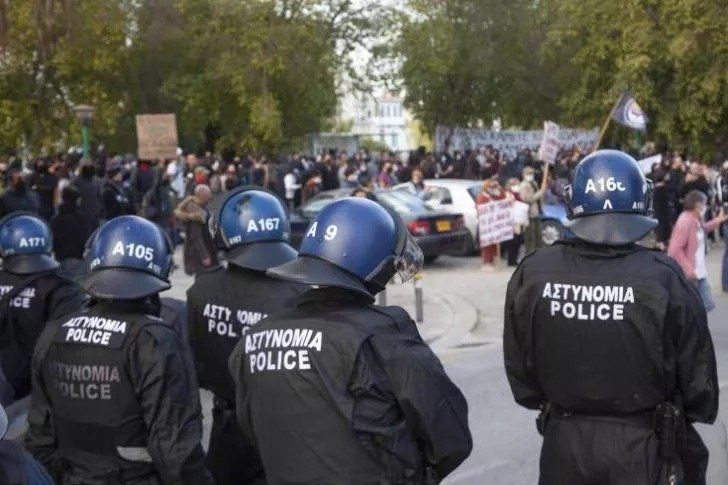
In both cases of migrants’ deaths, protests were organised by civil society groups criticising police conduct and government policy. One such protest was held in Limassol in April 2024, and another in Nicosia in January 2025 and in both cases, the police moved on to arrest participants, despite the small-scale, nonviolent and peaceful nature of the protests. In the Limassol protest, which was held outside the Limassol CID and concerned the case of Rahman, police arrested ten people, who face charges that include conspiracy to commit misdemeanours, disturbing the peace, public insult, and assault on a police officer.
Contradicting the police account, both protestors and the lawyers of the arrested spoke of an “unprovoked attack”, while in a public statement, the arrested further accused the police of verbal and physical abuse during their detainment. The Nicosia protest was organised in relation to the case of Khan, with police arresting four individuals after the protest had peacefully concluded, on charges of insulting behaviour and breach of peace. Subsequent arrests continued even 20 days following the protest, with outcry this time reaching parliament.
Given that the police do not tend to show the same zealousness in arresting people during protests not critical of them that are causing significant public disruption, it is rather difficult not to perceive the police’s conduct during these demonstrations as a clear example of two-tier policing. At the same time, it is an indicator of a culture of intolerance brewing within the police, as the vocal expression of criticism against it as an institution is increasingly treated as a ‘crime’, despite such public criticism being safeguarded in human rights law.
Legislating control, not rights
It is within this context that the government is proposing bills of a deeply anti-democratic nature. The first such bill concerns public protesting and aims to give the police extensive powers over public protests. The bill imposes strict regulations on public gatherings, requiring organisers of events involving more than 20 people to notify the Chief of Police at least seven days in advance, including detailed information about the event’s purpose, logistics, participants, and its potential impact on traffic, businesses, and public services.
Organisers—broadly defined to include individuals, organisations, unions, and political parties—are effectively turned into enforcers of police directives, responsible for maintaining order, and would be held responsible if protests turn violent, essentially shifting the responsibility of policing from the police to protest organisers. Police are granted sweeping powers to control events, including the authority to issue binding directives and to order the removal of any item that obscures a person’s identity, under threat of imprisonment of up to two years, a €3,000 fine, or both. Even spontaneous gatherings are subject to control under the proposed bill, with protestors having to designate an organiser on the spot.
In parallel, the government has proposed a bill enabling the monitoring of journalists. Under the proposed bill, the Chief of Police, the Director of the Cypriot Intelligence Service (CIS), or any authorised investigator could, with approval from the Attorney General, request an ex parte court order to monitor journalists, search premises, and compel disclosure of sources. In exceptional cases, authorities may also deploy surveillance software on journalists’ devices.
This bill has been proposed less than a year after Cyprus has been criticised by the Organisation for Security and Co-operation in Europe (OSCE), as well as international media freedom organisations, for another proposed bill that was aiming to impose harsh penalties for spreading disinformation, and which was criticised for having the potential to be used as a tool for political control rather than enhancing information quality. As Media Freedom Rapid Response (MFRR) noted in its statement: “Evidence shows that laws against disinformation have repeatedly been exploited by repressive authorities to influence public opinion on what is considered to be true or false, offensive, dangerous or seditious”.
Democracy beyond the ballot
Politicians in Cyprus often make rhetorical statements surrounding democracy, more often than not during electoral campaigns. Despite free and fair elections being a fundamental element of democracies, democracy as a modern system of governance is neither exhausted by, nor equated merely with electoral representation in governing institutions. It is also founded, crucially, on the entrenchment and protection of fundamental rights which aim to guarantee the free and equal access of citizens to the political process.
Key to these rights are the freedom of the press, allowing media to report independently and hold authorities accountable, the right to assemble and protest, enabling citizens to express opinions and demand change peacefully, and the right to criticize the government and public institutions without fear of reprisal.
The continuous proposing of bills that, if passed, would directly restrict fundamental freedoms, is reflective of the current government’s undemocratic logic of governance, seeking to limit public criticism and grassroots political participation. It is thus unsurprising, but nonetheless worrying, that the current Justice Minister Marios Hartsiotis openly mocked activists that protested in February outside parliament against the proposed bill on demonstrations.
Admittedly missing the point of the protest itself, just a month later, Hartsiotis publicly remarked during a speech at the monument to fallen police officers and firefighters at Police Headquarters: “I would like to take this opportunity to ask certain people to take off their carnival masks so that we can see them better, leave the sidewalks outside the Parliament and come here to stand in front of this monument to understand who the Cypriot police officers and firefighters are. If they have the guts, that is…”. It appears that in the mind of the current Justice Minister, the police, as an institution, should be respected a priori by Cypriot citizens.
In the public announcement calling for the protest concerning the killing of Shoaib Khan, the organisers stated that “We have no trust in the state and the police who investigate themselves and try to cover up their actions”. This sentiment of distrust was already described a year prior by sociologist Nicos Trimikliniotis, who told in-cyprus that law-and-order proposals are “a public confidence disaster”. As Trimikliniotis made clear, “Measures must be propositional and be rooted properly in the societal context and the problems they need to address. I don’t see them having any success in Cyprus – if anything the confidence in the Police will be reduced even more in the long term”.
This erosion of public trust signals a deeper democratic backsliding, as there is a systematic inversion of democratic norms. Rather than safeguarding civic freedoms from state overreach, the state is now actively positioning itself against civic participation. The arresting of peaceful protestors, the attempt to legally curtail protesting, the proposed erosion of the freedom of the press, and the open contempt for those who raise concerns, paint a picture of authoritarian tendencies at the heart of the present government. It should be remembered that it is the responsibility of the government and the police to earn the trust and respect of citizens—not the other way around.

