


Lawmakers on Wednesday began debating a bill regulating protests and demonstrations, with some opposition MPs expressing reservations about potential limitations to citizens’ right to assembly.
The proposed legislation, discussed in the House Legal Affairs Committee, would replace colonial-era laws, MPs heard.
It was drafted following the anti-migrant attacks in Limassol in 2023. The bill would require protest organisers to notify police seven days in advance, replacing an earlier proposal that would have required obtaining permits.
Under the draft law, organisers would be held responsible if protests turn violent, with provisions detailing when demonstrations can be dispersed and when wearing face coverings constitutes a criminal offence.
Justice Ministry representative Phaedra Gregoriou told the committee the legislation had been misunderstood, stating every provision is based on human rights court decisions and would allow authorities to take measures to protect lives and property.
AKEL MP Aristos Damianou expressed reservations about provisions that might restrict citizens’ rights to peaceful protest. He also pointed to inconsistent law enforcement, noting there are “five locations across Cyprus where young people gather and use drugs, and the police are not enforcing the law.”
Fellow AKEL lawmakers Andreas Pasiourtides and George Koukoumas questioned the criteria for determining when a protest exceeds acceptable boundaries and should be dispersed, asking whether “if two torches are lit, will the police intervene and ask for its dissolution?”
The bill would give the Police Chief authority to impose restrictions regarding protest routes, timing, duration, and space utilisation, including limiting demonstrations to portions of roads or public spaces, prohibiting access to certain public areas, and ensuring access to public services, utilities, or hospitals.
Committee Chairman Nicos Tornaritis acknowledged challenges with the bill while emphasising, “Yes to modernising legislation, yes to protecting human rights.” He clarified lawmakers did not want to create “a police-dominated state.”
The legislation would make it a criminal offence for anyone participating in a gathering to commit or incite violent acts aimed at disrupting the peaceful nature of the assembly, with offenders facing up to three years imprisonment, fines up to 4,000 euros, or both.
Additionally, refusing without reasonable cause to remove face coverings during protests would become punishable by up to two years imprisonment, fines up to 3,000 euros, or both.
For spontaneous gatherings without prior written notice, the Police Chief would be required to appoint a responsible officer to coordinate with protest organisers to ensure the event proceeds smoothly.
The committee will continue with an article-by-article discussion of the bill in upcoming sessions.
Civil society reactions
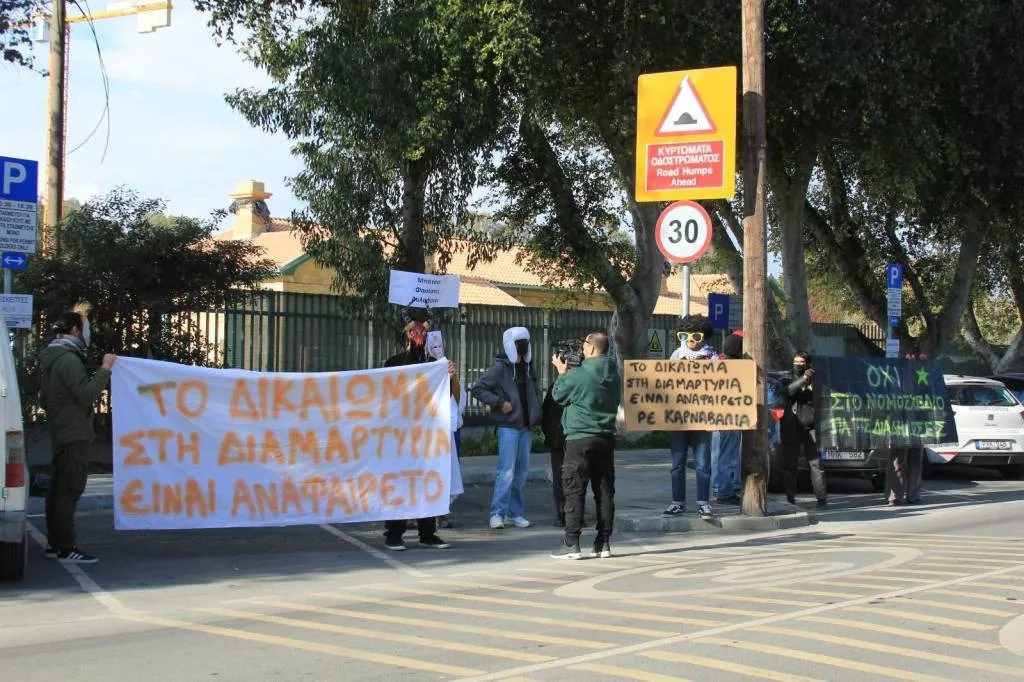
Yesterday, demonstrators gathered outside the House of Representatives to show their opposition to the bill, claiming that it represents a restriction to a fundamental human right.
In a statement, the afoa movement explained the motivation behind their participation carnival-themed demonstration:
“Today, February 26, during the first day of discussion on the controversial proposals to restrict the right to protest in the House Legal Committee, members of our community and other solidarity individuals are holding a symbolic protest outside the parliament building.”
“The right to protest cannot be diminished. Social and class struggles and their expression on the streets are neither legal nor illegal – they are just,” the statement continued.
The protesters said they wore masks to “characterise as a carnival the discussion around the government bill” and the proposal by the Democratic Rally (DISY) party criminalising wearing masks and hoods during protests. They called on parliament to reject both legislative measures.
“We will not remain inactive against the efforts of the Christodoulides government and the Democratic Rally to restrict the right to protest,” the statement concluded, with protesters indicating their readiness to “intervene more forcefully” if necessary.
Read more:

