


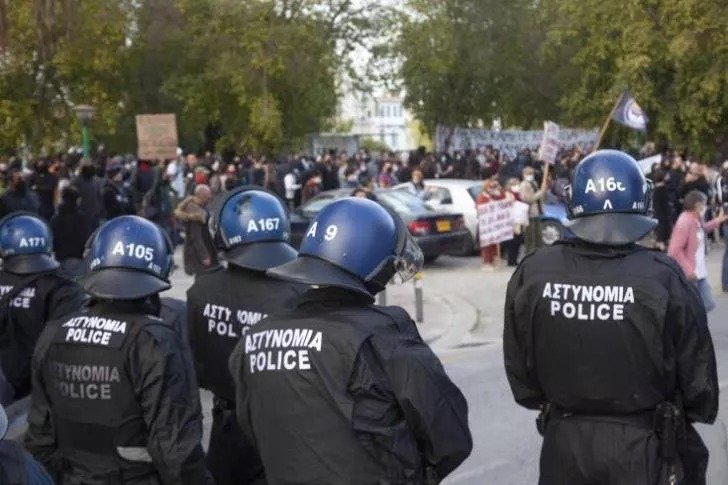
Reports of police brutality against protesters, arrests made up to 20 days after demonstrations, bans on displaying banners during national holiday parades, raids on hunger strikers, and video surveillance of entire protest events to identify participants – these are among the allegations levelled against the police by members of the Human Rights Committee.
The committee examined violations of the right to peaceful assembly following a motion brought forward by George Koukoumas and Alexandra Attalidou.
According to the Independent Authority for the Investigation of Allegations and Complaints Against the Police (IAIACP), there are currently two criminal and three disciplinary proceedings pending against police officers regarding their handling of protesters during an anti-corruption march in 2021, organised by the “Os Dame” movement during pandemic restrictions.
MPs delivered scathing criticism, highlighting numerous cases of protester arrests, ongoing court cases, and complaints about police violence.
They also accused the police of selective enforcement, arguing that interventions are based on protest content rather than security concerns.
Committee Vice-Chairman George Koukoumas cited several examples of interference with the right to peaceful assembly:
- The arrests made on 19 January 2025 during a protest outside the Police Station on Ledra Street, Nicosia, following the death of 24-year-old Pakistani man Shoaib Khan who died from police gunfire in the Potamia area. Koukoumas emphasised that arrests continued even 20 days after the event, with citizens facing unfounded charges and organisers being arrested for chants heard during the protest.
- On 1 October, journalist George Tattis and political activist Oz Karahan were arrested for attempting to display a banner that read, among other things, “Cyprus Republic: The Only Solution.”
- A trial against 11 participants in the “Os Dame” pandemic-era protests has been dragging on for over three years following incidents during the demonstrations.
- MP Costis Efstathiou described how hunger strikers protesting outside the Presidential Palace in support of Kurdish activist Kenan Ayaz were forcibly removed by police at 3 AM, before the court ruled on Ayaz’s extradition to Germany.
Assistant Deputy Police Chief Yiannakis Georgiou rejected these allegations, arguing that citizens often lash out at officers and property.
“Not all of us in the police force are perfect,” he admitted, adding that everyone pays for the actions of a few. “There may have been some mishandled situations,” he conceded.
Addressing specific incidents, Georgiou noted:
- During the protest over the Pakistani man’s death, police faced protesters with megaphones shouting abusive slogans against officers. “They were shouting ‘cops, pigs, murderers,'” he said, explaining that immediate intervention was avoided to prevent escalation, but surveillance led to subsequent arrests.
- Regarding the banner incident at the 1 October parade, he maintained that police have the right to inspect banners for potentially obscene or pornographic content.
“Citizens have no right to film police officers on duty. It interferes with personal privacy,” he insisted, claiming this was supported by a legal opinion by the Attorney General.
The Data Protection Commissioner disagreed, stating that both filming and photography are justified when purposeful.
“Police may only record demonstrations when problems arise,” she explained, adding that the same applies to protesters. She also emphasised that officers cannot demand to check citizens’ mobile phones.
The Commissioner of Administration’s representative countered the Assistant Police Chief’s argument about offensive chants, emphasising that the right to assembly is inherently linked to freedom of expression.
The Independent Authority for the Investigation of Allegations and Complaints Against the Police (IAIACP) highlighted ongoing complaints about verbal and physical violence by officers, as well as degrading treatment of citizens.
They confirmed that regarding the “Os Dame” protest, two criminal and three disciplinary proceedings are underway, addressing allegations of excessive force, rights violations, and misconduct.
Peaceful assembly: A fundamental right
Dr Aristotelis Constantinides, Associate Professor of International and Human Rights Law at the University of Cyprus, emphasised that citizens’ right to protest is constitutionally protected.
“It’s a fundamental right,” he stressed, while noting it isn’t absolute and can be restricted for security reasons. However, he explained that such restrictions must not prevent the exercise of this right altogether.
“The definition of peaceful assembly is established by the UN Human Rights Convention. An assembly ceases to be peaceful when there is physical violence against others that could lead to injury and/or death, or when serious property damage occurs. Minor pushing or offensive chants do not constitute such violence,” he clarified.
Legal expert Achilleas Demetriades emphasised the importance of making police engagement protocols public.
“The fact that a case is under trial is not reason enough to keep police conduct codes and engagement rules inaccessible. These are the authorities’ terms of reference, and citizens should be aware of them, even before participating in protests”.
Committee demands clarification
The Human Rights Committee may revisit this issue, while the Legal Affairs Committee will discuss it next Wednesday in light of proposed legislative amendments.
The Committee has requested the Assistant Chief to submit the police’s general guidelines for managing demonstrations, specific protest-handling instructions, the Police Academy’s curriculum regarding protest management, as well as the Attorney General’s opinion prohibiting the filming of police officers.
Read more:

