


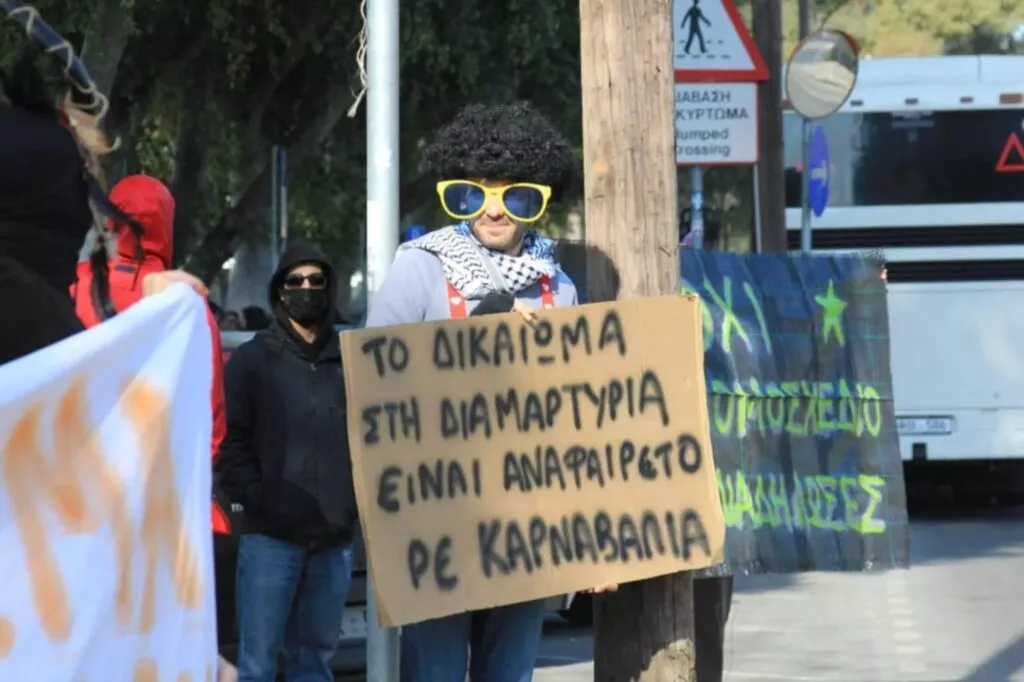
The government and lawmakers are seeking consensus on proposed legislation limiting the right to public assembly, whilst criminalising face coverings during demonstrations.
Members of parliament have expressed concern, particularly from AKEL party representatives, following a recent European Court of Human Rights (ECHR) ruling. AKEL MPs cited an ECHR decision which acquitted a German national previously convicted in his home country for wearing a face mask at a public gathering, determining the conviction violated constitutional freedom of expression rights.
During House Affairs Committee discussions, officials noted conflicting European court decisions, with some rulings supporting prosecution of individuals wearing face coverings at public events.
Police discretion in assembly dispersal
Debate focused on circumstances warranting dissolution of public gatherings or protest marches. Committee members questioned why 300-400 participants should face consequences when five individuals cause disturbances.
Justice Ministry representative Phaedra Grigoriou explained that police commanders retain authority to determine when assemblies require dispersal. The responsible officer initially coordinates with event organisers regarding conduct procedures.
If assemblies deviate from planned activities or violence appears imminent, organisers receive compliance requests. Following non-compliance, police issue dispersal warnings. Final intervention decisions require comprehensive assessment of all circumstances.
Enforcement questions raised
MPs questioned how proposed legislation would have altered police response during a highway blockade by hunters in Skarinou. Grigoriou declined to speculate, noting police previously stated non-intervention was necessary to maintain public safety.
The legislation criminalises three specific offences whilst clarifying that event organisers bear no criminal responsibility. Criminal liability applies to individuals engaging in or encouraging disruptive behaviour, participants refusing to remove face coverings when requested, and those failing to disperse following official dissolution orders.
Committee Chairman Nikos Tornaritis of conservative DISY said the legislation aims to protect citizens’ demonstration rights whilst ensuring appropriate penalties for disruptive behaviour. Article-by-article discussions have reached the midpoint, with completion expected soon.
Addressing concerns about assembly control measures, Tornaritis explained the legislation establishes more organised institutional arrangements. Organisers must notify police and local authorities of planned gatherings to prevent disruptions affecting both participants and non-participating citizens.
Ongoing debates on protest rights
The legislation, introduced by the government, intends to replace colonial-era laws with a modern framework governing public assemblies. Key provisions include a requirement for protest organisers to notify authorities at least seven days in advance, detailing the event’s purpose, route, and other logistical aspects. Organisers would bear responsibility for maintaining order during demonstrations and could face penalties if protests turn violent. Additionally, the bill proposes criminalising the refusal to remove face coverings during protests when there is reasonable suspicion of violence, with penalties of up to two years’ imprisonment or fines up to €3,000.
The proposed legislation sparked debate among civil liberties advocates, legal experts, and law enforcement officials. Supporters argue the changes are necessary for public safety and order, while critics say they represent a crackdown on fundamental democratic rights.
The Cyprus Bar Association warned of a legal loophole, stating that the current wording allows discretionary power without the possibility of administrative appeal, leaving decisions effectively unchecked.
Read more:


