


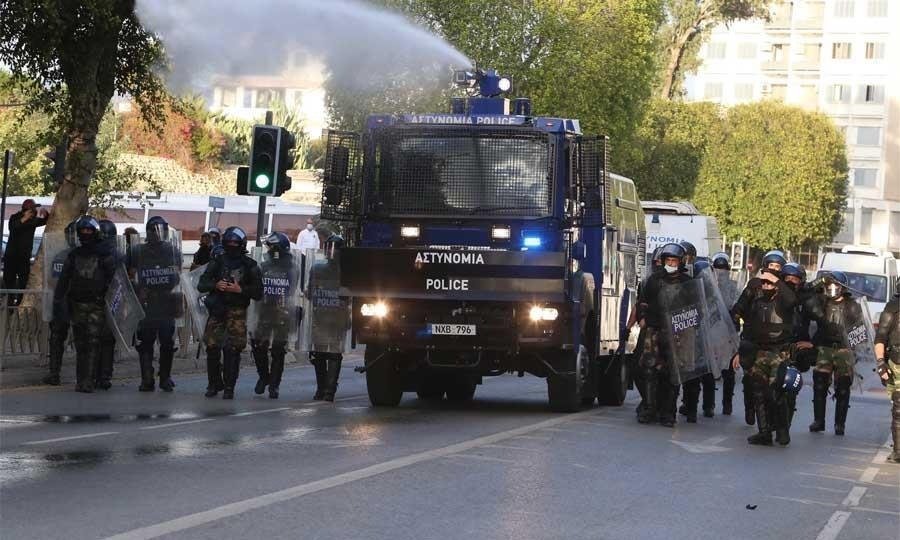
Grassroots civil society groups have criticised the government for promoting a bill which would grant the police powers to restrict protests.
If ratified into law, the bill would provide the government and the police with the power to significantly restrict public gatherings and protests, including the possibility of banning them altogether.
In a public statement, grassroots groups Aeriko, Afoa, Syspirosi Atakton and Spirithkia raised concerns over the bill, noting that it “attempts to control the character, location, expression, and overall public image of political gatherings and demonstrations”.
The groups further emphasise that the bill would restrict freedom of expression, leaving the imposition of hefty fines for perceived irregularities during gatherings or protests to the judgment of the police.
They further argue that the bill is potentially unconstitutional and undemocratic, aiming to suppress public criticism. “Political action is being assigned to the criminal sphere and into the hands of the forces of repression,” they conclude.
Anti-racist community organisation Far-Right Watch Cy has further criticised the bill, stating that the bill is an “unprecedented slide towards authoritarianism”, noting that it appears to violate the Venice Principles and the International Covenant on Civil and Political Rights, as well as the relevant recommendations of the UN Human Rights Committee and the Law Commissioner of the Republic of Cyprus.
The group highlights that the bill would allow the “criminalisation of gatherings for vague reasons of public interest”, make protests illegal unless organisers provide a seven-day notice to the authorities, and enable the police to dispel any gathering not meeting these criteria.
It further warns that the police will be granted the power to “ban all demonstrations for a month” as well as “impose exhaustive fines of 10,000 euros on all individuals present at gatherings deemed ‘illegal’”.
United for Palestine (UFP) also raised its opposition in May, criticising the bill for “restricting the inalienable and constitutional human right to assemble and demonstrate”.
The Ministry of Justice officially announced the launch of a public consultation on the bill, titled “The Public Gatherings and Parades Law of 2024”, on April 26. The public consultation period lasted until June 5.
Peaceful protest is enshrined in the rights of freedom of expression and freedom of assembly, which are protected respectively under articles 10 and 11 of the European Convention on Human Rights.

