


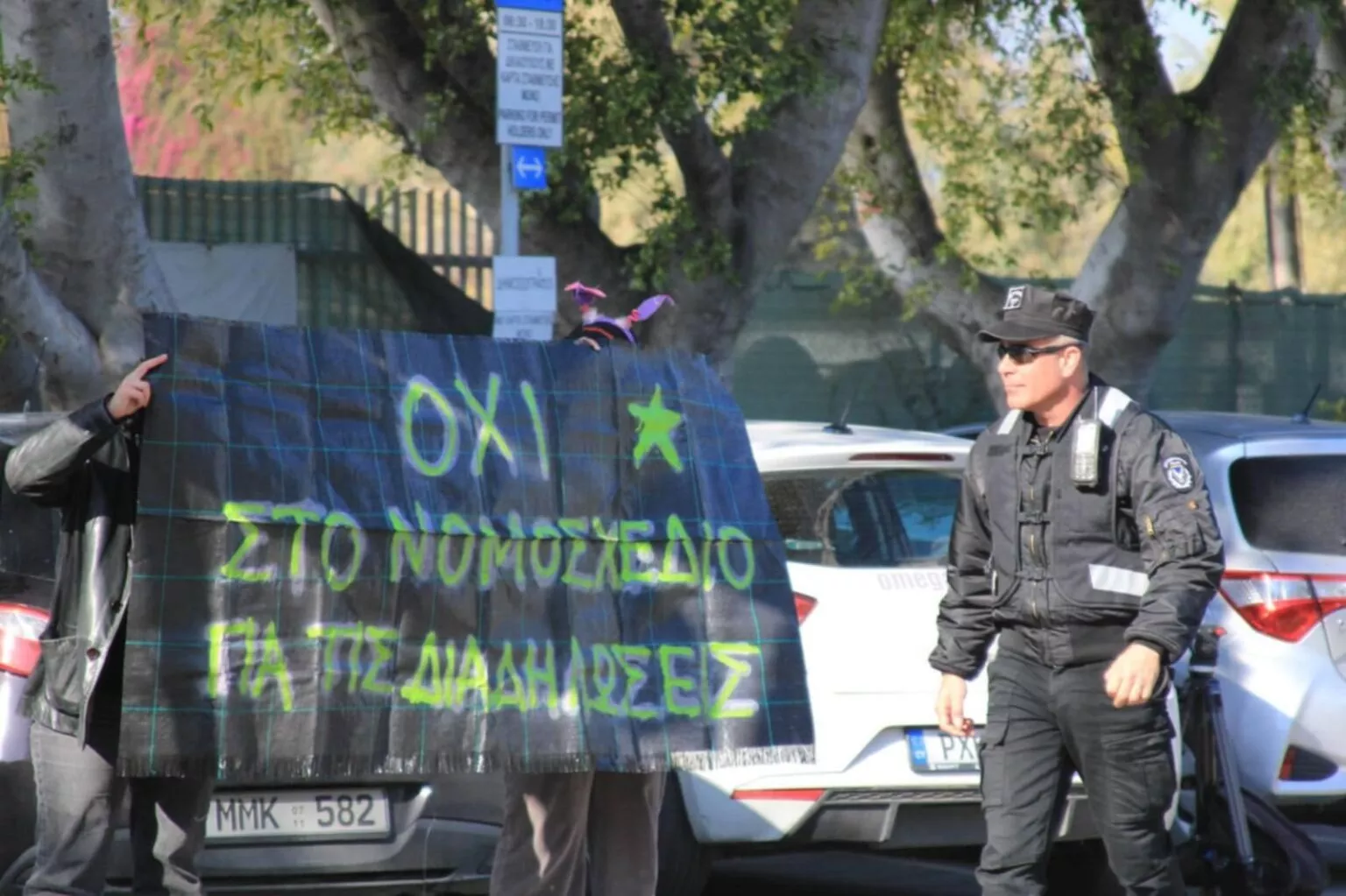
A government bill submitted for parliamentary review seems to be introducing an old style ‘police state’ in the name of modernising the legislation on peaceful gatherings, as sources with knowledge of the bill told Phileleftheros reporter Vasos Vasileiou.
This sort of enhanced police control approach on public meetings is being implemented in a bill which makes sure to point out that the freedom of ‘gathering in peace’, is safeguarded by Article 21 of the Constitution, Article 11 of the European Convention on Protection Human Rights and Fundamental Freedoms, Article 12 of the EU’s Charter of Fundamental Rights and other relevant international treaties.
So based on this proposed legislation, the organiser of a gathering or march must inform the Chief of Police in writing, either electronically or in a letter, at least a week prior to the date on which the event is scheduled to take place.
Essentially, the bill aims at turning the organiser of any gathering, parade, meeting or otherwise into a police employee at the very least, as they are obliged, as noted, ‘to conform with their directives, enforcing any action that the police proposes to maintain order’.
The organiser, as proposed, is obliged to take all action to secure the smooth and peaceful course of the event, using every measure considered necessary and cooperate fully with the local authority administratively responsible for the gathering. ‘The organiser must follow all directives from the officer in charge of the event and his team, who will maintain order throughout’, the bill says.
Participants in the gathering will also have to follow police directives according to the bill, which indicates that during the ‘gathering or parade, police, through the officer in charge, has the power to issue oral or written directives to the participants or the wider public around them, in order to facilitate traffic and other factors that secure the smooth running of the event’.
Under any suspicion that a gathering might turn violent, police ‘have the right to order any individual in the area of the event, to remove any object, product or clothing in which their identity is hidden or covered or their facial characteristics are distorted in a way that they cannot be recognised’.
In other words, officers can essentially order anyone to remove any piece of clothing from their person (not just a hood for example), with the justification that such an item of clothing or anything else on them is disguising their identity.
Individuals who refuse to conform to this directive, will be subject to imprisonment of up to two years, a fine of up to 3 thousand euro or both sentences concurrently.
Police must be informed if any gathering involves more than 20 people, with organisers obliged to offer a comprehensive explanation of the event’s practicalities and all the arrangements they will be making on how their gathering will take place, under what circumstances, participants and how it will progress.
Organisers must disclose the name and contact details of the organiser or a representative, the purpose of the gathering, start and finish times, as well as the area and course of the event, including the manner in which it might affect traffic and the operation of businesses, public services and public utility services.
The organiser must also be clear about the manner in which the gathering might affect the rights of third parties and whether there will be use of vehicles, banners or other objects.
According to the bill, ‘organiser’ includes an organisation, a political party, a union, a club, or a natural or legal person organising a protest, gathering or parade.
The word parade signifies ’20 or more people in a public area, either on foot or in vehicles, moving towards a certain direction and protesting, expressing similar views and publicising demands of any nature’. A ‘steady’ gathering is one taking place in the same area.
The organiser also needs to notify local authorities in writing.
If a gathering is impromptu, the Chief of Police appoints an officer in charge, who calls on participants to designate an organiser, who will be responsible for the smooth and peaceful running of the event.
Public area means street, square, junction, bridge or any other outdoor public space that can be used without permission, terms or payment.

