


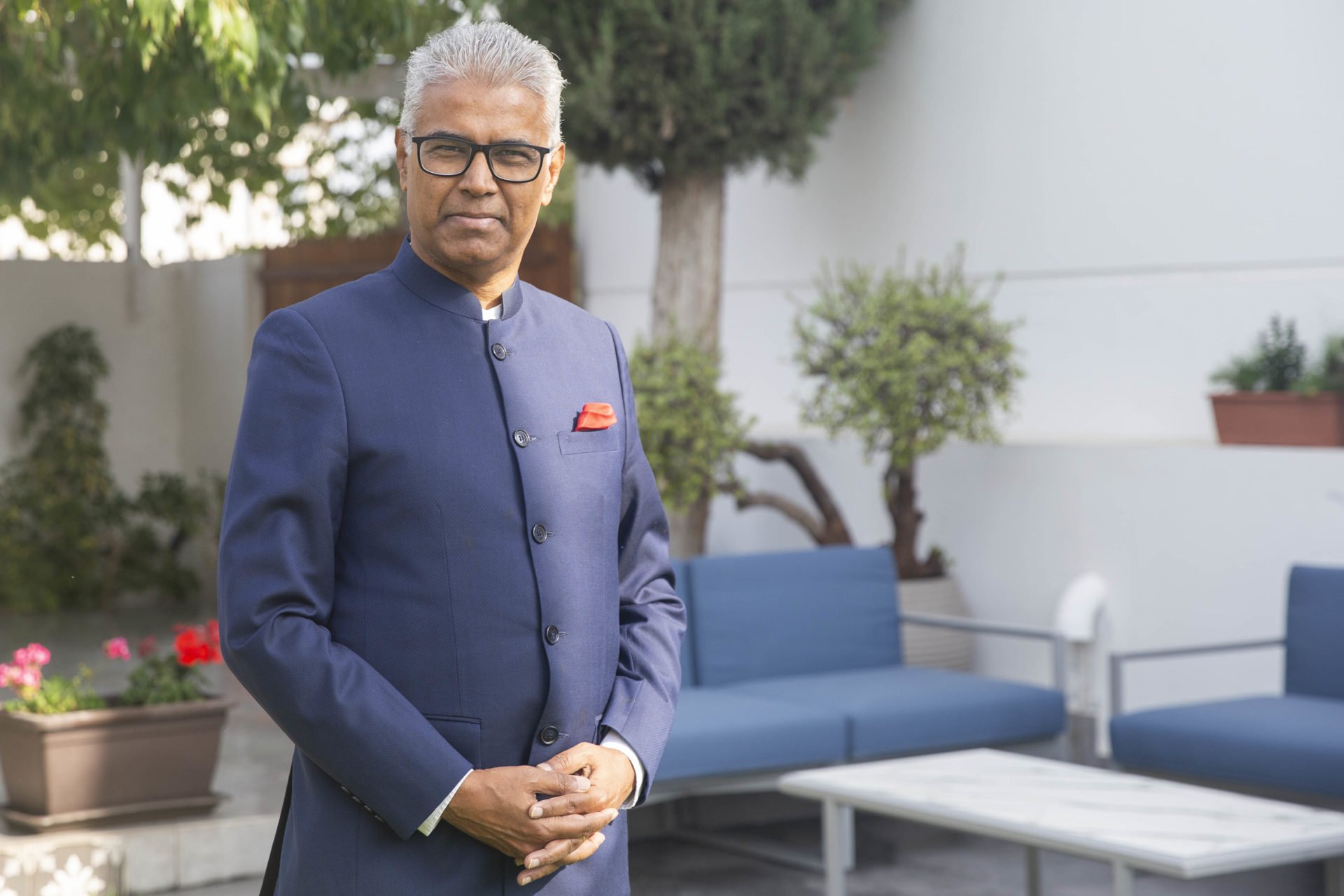
Interview with Stelios Marathovouniotis and Andreas Bimbishis
India sees Cyprus playing a pivotal role in advancing the India-Middle East-Europe Economic Corridor (IMEC) and deepening defence cooperation, as the island prepares to assume the EU presidency in January, the Indian High Commissioner to Cyprus has said.
Speaking to Phileleftheros, High Commissioner Manish revealed that Cyprus could champion the stalled Northern Corridor of the IMEC project during its EU presidency, as bilateral ties between the two countries have been elevated to a strategic partnership following Prime Minister Narendra Modi’s visit earlier this year.
The relationship upgrade comes alongside a five-year joint action plan covering defence production, investment flows worth $15.5 billion over the past 25 years, and growing cooperation in digital technology and renewable energy.
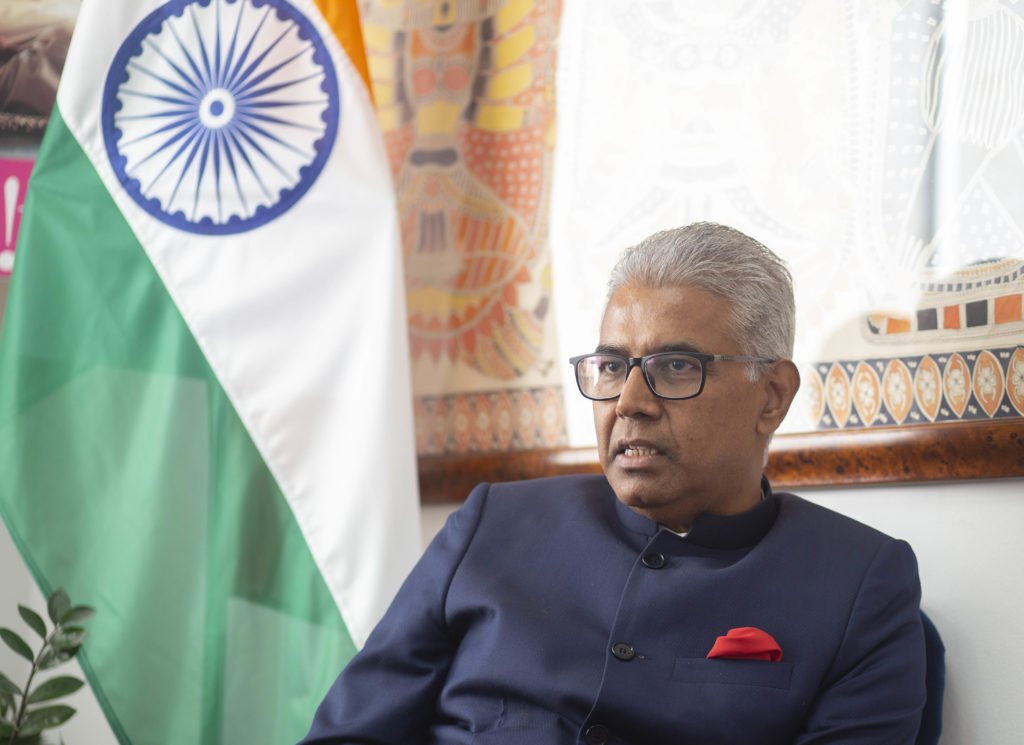
India’s ties with Cyprus go back decades, starting from the anti-colonial struggles and their participation in the Non-Aligned Movement. Cyprus even had a First Lady of Indian descent, while three Indian Generals have served as UNFICYP commanders. What is the state of the India-Cyprus relations in 2025?
This year has been transformative for India-Cyprus relations. With the visit of Prime Minister Narendra Modi, our relationship has elevated to a comprehensive strategic partnership. We have finalised a joint action plan for 2025-2029, which maps synergies across research and development, tourism, mobility, defence, security, regional cooperation, infrastructure development, shipping, trade, investment and technology.
I must convey my thanks to the President of the Republic of Cyprus for personally taking keen interest in the Prime Minister’s visit. Defence and security has emerged as one of the most important aspects of our relationship. Immediately after the visit, we had an Indian frigate coming to Limassol, and a defence production delegation came from India to explore synergies for defence cooperation.
On 29th and 30th October, Foreign Minister Dr Constantinos Kombos visited India, which reinforced what we discussed during the Prime Minister’s visit. As Cyprus prepares for EU presidency, it was also an opportunity to review what India and the European Union can do together during Cyprus’s presidency.
Historically, we have been friends, but in the contemporary context, we need to do much more, keeping in mind Cyprus’s vision of 2030 and India’s vision of 2047. We’re focusing on defence, security, digital technology, FinTech and renewable energy as key areas of convergence.
What does each country gain from this partnership? Why does India, one of the world’s largest economies, need Cyprus?
Whether a country is big or small doesn’t matter. We work in the philosophy that we should grow together hand in hand. As diplomats, our duty is to find common points and synergies.
Cyprus has a very important geographical position, straddling the Mediterranean with access to the European Union, Middle East and North Africa. Your investment regime, tax incentives and jurisdiction make it very attractive for businesses seeking both inbound and outbound opportunities.
Cyprus brings tremendous value to India. In the past 25 years, we have received $15.5 billion in foreign direct investment from Cyprus, making it consistently one of our top 10 FDI sources. The Government of India has categorised Cyprus as a Category One country for foreign portfolio investment. With many fund managers and FinTech companies here, investors from Cyprus can take advantage of India’s policy framework. We’re working to promote alternative investment funds for investing in India.
The investment flows span real estate, pharma, logistics and technology sectors. Many companies headquarter in Cyprus, and investment from Europe and other regions passes through this jurisdiction. We have a government-to-government Double Taxation Avoidance Treaty, renegotiated in 2016, which gives confidence to investors from both countries.
Conversely, India is a huge market for Cypriot companies seeking trade or service linkages. We’re growing at 6.5 to 7% per year—the fastest growing economy. It’s natural that Cyprus should look eastward. Since I’ve been here 18 months, I’m happy that more Cypriot businesses, chambers and institutions have considered this. The period has been very interesting for trade, business and investment linkages.
Your robust taxation investment base creates a win-win situation. Indians relocating here can access the European market by becoming European companies. Your country is mainly service-oriented, and many Cypriots access India for software development, shipping and other service sectors. Some have invested in manufacturing. Funds located here use Cyprus to invest in India. That’s how value is generated.
We’re also good friends in international organisations like the UN, Commonwealth and European Union. We support each other on territorial integrity and sovereignty. India is a strong supporter of the Cyprus issue and backs the Republic of Cyprus’s position.
Cyprus can advance the IMEC project during its EU presidency
What role could Cyprus play in the India-Middle East-Europe Economic Corridor (IMEC)?
The IMEC project was launched during India’s G20 presidency in 2023. It’s a landmark initiative to bring India, Middle East and Europe closer through multi-modal, multi-nodal linkages—sea, land and rail—from western India through UAE and Saudi Arabia, down to Israel, and linking up the Northern Corridor to Italy, Germany and France.
Eight countries were original signatories: India, USA, European Union, France, Italy, UAE, Saudi Arabia and Israel. There are two nodes—the southern corridor from India to Middle East has seen significant development between India, UAE and Saudi Arabia. However, because of ongoing conflict, the Northern Corridor has not started.
Here comes the opportunity for Cyprus. You’ll become EU President in January and may, under your presidency, take up the IMEC agenda and advance the Northern Corridor, in which Israel, Italy, France, Germany and Cyprus are key partners. Cyprus is very interested to be part of this initiative as one of the important nodes.
Cyprus’s strategic location can add value through logistics hubs, seaports, digital connectivity or energy hubs. Cyprus can champion this Northern Corridor through its European Union presidency.
Most trading used to happen through traditional routes—Red Sea, Suez Canal—but conflict and non-state actors have made it expensive and difficult. The idea is to de-risk existing routes by adding alternatives, not to make them redundant. With support from EU, USA and Middle Eastern countries, this can become reality in the near future. India has already started working on seamless trading platforms between India, UAE and Saudi Arabia.
Does the Cyprus problem complicate regional initiatives like IMEC? And how does India view tensions with Turkey?
India’s relationship with the Mediterranean region has been centuries old. Maritime trade in spices, silk and textiles was always there. The opening of Suez Canal facilitated this. The Atlantic region and Indo-Pacific region will be linked through the eastern Mediterranean.
Last year, we hosted a major congress in India with Mediterranean countries focused on business and security. With challenges over the last three to four years—the Covid pandemic, conflicts in the Middle East and Europe, disruption of global supply chains and trade wars—security and stability an important elements of India-Mediterranean cooperation. We need exercises, consultations and exchanges to secure our trading routes, supply chains and energy fields.
Energy cooperation is crucial. As people move toward green energy, green hydrogen and natural gas, this area’s abundant gas reserves can be important for India, as we’re energy-dependent. Green hydrogen and green ammonia potential will help all of us in this corridor.
All of us are seafaring nations with significant coastlines. Maritime blue economies are important. For Cyprus as an island, maritime resources for drinking water, coastal protection and sustainable fisheries are vital aspects.
If the corridor is built, there will be huge requirements for urban infrastructure, boosting construction companies and economies worldwide.
The technological dimension is equally important. Digital connectivity, AI and cable interconnectivity for trade and data flow are critical. In 18 months here, I’ve seen Cyprus taking positive steps in investment and external trade policy—you’re the fastest growing economy in the European Union. But you must be mindful of geopolitical challenges and prepare so you don’t lose advantages as a shipping nation or service provider. If played carefully, there’s potential to become an energy hub or digital services hub.
Regarding the Cyprus issue, India always supports Cyprus’s cause. Our position is identical to the Government of the Republic of Cyprus. It’s up to the world, including the United Nations, to resolve this.
This connects to multilateralism. Multilateralism has struggled recently. Global issues—climate change, Sustainable Development Goals, regional conflicts—aren’t being resolved through the UN framework. Because of the organisation’s historical nature, there’s heavy resistance to reforming the UN Security Council.
Multilateralism reform is vital to address conflicts like the Cyprus issue, which has persisted for 51 years, or Israel-Palestine, or Russia-Ukraine. These exist because of drawbacks in the multilateral system and the exclusion of prominent emerging nations who could bring value to solving such problems globally.
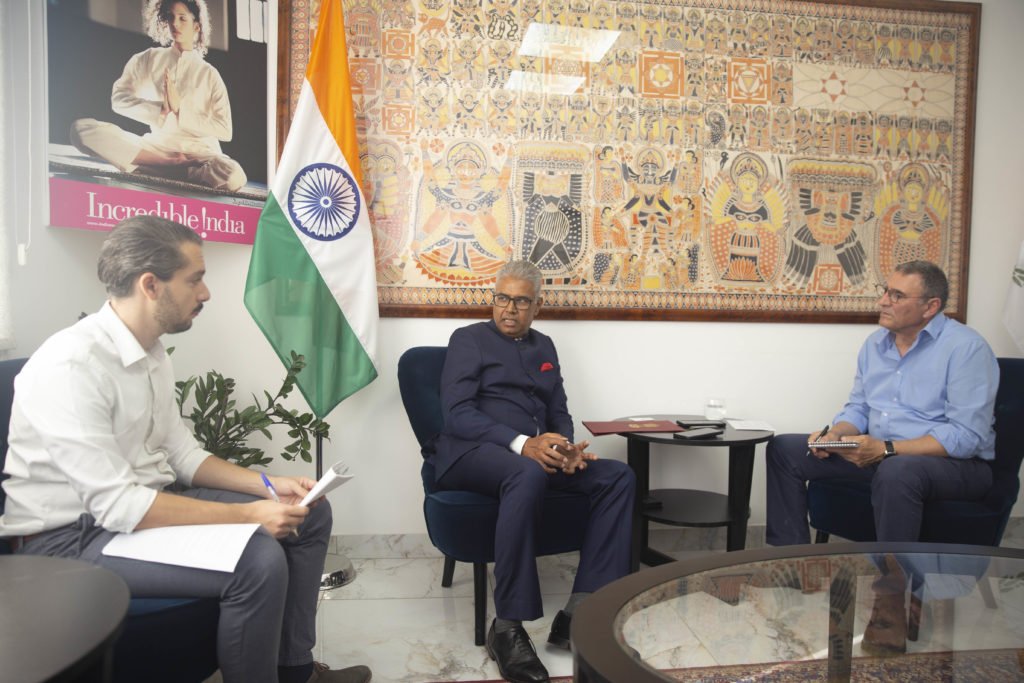
How do you view the stance of Cyprus on the India-Pakistan conflict?
Cyprus and India support each other’s positions on territorial integrity and sovereignty. Cyprus has vocally supported India. When there was a terrorist attack on Palgam in April this year, Cyprus was one of the early countries to strongly condemn it. The Foreign Ministers spoke several times, and the President wrote to my Prime Minister condemning the terrorism.
In the Joint Declaration issued during the Prime Minister’s visit, Cyprus strongly condemned the cross-border terrorism which India has faced for decades. We’re one of the countries most impacted by international terrorism and cross-border terrorism. Cyprus has supported ending cross-border terrorism, bringing culprits to justice and dismantling terrorist financing structures.
Similarly, we’ve always supported Cyprus in all forums—UN, Commonwealth or bilaterally—regarding the need for resolution of the Cyprus issue through the bi-communal, bi-zonal framework. We support each other on very key issues of core interest.
India has long sought a permanent seat on the UN Security Council. Is the current system outdated? Should India be at the table?
India has been striving for UN Security Council reform. These institutions—the United Nations, World Bank, International Monetary Fund, WTO—were created in 1945 when the world situation was different. In the 21st century, the reality has changed.
India is the fastest growing economy, largest market, and home to the world’s largest population. We’re a responsible nation supporting various UN policies and programmes. We contribute to peacekeeping and South-South development programmes. We aspire to be part of the expanded UN Security Council with permanent membership, but there are roadblocks.
There’s an inherent difficulty in the UN Charter itself. It gives veto rights to the permanent five members, and to amend the Charter, you need concurrent positive votes from them. That’s not happening because they don’t want to amend it. Discussion is happening, but it hasn’t progressed.
We work very closely with Cyprus on this issue. Cyprus is very supportive of UN reforms and India’s position. Cyprus supports India’s entry as a permanent member of the Security Council.
It’s a requirement of the present day because many countries who can contribute to global peace and development are excluded from important decision-making. There’s no equitable representation from Asia, Africa, Latin America or the Middle East. It doesn’t reflect contemporary reality.
The UN has contributed significantly—decolonisation, ending apartheid, developmental and disarmament issues. But going forward, there are many lacunas needing fixes. As a major international player, we keep pushing through various forums—UN, Commonwealth and plurilateral forums like BRICS. BRICS is gaining more salience because of these inherent multilateral challenges and issues we’re facing—Covid pandemic, disruption of global trade practices. That’s why countries are seeking alternative ways to push their voices and work together.
There are opportunities for Cypriot companies to partner with Indian private or public sector companies to bid for common EU defence projects
You’ve mentioned expanding defence cooperation. What does this look like in practice? Could Cyprus purchase Indian weapons systems?
Our defence cooperation started with a bilateral agreement signed in December 2022 when our External Affairs Minister visited Cyprus—a military and security cooperation agreement implemented through an annual calendar programme.
The Joint Declaration and joint action plan include substantial elements for upscaling defence cooperation through various forms. Initially: services staff talks, exercises, ship visits and training programmes—ways for our armed forces to know each other. Visits, talks and exchanges will happen.
The defence industry has both strategic and economic impact. Cyprus wants to attract more companies to expand within the European Union. The EU has a huge defence expenditure programme, bringing opportunities for Cypriot companies to partner with Indian private or public sector companies to bid for common projects. Certain processes are needed regarding legal framework for joint bidding of defence projects within the EU framework.
I hope India will soon sign an India-EU defence and security agreement, making Indian companies eligible to bid for certain EU programmes. In this context, we had an initial meeting between Indian defence sector companies and Cyprus Defence Industry Association in September when a delegation came from India.
India now has a very robust defence industry. We’re not only importers but exporters too. India will be open to any request from Cyprus based on your internal policy framework. Defence industry export is a new area where India is emerging as a global player for exporting equipment, hardware, ammunition, missiles and software. We’re exploring that possibility.
Indians are coming because Cypriots need them
How large is the Indian diaspora in Cyprus? And when can we expect direct flights between the two countries?
Cyprus has become an attractive destination for non-EU workers because of available skilled manpower from South Asia, including India. The European Union is ageing, and there aren’t enough workers for certain industries.
Latest data from the Deputy Ministry of Migration shows about 14,500 people from India or of Indian origin living here. They’re in various sectors—importantly shipping, technology, international students and researchers, but also service sectors, agriculture, caregivers and domestic work.
Indians are coming because Cypriots need them. In 18 months here, I see every business and factory owner needs workers who aren’t locally available. We’re discussing a framework—an intergovernmental agreement for a mobility agreement—because legal and predictable migration is always good. A framework agreement would guide both the sending and receiving states regarding temporary workers, business visitors and international students.
This was discussed during both the Prime Minister’s and Foreign Minister’s visits and is part of the action plan.
Related to this, since more Indian workers will contribute to social insurance programmes, there needs to be an agreement on portability of contributions. If someone works seven or eight years here and contributes to social pension schemes, it should be easy for non-EU workers to take back some contributions when they return. We’re discussing both these related issues.
Regarding direct flights, starting one is always a commercial decision by airlines. Some movement is happening. Since the past few months, we have an interline agreement between Cyprus Airways and Air India. Services originating from Larnaca and flying through hubs—Dubai, Paris, Milano or Tel Aviv—can issue a single ticket with baggage booked through.
We hear IndiGo may announce a direct flight to Athens next year. Business activities are increasing with Cyprus. Indians are coming more frequently. Tourism is increasing. I believe these initial steps will ultimately lead to direct flights.
Your government’s Ministry of Tourism and we are discussing with Indian airlines like IndiGo and Cyprus Airways how to start this. But we can only nudge or advocate. Finally, companies must see the value. If money is to be made, they’ll start the flight.
Connectivity isn’t difficult currently—you can fly via Dubai, Cairo, Doha, Bahrain or Tbilisi, Georgia. There are connections, though not direct. It takes 10 to 12 hours with layovers depending on stops.
I’m very hopeful. Tourism is increasing. Many Cypriots go on curated tourism to India, and several Cypriot tourism companies take tourists there. Indians haven’t been coming in large numbers, but with the opening of Thomas Cook India office here—TCI Euro—they’ve headquartered themselves for global European operations. They plan focused inbound tourism to Cyprus from India, bringing MICE tourism and group tourism.
We also hear some Indian film companies are interested in shooting here. That will boost Cyprus, because Cyprus’s visibility has increased in India tremendously following visits between businesses and political leaders, with the Prime Minister and your Foreign Minister. Everyone is now aware of where Cyprus is and its advantages.
Going forward, there’s hope for all of us that this will make life easier.
Read more:

