


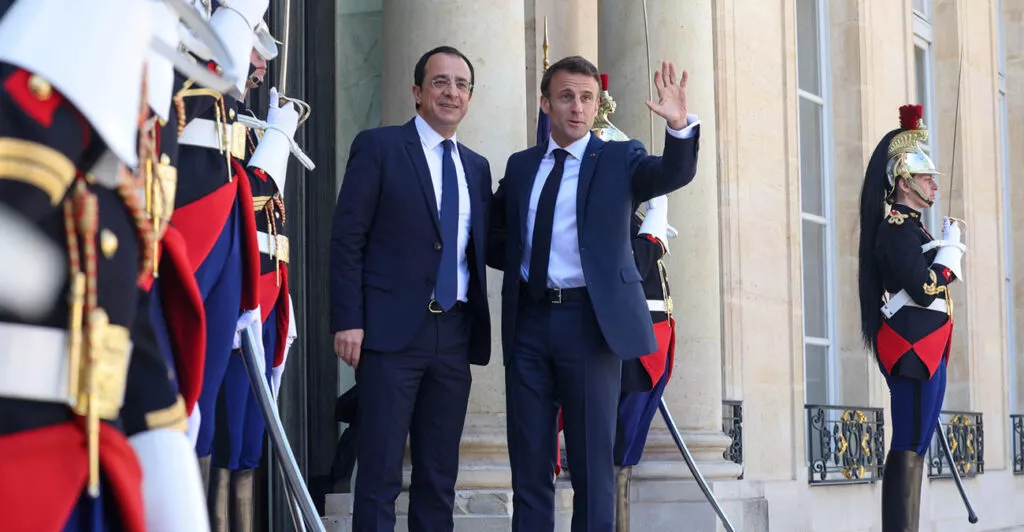
The new dynamic in relations between France and the Republic of Cyprus is creating new realities, both bilaterally and regionally. It’s clear that the framework discussed recently highlights new axes of political action and reinforces existing ones, included in the 2016 strategic agenda, which will be updated and upgraded.
The two governments have already made progress, exchanging texts, and are now moving towards refining a joint document that will lead to the final version. “The goal is for the strategic alliance to translate into tangible cooperation,” said a competent source, noting that practical steps will be taken and the text will not be merely declaratory.
As the President of the Republic stated a few days ago, once an agreement is reached, French President Emmanuel Macron will come to Cyprus specifically for the signing. This could happen as early as August, but no later than autumn.
The two governments, therefore, want this to happen soon and it is a priority for both Presidents to complete consultations and institutionalize the cooperation. Macron and Christodoulides have entrusted this matter to their respective Foreign Ministers and Deputy Ministers for European Affairs.
The next significant step in this effort is the arrival in Nicosia, at the invitation of his Cypriot counterpart, Constantinos Kombos, of the French Foreign Minister, Jean-Noël Barrot. Mr. Barrot will come to Cyprus to speak at the annual gathering of the Republic of Cyprus’s ambassadors, scheduled for July 28-29-30. The French official will visit the island on July 30-31. The French Foreign Minister will be the official speaker for the Cypriot ambassadors, but his presence will also be combined with bilateral talks and an in-depth discussion of the details of the strategic cooperation text. Specifically, the two Foreign Ministers agreed to leverage Mr. Barrot’s presence here to thoroughly discuss the text, which will presumably be in its final stages by then.
Video Conference and Document Finalization
In anticipation of this, Deputy Minister for European Affairs, Marilena Raouna, held a video conference last Monday, July 14, with her French counterpart, Benjamin Haddad, during which all issues were discussed, and some points were raised for inclusion in the final text. These are largely issues that strengthen the strategic cooperation between France and Cyprus. The French side undertook to codify the main axes that emerged from the discussion during last Monday’s video conference. This is expected to happen in the coming days, and the text will be sent to Nicosia for comments with the aim, if possible, for the final version to be before Constantinos Kombos and Jean-Noël Barrot by the end of the current month. Given that Christodoulides and Macron are keen for a swift outcome, their associates are working quickly to ensure the strategic cooperation is signed soon.
What the Agreement Will Include
The final text will cover many areas of cooperation. Among these fields, the following are mentioned:
Firstly, defense matters, where cooperation already exists (and henceforth with the involvement of Cypriot companies). It is noted, however, that there is mutual willingness for deepening. Paris is showing interest in military and other infrastructure in Cyprus. The strategic agreement will also include a reference to “Critical Infrastructure” (ports, airports). It is recalled that France showed interest in facilitating vessels and constructing infrastructure next to the naval base in Mari. In this regard, teams of French experts visited Mari in April 2019 for an on-site study of the area, for purposes related to the design and construction of a naval station.
Secondly, security matters, concerning both the bilateral and European levels.
Thirdly, the definition of specific plans for the region, within the framework of regional actions. This includes the large India – Middle East – Europe Corridor (IMEC), in which Cyprus is involved in the planning, and France can participate by offering expertise and collaborations on various issues.
Fourthly, innovation issues (joint plans in defense, education, digitalization, etc.).
Fifthly, education matters.
Sixthly, trade issues.
Seventhly, maritime security issues.
Eighthly, the critical issue of migration.
Ninthly, issues of combating terrorism.
Furthermore, the establishment of a mechanism for monitoring and implementing actions is being discussed, with annual meetings at the foreign minister level and interim high-level official evaluations of progress between the two states.
Euro-Turkish Relations in the Picture
This strategic cooperation can be approached through the processes in the wider region and the continuous redistribution of power. It is clear that France’s strategic presence in the region is sought within alliances that can be formed on a specific basis.
Euro-Turkish relations also enter the cooperation equation. It is clear that both countries believe that progress on the Cyprus issue can be made through Euro-Turkish relations. It is recalled in this context that during the recent NATO summit, on the sidelines of the proceedings, the leaders of France and Turkey, Emmanuel Macron and Recep Tayyip Erdoğan, met. The latter sought French assistance to strengthen Euro-Turkish relations. Mr. Macron is reported to have told his Turkish counterpart that for progress to be made, Turkey must also take steps on the Cyprus issue. Turkish Foreign Minister Hakan Fidan heard the same from President Christodoulides in New York.
It is clear that Turkey ardently desires progress in its relations with the European Union. Occupying Turkey is primarily interested in its participation in European defense matters, an upgrade of the customs union (it is recalled that the Ankara Protocol includes Cyprus-related obligations, such as the opening of Turkish ports to Cypriot ships). Furthermore, Ankara is seeking visa liberalization. It is recalled that regarding the latter, the Commission’s report on Turkey (Ursula-Borrell) called on member states to explore ways to facilitate access for Turkish citizens to visa applications in the EU, utilizing existing facilities.
With the US and UK
It is clear that there will soon be news about the strategic alliance between the two EU partners, France and the Republic of Cyprus. It is noted in this context that Nicosia has initiated strategic dialogue with the United States and Britain.
It is obvious that such agreements are considered by the Republic of Cyprus to be a result of the role it can play – and is playing, as developments show – in the region. At the same time, however, it is estimated that these openings and collaborations also strengthen the state of Cyprus in various fields. That is why these collaborations are being pursued, with Nicosia’s goal being, as it is said in diplomacy, a win-win situation.

