


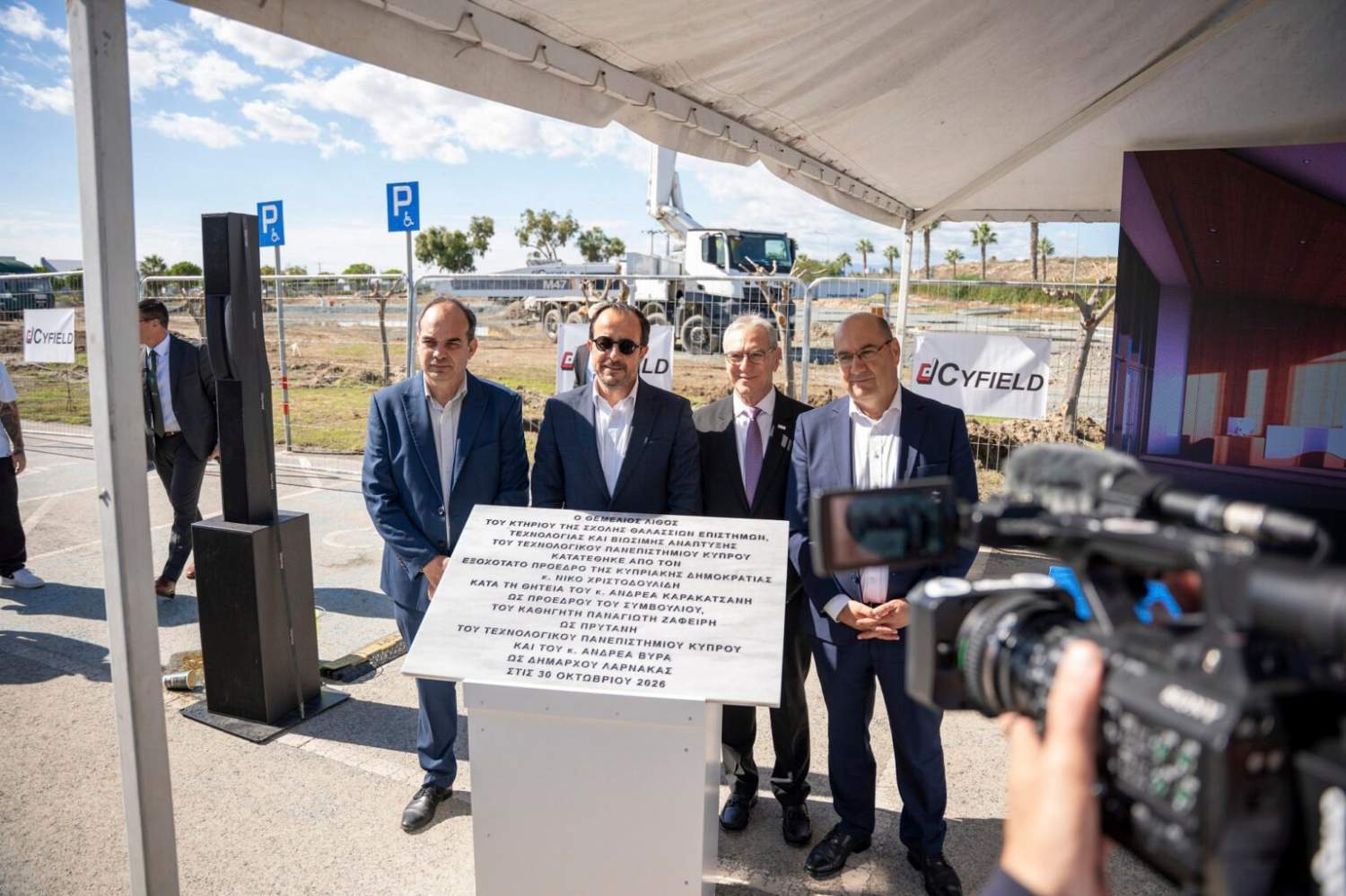
Construction has begun on the Cyprus University of Technology’s (CUT) 11-million-euro School of Marine Sciences, Technology and Sustainable Development at Mackenzie in Larnaca. The university aims to launch the school’s first undergraduate programme at another site in September 2027.
The President laid the school’s foundation stone at a ceremony on Friday. CUT rector Panayiotis Zaphiris and the school’s dean, renewable energy professor Alexandros Charalambides, told Phileleftheros about the school’s aims and the steps being taken to meet its deadlines.
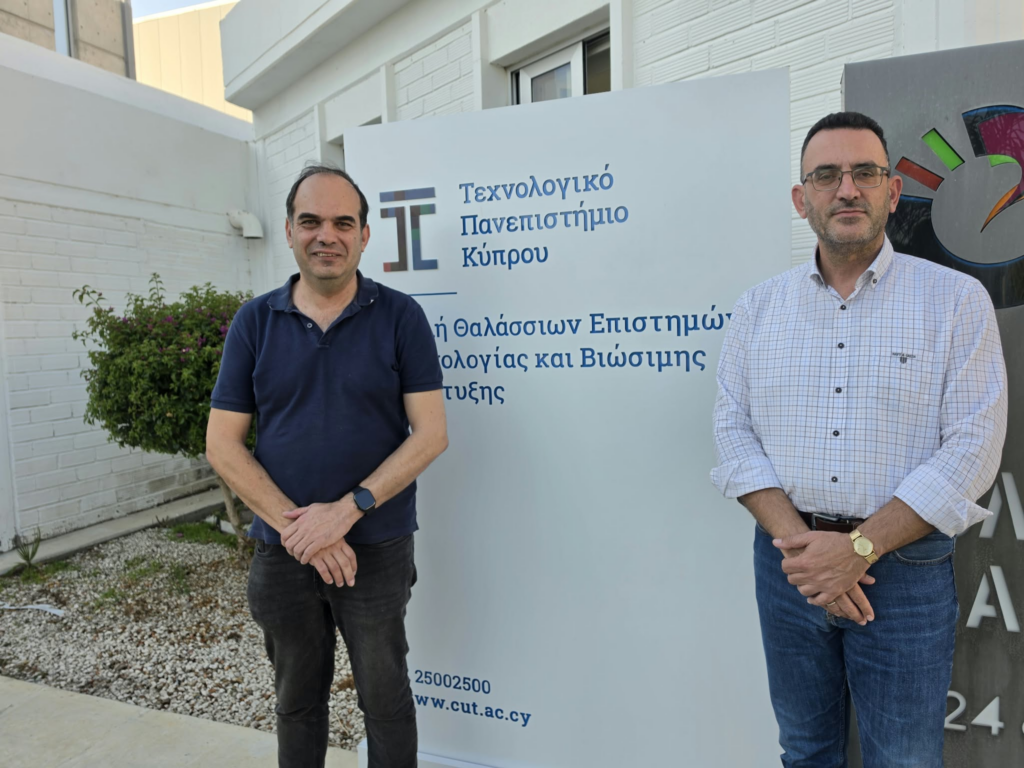
The two men are formally the first two professors of the Department of Sustainable Development. They are already working from offices provided by Larnaca municipality at the Multipurpose Centre for Social Welfare and Employment. Two more academics have recently been hired, and two more will join by December.
Zaphiris said the university had applied to the Cyprus Agency of Quality Assurance and Accreditation in Higher Education (CYQAA). He expects one programme to be accredited by the end of the year, so that the undergraduate programme in sustainable development can start in September 2027. The school will need five years to be fully developed, he said, but the university’s presence in Larnaca will be felt from next year.
Approved with a viability study
Zaphiris said setting up the school had not been easy. It succeeded, he said, because it had the backing of the President and the mayor of Larnaca. The government had asked for a viability study, and the university secured a letter of commitment to the political decision to create the school.
To his knowledge, it is the first public school in Cyprus to be approved on the basis of a viability study. An international academic committee was set up to create it, including professors from the universities of Oxford and Cambridge.
Limassol remains CUT’s base
Zaphiris said the Larnaca school would not affect the university’s plans in other cities, and that CUT’s seat and main core would always be in Limassol.
“The talk that schools are leaving and CUT will be weakened in Limassol is untrue,” he said. Since 2020, student numbers on the university’s Limassol programmes have risen from 2,000 to 2,500, and more will be added as programmes there grow. There are another 500 students in Paphos, and Larnaca will have 300, with scope to reach 500. CUT expanded to other cities because it could not do so in central Limassol, he said.
Two departments
The school will have two departments: Marine Sciences and Technology, covering marine biology, and Sustainable Development. The two academics said the University of Cyprus currently has the only public biology department. Zaphiris said the new school’s graduates would be able to do exactly what biology graduates do, with the chance to specialise in another field as well.
The Department of Sustainable Development, the first in Cyprus, is the bigger challenge because it will cover a wide range of subjects. “Many people think it is only about the environment and engineering,” Charalambides said. He said it would deal more with design methodologies, marketing, communication, policy, economics and sustainable urban design.
He added that the university will soon sign a memorandum of understanding with large companies and organisations in Cyprus, so that students can do their work placements there.
Asked where sustainable development graduates could work, Zaphiris said an EU directive will make it compulsory for large organisations and small and medium-sized ones to have a sustainability officer, and graduates would be in demand there. They could also work for companies that carry out sustainability studies, or for municipalities on urban development. He cited the arts centre being prepared by Larnaca 2030, which will have activities linked to sustainable development.
Benefits for Larnaca
Asked how Larnaca would benefit, both men stressed the long-term gains, which they said were more valuable. Charalambides said that when education is linked to the needs of the community and students work with local bodies, the benefits multiply. An ecosystem gradually develops that attracts people from abroad and gives rise to new products and kinds of business, but the results will take 20 years to show, he said.
Zaphiris said the aim was not only to rent out flats and keep restaurants busy. He said the school could tie in with Larnaca 2030 and with the city’s distinct character, noting, for example, that it does not want tall buildings. It could also work within the ecosystem of the Cyprus Marine and Maritime Institute (CMMI).
Being close to the airport is a big advantage for visitors from abroad, he said, and the school could become a centre for lifelong learning, bringing foreign scientists to develop ideas for the city alongside the university.
He said the school will work with local businesses, the CMMI and the Department of Fisheries’ Cyprus Marine Aquaculture Research Centre. The university also intends to build halls of residence next to the school at Mackenzie, which, given their location, could also be used for conferences and summer schools.
Postgraduate and English-language plans
Under CUT’s plans, the first master’s programmes are expected to be developed in 2031-2032, with doctoral programmes offered earlier. The university also plans English-language programmes. Zaphiris said it was working with China on these, had seen strong interest and had signed memoranda of cooperation. Such programmes could bring people from abroad, he said, but the school first needs graduates to show it is succeeding.
Charalambides said talks are already under way with universities so that students can spend a semester abroad through Erasmus.

