


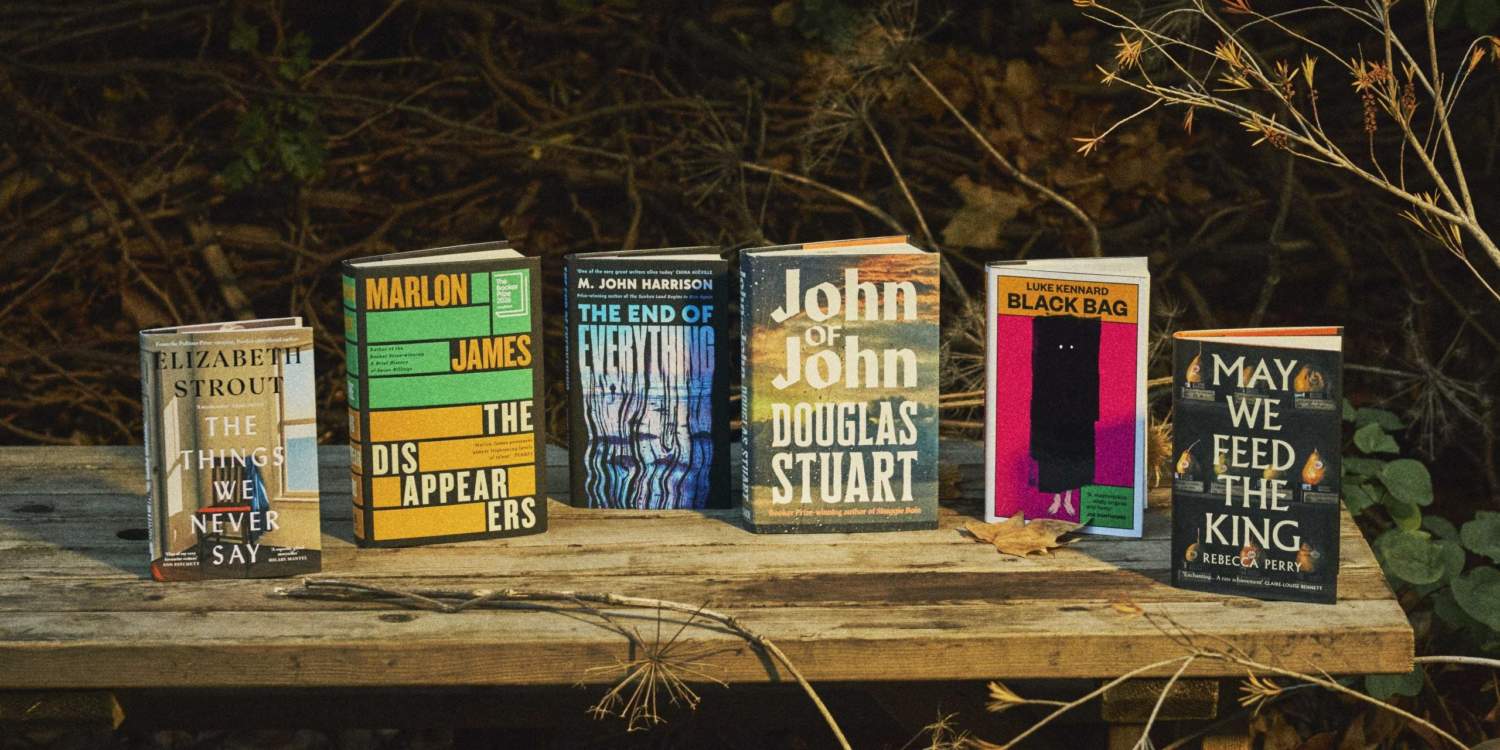
When the Booker prize was first launched in 1969, its aim was to get more people reading and to stimulate discussion about contemporary literature. Now, we all know reading is at an all time low but there really has never been a better time to reignite your love of fiction and to discover (or rediscover) your love of reading. And, this year’s shortlist is really a testament to the breadth of stories available out there.
There’s poetic historic fiction with May we Feed the King about a reluctant medieval king from Rebecca Perry. For lovers of science fiction, M. John Harrison has written a tale about aliens and social collapse set on the Kentish coast. And, there’s laughter to be found in Black Bag by Luke Kennard about an out-of-work actor who lands a gig in a psychological experiment.
There are also new works by previous winners and nominees. Marlon James is back with a startling portrait of the lives of gay men in Jamaica. Douglas Stuart gives us his chilly Hebridean family drama, John of John. And, finally there’s the gentle political commentary of Elizabeth Strout’s The Things We Never Say about what happens when good people stay quiet.
Ahead of the prize being announced on November 9, we’ve asked six experts to guide you through the nominations for 2026.
Black Bag by Luke Kennard
Black Bag was inspired by a 1967 experiment at Oregon State University in which an individual cloaked in black sat mutely in a seminar for a semester. Where the study focused on the reactions of the witnesses, Black Bag is the story and meditations of the man who becomes increasingly attached to his role and, amusingly, his bag.
Kennard’s protagonist is a flat-broke actor relying on cash-in-hand corporate murder mysteries and the kindness of his friend Claudio in an otherwise dismal world. Wearing the bag outside of the classroom not only removes the problem of how to be but even attracts the attention of a female professor who wants “to fuck nothing” – he is both strikingly visible and anonymous. The novel is laugh-out-loud funny but melancholy and provocative too. Some of Bag’s strongest relationships are those he imagines, like ongoing conversations with his parents’ dog and narrated village life with a fictional Swedish wife.
By Tory Young, associate professor in English literature
The End of Everything by M. John Harrison
The backdrop of The End of Everything is alien invasion, but treated with a ludic contempt for genre conventions. An ineffectual war is being waged against the sardonically named iGhetti – amorphous entities who have leaked into the world “from the astral plane”. Phillip Tennent, a beachcomber somewhere on the Kent coast, finds an iGhetti artefact washed up by the tide, a thing that slowly begins to ape humanity, an event which throws Tennent’s life and the life of his ageing, forgetful aunt, Marnie, into brutality and random violence.
In his 2023 “anti-memoir”, Wish I Was Here, M. John Harrison writes of his world-building: “I’d rather pile up real facts to reveal something evidently unreal than pile up invented facts to make something unreal seem real.” The real facts pile up here – cheek by jowl with dense allusion and the surreal – into a work of slippery unreality, which is nevertheless congested with raw feeling and startling poetry.
Tim Jarvis, senior lecturer in creative writing
The Things We Never Say by Elizabeth Strout
Elizabeth Strout’s slight book is a series of snapshot insights into the thoughts and memories of protagonist, Massachusetts Bay high school History teacher Artie Dam. With Artie at the centre, it captures the problems, relationships, and futures of a community: extended family, students, colleagues, whose lives connect unexpectedly, or are influenced by brief interactions – statements of support or honesty. Sometimes, Artie worries he lies through kindness; he isn’t to know that his positivity manifests unexpected joys.
Nominated for the prize three times before, Pulitzer-winner Strout’s elegant text is both melancholic and evocative.
Measured, thoughtful, and good, Artie Dam is caught up in political, socioeconomic, personal, and philosophical questions threatening to derail his life. These also bring him closer to people he loves, including his son Rob and his extravagant, reckless friend, Flossie. Artie clings on to the possibility of free will while the reader hopes that everything will work out well for Artie.
Jenni Ramone, associate professor of postcolonial and global literature
The Disappearers by Marlon James
The Disappearers pulls the reader into a seemingly knowable time and place – the Jamaica of 1988 to 2005. Yet what James seeks to make known and felt is not to be found in any record or archive.
The action begins as eight men gather to rehearse John Herbert’s provocative and unsettling 1967 US prison play Fortune and Men’s Eyes about homosexuality and sexual power play. A homophobic mob storms a rehearsal and by the end of the evening, one man is murdered and another blinded. Shortly afterwards, two disappear. Six years later, the search for the disappeared continues and the novel makes it clear that gay men in Jamaica disappear way before anyone notices they’ve gone.
In Marlon’s writing of their differences in class, ethnicity, social privilege, sexual preference, desire for attachment, emotional intelligence, eloquence, and identity constructions, the novel writes away the enforced flatness of slurs and stereotypes of gay men to humanise at scale. It’s an everyday act of narrative restitution that has revolutionary significance given the continuing sexual politics of Jamaica.
Alison Donnell, professor of modern literature
John of John by Douglas Stuart
An omniscient narrator presides over John of John as we follow John-Calum Macleod – Cal – a recent Edinburgh art school grad, who has been studying fashion and textiles. Learning that his maternal grandmother Ella is ill, Cal is persuaded to return home by his lay-preacher father, John, during one of their weekly phone calls.
Once home, we’re witness to the claustrophobic dysfunction of the Macleods’ home, a small croft where John rears sheep, weaves tweed, and has strong connections to the “Wee Free” church. John struggles to show anything other than contempt towards his son, who has come home with growing debt and orange hair.
As a young gay man hailing from a strict and repressive Free Presbyterian background, Cal remains still in the closet as far as his island is concerned. The torment and guilt of his sexuality weigh heavily on Cal throughout the novel.
The drama and (sometimes verging on implausible) twists of this book make it feel like a soap opera, in the traditional sense of the term: small, interconnected characters and high melodrama, with domestic spaces as scenes of desire, revelation and unpredictability. But this is not a criticism. Stuart’s lyrical prose and atmospheric narrative elevate the genre – reimagining the domestic and familial tropes by focusing on the unrequited affections of the men in the story.
Stevie Marsden, lecturer in publishing
May We Feed The King by Rebecca Perry
This is a poet’s novel, without the seductive immersion more usual for those on the Booker shortlist. In three parts, the first and last are narrated by a person – their sex is never given – whose job is creating food scenes in historical sites. Following a never specified tragedy, they are commissioned to create a tableaux in a former palace. In the archive they come across a page detailing the failings of a medieval king. The middle part of the novel is that king’s story.
While the narrator’s work is about bringing the past close, the novel itself is an exercise in distance. We are told very little about the tableaux maker; the characters in the middle section are known only by their roles.
This distance enacts the novel’s central questions about history and storytelling, but it is not a cold distance. The novel is full of passages of beauty and delight. The narrator’s description of a website that sells replica food made me laugh and took my breath away.
Leigh Wilson, professor of English literature

