


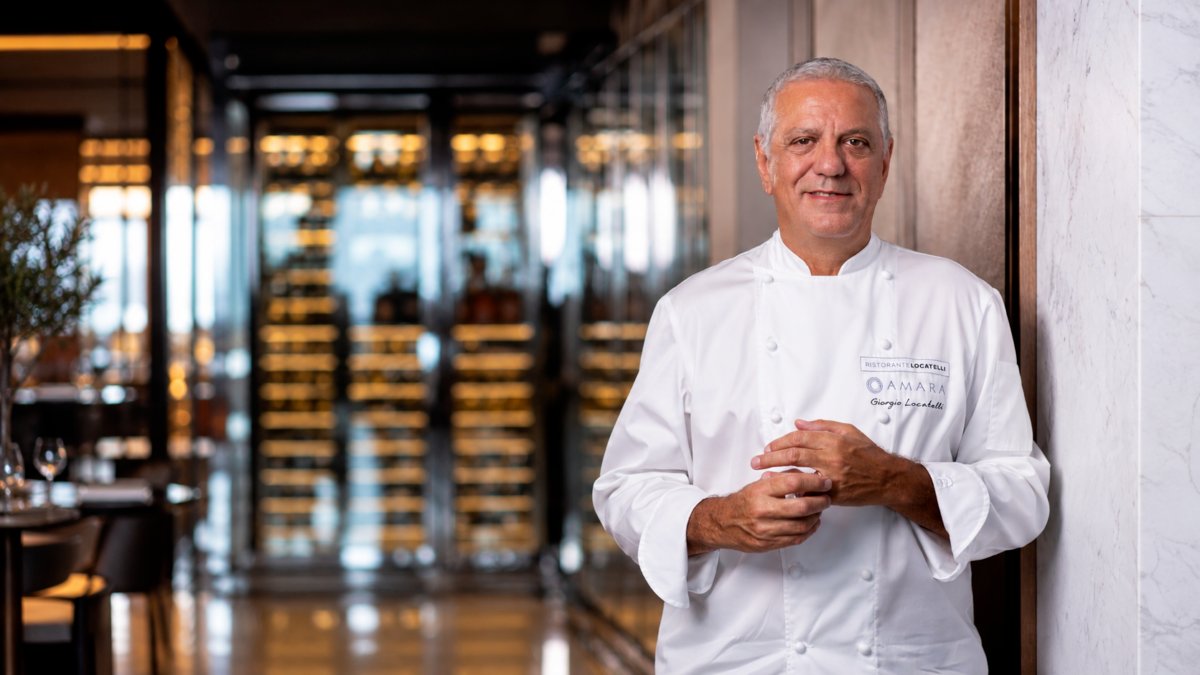
Celebrity MasterChef UK, a new look, and the end of a major chapter in his life: “It’s important to be able to change”
Giorgio Locatelli is going through a time of big change. One chapter of his professional and personal life has closed, but two exciting new ones have opened: his role on Celebrity MasterChef UK and his new venture, Osteria Locatelli at the National Gallery in London. We met him at Ristorante Locatelli at AMARA to talk about the new challenges of a career that keeps evolving.
This year has brought a lot of change. One is your role as a judge on Celebrity MasterChef UK. What excited you about it?
It’s more of an entertainment show than a cookery programme as such. What interests us is seeing someone’s character in different circumstances. People often know celebrities only through the image they present in public. This show gives viewers the chance to see a different side of them. I loved the sportspeople, they were amazing! But they were all brilliant: the comedians, the YouTubers. After all, it’s that distinctive character that made them popular in the first place.
How is your approach different from the Italian MasterChef?
On MasterChef Italia I feel I can really make a difference to these people’s lives. If someone wins, their life can change, or at least take a big step in that direction. On Celebrity MasterChef, on the other hand, we’re dealing with people who are already very well known. But it’s still a competition, and everyone wants to show their best side. Nobody wants to come across badly. There’s something else I find interesting, too. Every time they cook a dish, there’s a family story behind it, a memory, something personal. That’s the beauty of cooking. And these people, especially the actors and comedians, are very good at telling that story.
Another change, and a very visible one: your new look! How did you decide?
Filming for Celebrity MasterChef started in January and finished in March. I had a two-week gap and then filming started on the Italian MasterChef. Almost six months of filming altogether. And in the middle of all that, my hair had become a big issue. Shorter, longer, tied back, styled, and back to square one. On the last day of filming in Italy, at the final, we were at the party in the evening and I thought: “I’m cutting it off!” I said to my hairdresser: “Have you brought your kit? Let’s cut it!” She said: “I’m not doing anything unless Plaxy agrees.” So we rang my wife and got the green light. It was so liberating!
The headline of a recent interview with you was: “I want to be known as a good chef, not for a bloody haircut!”
Everyone went mad over the new haircut. People started posting photos and writing about it. It was absolutely crazy! Even the Italian press got interested in my hair. The biggest Italian papers, including Corriere della Sera, ran stories about it. That’s exactly when I said the line that became the headline.
How do you feel about being a celebrity chef?
It’s nice to be important, but it’s much more important to be nice. I always keep that principle in mind. You should never believe the image your PR people create for you, and you must always keep your feet on the ground. When you’re that recognisable, you have to use it for a good cause, to give something back to people. Chefs didn’t have this role in the past. The media have done a lot for us, and it’s a position we should use properly.
I like the idea of a chef who has influence and can make a difference, but we have to remember we’re still cooks. We make food; we’re not doing brain surgery. The people who do that job deserve Nobel prizes, not us. What I’d like to do in future is work more in education, teach others, help people. Bring a little “magic” through food.
For more than 20 years, Locanda in London was a huge chapter of your life. When it closed, did you feel you had lost a part of yourself?
The first few months were hard. Twenty-four years is a whole lifetime! But at the same time I felt a sense of freedom. It was a huge weight, not just for me and my wife but for the whole family, our children. The restaurant shaped our lives in a way that was very different from a “normal” family, if there’s even such a thing. But it was also a wonderful experience. I had a very special relationship with the customers, and that relationship is still there. I’ll remember them for the rest of my life. These people came to Locanda and became part of its story.
Do I miss it? When I think about it romantically, yes, I do. But straight away I remember all the day-to-day difficulties of running a restaurant like that and… I come to my senses! It’s important to be able to change, to move on and do something different. The economic climate has become tough, so it made sense to create something else. At the same time, my television career is going very well, both in England and in Italy.
It’s also interesting that Locanda kept its Michelin star right up to the last day…
It’s true, we closed Locanda still holding the star. We never lost it. We wanted our food to be above the ordinary, to offer a really good experience, and we kept that up consistently for 24 years. But as market prices and rents went up, profit margins shrank, and that made it unviable.
Do you think the restaurant model as we know it needs to change radically?
It’s already changing, and it always has. Think about what people ate in the ’50s, or even the ’90s. Every decade brings something new, shaped by everyday life, which changes too. A restaurant reflects the world around it and responds to people’s needs and wants. The changes over the past 30 years, from the ’90s to today, have been truly remarkable. A restaurant has to adapt and respond to what its customers want. We always tell people to follow their dreams, but a restaurant that wants to stand the test of time also has to adapt to the economic conditions it operates in.
I don’t believe, though, that this is the end of fine dining, as some people claim. People will always want to go somewhere that makes them feel they’re somewhere special, and they’re willing to pay for that experience. These restaurants may change their food and the way they operate, but the appetite for that experience remains. Personally, I like restaurants everyone can go to, not just one particular type of person.
You’ve never liked elitism in fine dining…
I’ve always believed a restaurant should appeal to as many people as possible and offer something anyone can enjoy. Whether you’re a rock star or a farmer, everyone should feel welcome.
What draws you to your new venture, Osteria Locatelli at the National Gallery in London?
It’s an osteria: a small, simple place with a menu that changes often, based largely on what we did at Locanda but presented and served differently. It’s not a destination restaurant or somewhere for special occasions. The idea is that people visit the Gallery and, among the thousands of visitors, some want a good meal while they’re there.
I didn’t expect us to be chosen for it, and I was especially pleased they went for Italian food, because I want to remain one of the ambassadors of good Italian cooking. The prices are affordable and people seem to love it. With rents in London rising so steeply, it’s extremely hard to run a restaurant. This model lets us offer good quality at reasonable prices.
Is it true that when you worked at the Savoy in the late ’80s, the Gallery was your favourite place to spend your break?
My colleagues would go to the pub for an afternoon drink and I’d go to the National Gallery. It meant a great deal to me to have such easy access to a place like that in my everyday life. That’s culture! I’d look at the Italian art, and there were incredible works, from Canaletto to Caravaggio, who is one of my favourite painters. And now, with the Osteria, that access has become even easier!
You’ve spoken about your family’s anti-fascist background. Do you have strong political views yourself?
My father’s brother, Gionino, was just 21 and a partisan. They arrested him and shot him. I remember my grandmother bringing us up telling us over and over not to get involved in politics, because the family had already paid a very heavy price for its political choices. She didn’t want to see history repeat itself with any of her children or grandchildren. But it mattered that we grew up with those values: me, my brother and my cousin. I have strong views on things; I’m not someone without opinions. But I believe you can keep politics separate from your working life.
You’ve talked about the need to change the culture in professional kitchens. What’s the philosophy in your kitchen?
At some point I realised I was paying my staff almost twice the going rate. Because we wanted to give people a real chance to progress. For me, my staff are my family. We all eat together, my children included. I look after them and I want them to be healthy and happy, just as I want my own family to be.
When I read what was written about Noma and that whole debate, I thought how important it is for people to know what really goes on in kitchens. Everyone in my generation has experienced bullying and humiliation in kitchens, but you can teach someone without humiliating them. Of course mistakes happen, and at some point you may lose your patience, but that doesn’t mean you should insult or belittle anyone.
How do you feel each time you come back to Cyprus and Ristorante Locatelli at AMARA?
AMARA is a special place. Even when I come here for work, I feel calm from the moment I arrive at the hotel. Yesterday, for example, I had real trouble with my flight from London and got here after midnight. I opened the window and there was complete silence, just the sound of the waves. It was beautiful. Maybe now I’ll get the chance to come more often and stay longer.
I love that my people at the restaurant have settled into life here, too. Dario Sutera, for example, was with us in London, then went to Dubai, and then came to Cyprus to run the kitchen at Ristorante Locatelli at AMARA. When he came here he had no children, and now he has three! He’s built his life in Cyprus and, as I joke with him, he’s a Cypriot now.
How has the restaurant’s identity evolved over the years?
Over the past five years, Cyprus, and Limassol in particular, has taken a huge leap forward in food. What’s happened is incredible! Obviously there’s more competition, which we expected, of course, but it helps us evolve. The hotel has four very different restaurants, and it’s important for us to offer something that suits the place and the expectations of the people who come here. They’re not coming to a restaurant in central London. There’s a holiday feeling here, a carefree feeling, so our approach is different. We stand for Italian elegance, but also for warmth and conviviality, letting people enjoy each other’s company. There’s live music in the bar, but in the restaurant we’ve created a space where relationships can flourish, whether it’s a family, a couple or a group of friends. We want the atmosphere to bring people closer together.
Our restaurant team has also been with us for eight years now and has really matured. People come to the restaurant for us, and they’re very happy with what they find. We represent fine Italian dining in Cyprus, probably at one of the highest levels on the island, and what we produce is genuinely very good. At the same time, we’ve started to feel more confident about bringing some local ingredients onto the menu, and we’ve experimented with them in London too. For example, we’ve created a zivania sorbet! I’m trying to bring these two cultures together, and we also do that through the events we hold, such as wine events, to make the whole experience even more interesting.
Has Cyprus influenced your own approach to food?
This multiculturalism, this mix of cultures, makes room for experimenting with food. Maybe that’s why I find what’s happening in Limassol so interesting. People from different places come to Cyprus, bring their own experiences with them and build a new life here. The city now has a strongly international character. Different people and cultures living side by side is an opportunity, especially for food, because it makes room for new ideas and influences. Some see it as a threat. I don’t. War is a threat.
If you were starting over today, would you make the same choices?
Of course! I’d certainly avoid some mistakes, but we are the sum of everything that has happened to us, and the hard experiences have taught us far more than the pleasant ones. And the idea that failure is a bad thing is absurd. Failure matters. If children don’t learn to fail, they won’t know how to deal with it when it finally comes. When you fail, you fall down and then you get back up. It’s deeply human. But looking back, and judging some people by the way they treated me, perhaps I’d handle them differently. I’d be more careful and wouldn’t trust them so much.
“Success is being happy” was the headline of our previous interview, five years ago. Do you still stand by that?
Absolutely! Success really is being happy. It doesn’t matter if you have millions in the bank. I’ve met so many unhappy millionaires and, at the same time, so many happy labourers. Life shouldn’t revolve around our finances. People seem to have completely lost the plot. They’re trying to get rich and powerful, and at the same time they’re so unhappy.
Ristorante Locatelli, AMARA Hotel, 95 Amathountos Avenue, Limassol, 25 442222.

