


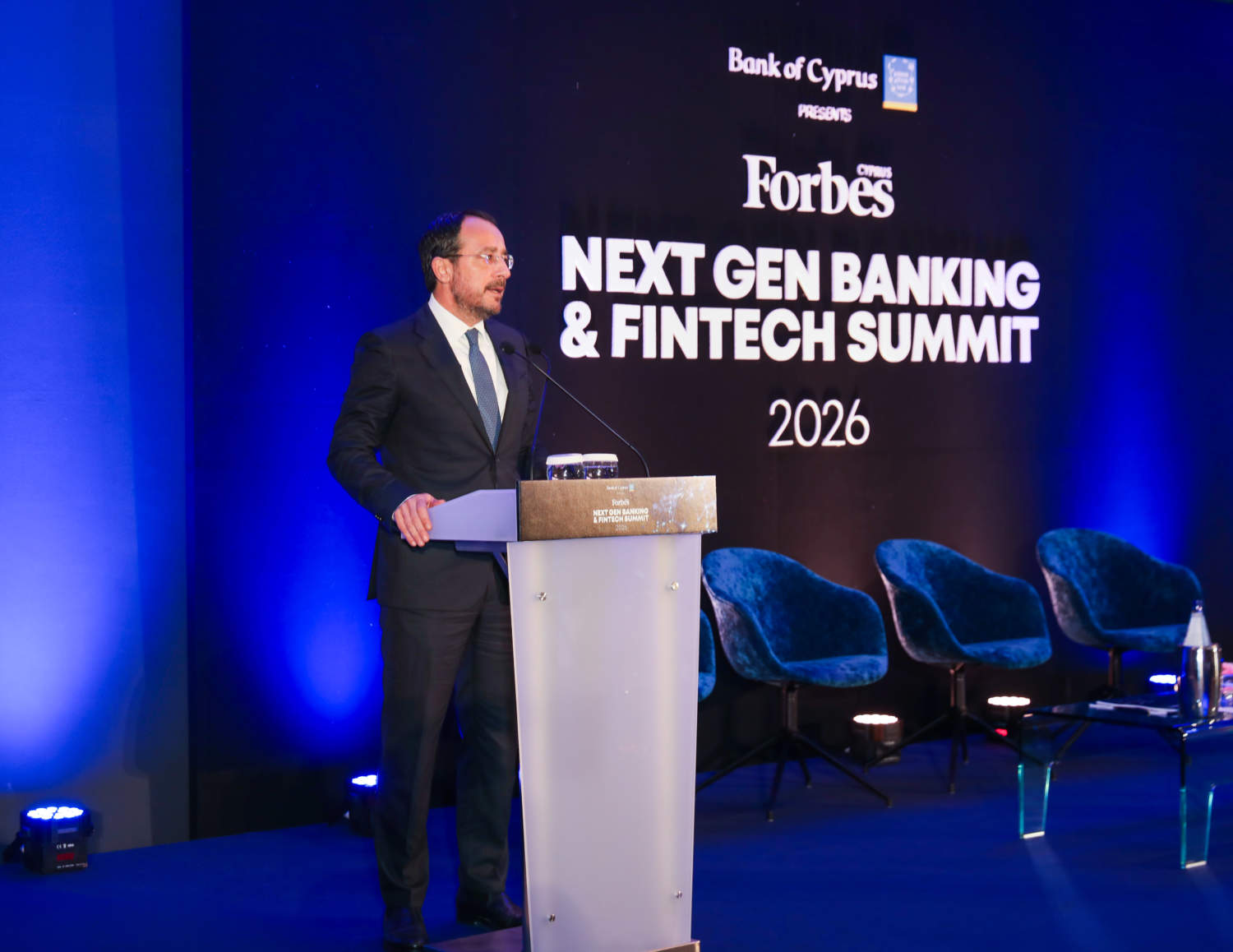
Cyprus has demonstrated its ability to maintain economic stability despite international uncertainty and is seeking to build on its strengthened banking sector to become a European hub for financial technology investment, President Nikos Christodoulides said on Tuesday.
Addressing the Forbes Cyprus Next Gen Banking & Fintech Summit, organised by Phileleftheros Media Group in cooperation with Capital S.A. at the Four Seasons Hotel in Limassol, Christodoulides highlighted the country’s improved public finances, resilient banking system and growing technology industry as advantages for attracting international businesses and investors.
“We have demonstrated that Cyprus can offer stability even in the most challenging international circumstances,” he said, adding that the next priority was to translate that stability into investment, innovation and lasting competitiveness.
Christodoulides said the Cypriot economy had expanded by approximately 10% over the past three years, despite geopolitical uncertainty and economic challenges affecting Europe and the wider region.
He pointed to Standard & Poor’s recent upgrade of Cyprus’s sovereign credit rating from A- to A, with a positive outlook, as evidence of renewed confidence among international investors and financial markets.
According to the President, the proposed 2027 state budget provides for a fiscal surplus of around 4% of gross domestic product, while public debt is projected to fall below 50% of GDP in 2026 and reach approximately 45% by the end of 2027.
He attributed the improved economic indicators to deliberate policy decisions aimed at strengthening the country’s resilience and restoring international confidence.
Cyprus seeks to become European fintech hub
Christodoulides placed particular emphasis on the government’s ambition to strengthen Cyprus’s position in the international financial technology industry, using the country’s economic stability and competitive advantages to attract fintech businesses.
He said the objective was to establish Cyprus as “a trusted, agile, and internationally connected European gateway for financial innovation”.
The government wants fintech companies to establish substantial operations in Cyprus, develop new financial products and services, attract investment and specialised talent, and expand into European and international markets.
Christodoulides identified Cyprus’s membership of the European Union and euro area, its geographical position, skilled workforce and established professional services sector as advantages for businesses seeking access to the European single market.
According to figures cited by the President, the wider technology sector contributes approximately 15% of Cyprus’s GDP, while the country ranks 32nd globally for its fintech start-up ecosystem.
He said Cyprus already hosted a growing number of payment institutions, electronic money institutions, financial software companies and specialised digital financial services providers.
The President also highlighted the opportunities arising from artificial intelligence, digital assets, tokenisation and real-time payments.
These technologies, he said, could help banks improve customer service, accelerate customer onboarding, strengthen fraud detection and regulatory compliance, and operate more efficiently.
For fintech companies, they offered opportunities to develop new financial products, introduce innovative business models and compete internationally.
Strong banking sector must benefit wider economy
Turning to the banking sector, Christodoulides said Cyprus had made substantial progress in strengthening bank balance sheets, reducing non-performing loans and improving financial resilience.
Citing the European Banking Authority, he said Cyprus and Luxembourg stood out among EU member states for the capital strength of their banking systems.
However, he stressed that stronger banks should also deliver benefits to the wider economy and citizens.
“We must continue to encourage a more competitive banking environment,” he said, calling for “appropriate returns to depositors”, improved access to finance and greater support for productive investment.
Christodoulides also outlined government initiatives supporting financial innovation, including the Cyprus Equity Fund, the National Development Organisation for Enterprises and programmes promoting research and innovative businesses.
He referred to the Minds in Cyprus initiative, aimed at attracting specialised talent, and the national artificial intelligence strategy to 2032, which identifies financial services as a priority sector.
The President emphasised that fintech development must be accompanied by cybersecurity, data protection, responsible AI use and regulatory clarity.
He also highlighted the Central Bank of Cyprus’s Innovation Hub and regulatory initiatives intended to facilitate cooperation between innovative businesses and supervisory authorities while protecting financial stability and consumers.
Christodoulides concluded that Cyprus needed banks capable of responding to the economy’s needs and fintech companies able to attract investment, develop secure financial solutions and create high-value employment.
Read more:

