


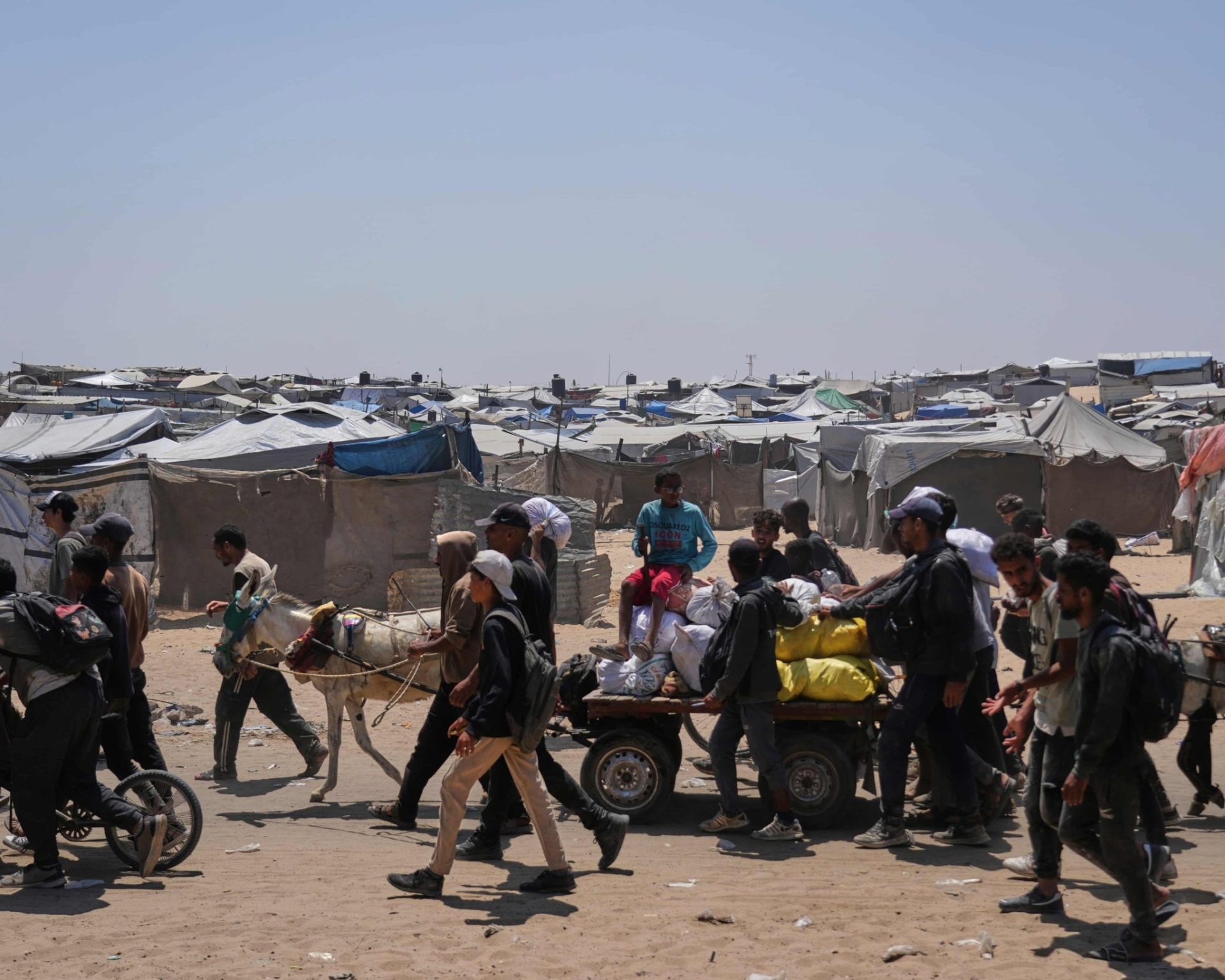
The Israeli military on Saturday ordered Palestinians in Gaza City to leave for the south as its forces advance deeper into the enclave’s largest urban area.
Israeli forces have been conducting an offensive on the northern city’s suburbs for weeks after Prime Minister Benjamin Netanyahu ordered the military to capture it.
Netanyahu describes Gaza City as a Hamas stronghold, stating its capture is necessary to defeat the Palestinian Islamist militants whose October 2023 attack on Israel sparked the war.
Hundreds of thousands face displacement
The assault threatens to displace hundreds of thousands of Palestinians sheltering there from nearly two years of fighting. Before the war, around one million people, nearly half of Gaza’s population, lived in the city.
Israeli military spokesperson Avichay Adraee wrote on X that residents should leave the city for a designated coastal area of Khan Younis in southern Gaza, assuring those fleeing they would receive food, medical care and shelter in the “humanitarian zone.”
On Thursday, the military said it had control over almost half of the city and claims to control about 75% of all Gaza.
Residents resist repeated displacement
Many of those in Gaza City were displaced earlier in the war only to later return, with some residents saying they refuse to be displaced again.
The military has conducted heavy strikes on the city for weeks, advancing through outer suburbs, with forces this week positioned within kilometres of the city centre.
Netanyahu, backed by right-wing coalition allies, ordered Gaza City’s capture against the advice of Israel’s military leadership, according to Israeli officials. Despite hesitation, the military has called up tens of thousands of reservists to support the operation.
International isolation grows
The war in Gaza has increasingly left Israel diplomatically isolated, with some of its closest allies condemning the campaign that has devastated the small territory.
Palestinian militants took 251 hostages into the enclave after their cross-border attack on southern Israeli communities on 7 October 2023, which killed about 1,200 people.
More than 64,000 Palestinians have since been killed in Gaza, local health authorities say, with much of the enclave reduced to ruins and residents facing a humanitarian crisis.
All-or-nothing hostage negotiations
Growing calls within Israel, led by families of hostages and supporters, demand ending the war through a diplomatic deal securing the release of the remaining 48 captives. Israeli officials believe 20 of the hostages are alive.
Netanyahu is pursuing an all-or-nothing deal that would see all hostages released at once and Hamas surrendering.
Israeli military officials say they have killed many of Hamas’s key leaders and thousands of fighters, reducing the Palestinian militant group to a guerrilla force.
Hamas has offered to release some hostages for a temporary ceasefire, similar to terms discussed in July before negotiations mediated by the US and Arab states collapsed.
US President Donald Trump said on Friday that Washington was in “very deep” negotiations with the Palestinian militants.
Military operations to intensify
Hamas, which has ruled Gaza for nearly two decades but today controls only parts of the enclave, has said it would release all hostages if Israel agreed to end the war and withdraw all forces from Gaza.
Most freed hostages were released through diplomatic negotiations mediated by the United States and Arab states. Israel and Hamas have accused each other of negotiating in bad faith since talks broke down in July.
Defence Minister Israel Katz said on Friday that military operations in Gaza would intensify until Hamas accepted Israel’s conditions for ending the war: releasing hostages and disarming. Otherwise, the group would be destroyed.
Experts, governments, United Nations agencies, and non-governmental organisations have accused Israel of carrying out genocide against the Palestinian people.
(information from Reuters)
Read more:

