


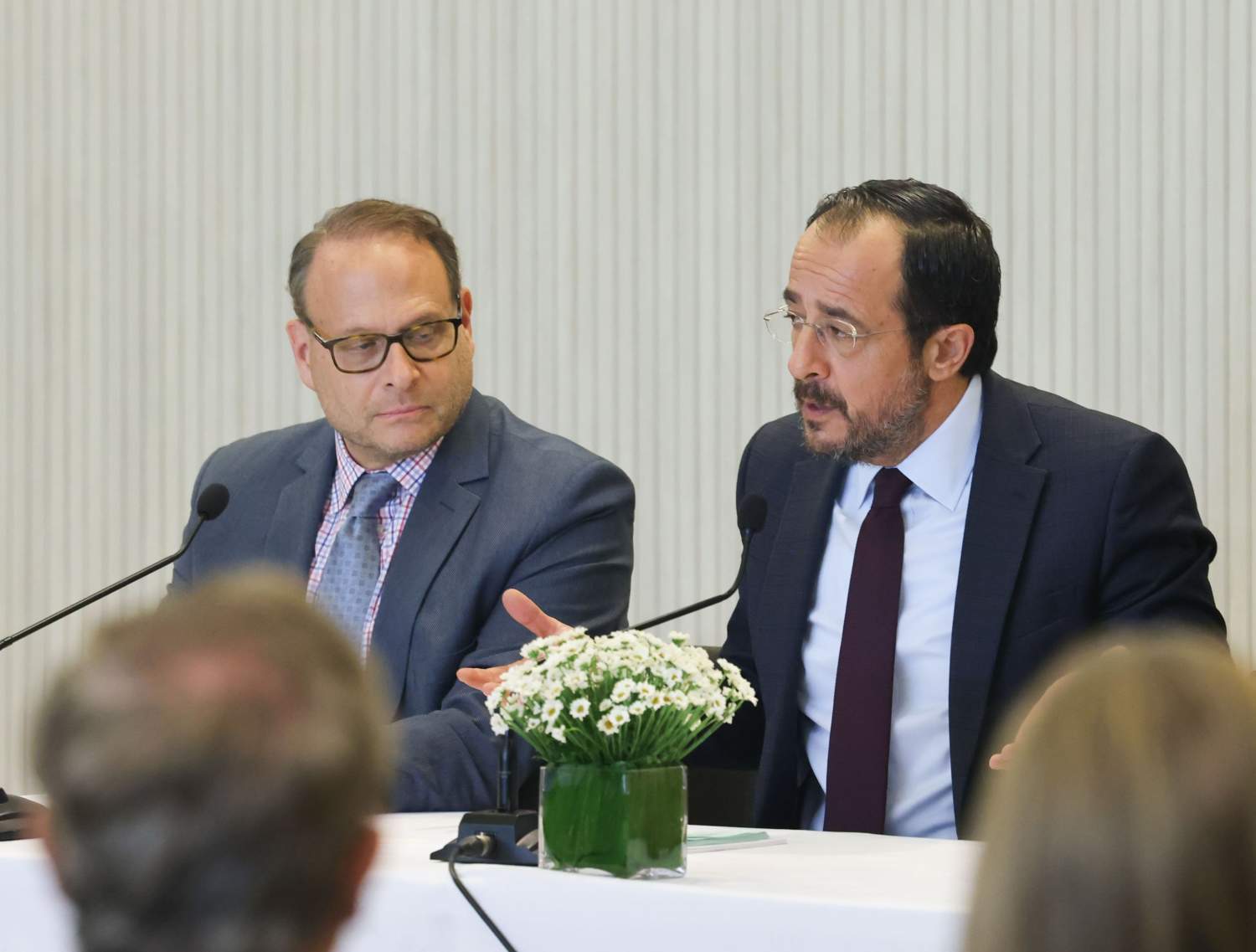
President Nikos Christodoulides and the leadership of the American Israel Public Affairs Committee (AIPAC) discussed on Wednesday further strengthening Cyprus’s relations with the United States and Israel, and speeding up efforts to reinforce the 3+1 mechanism, at a meeting at the Presidential Palace, according to a statement from the presidency.
The statement also said the AIPAC delegation was led by outgoing president Bernard Kaminetsky and president-elect Yehuda Neuberger. Talks also covered the Cyprus problem, the situation in the Eastern Mediterranean and the wider Middle East, Cyprus-US relations and cooperation between Cyprus, Israel and the US. AIPAC pointed to its continued support for Cypriot interests in the United States.
Christodoulides briefed the delegation on the current state of the Cyprus problem and on his efforts to resume talks from where they broke off at Crans-Montana.
He then addressed a wider meeting with all members of the delegation and answered their questions on issues of mutual interest.
During their stay in Cyprus, the delegation also attended a ceremony in Nicosia honouring Jewish refugees and the children born between 1946 and 1949 at the former British Military Hospital in Cyprus.
Criticism of Israel-Cyprus ties
Closer ties with Israel have drawn opposition in Cyprus. Opposition party AKEL has accused DISY, DIKO and ELAM of turning parliament into a lobby for Israel’s interests after the three parties formed a parliamentary group in cooperation with the Israel Allies Foundation. It described that move, and the creation of a Cypriot branch of Transatlantic Friends of Israel, as extremely provocative.
AKEL said that while even Israel’s traditional Western allies were imposing sanctions on members of the Netanyahu government, the Christodoulides government and the three parties were stepping up political support for Israel. It asked how Cyprus could credibly demand pressure on Turkey while politically supporting “another occupying and settler state”.
DISY replied that strengthening ties with Israel was a strategic choice and that Cyprus’s international partnerships did not need AKEL’s permission. It said a country under Turkish occupation needed strong international support.
Read more:

