


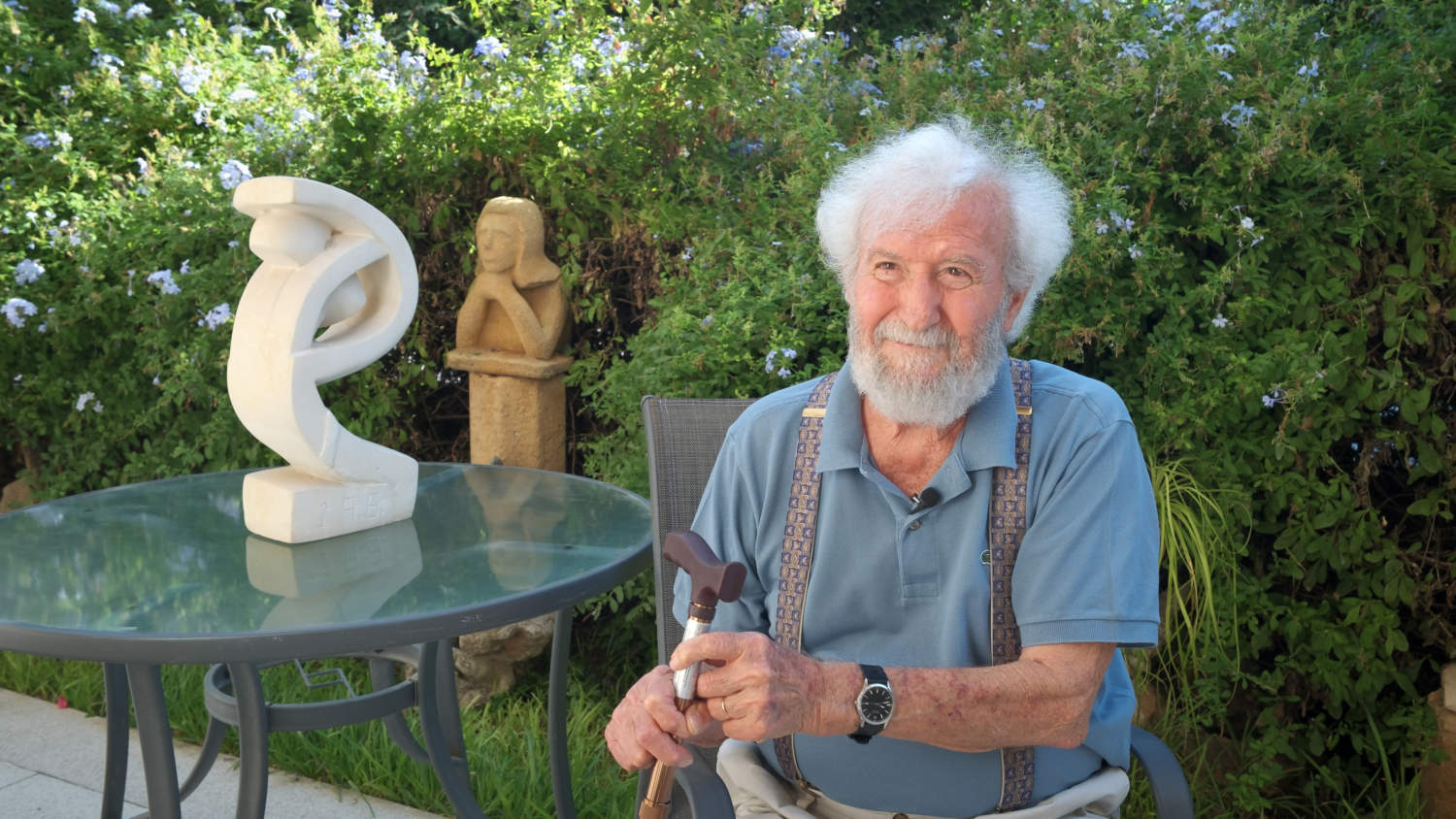
The sculptures of Charalambos Christodoulou drew an appreciative audience to his latest exhibition, held last Sunday at the sculptor’s home in Nicosia, reaffirming the enduring regard in which his work is held in the Cypriot capital. The occasion was enriched by the presentation of a book documenting Christodoulou’s sculptural collection and the screening of a short documentary directed by Danae Stylianou, offering visitors a further glimpse into the artist’s life and creative vision.
For an artist who came to sculpture not through an academy or formal artistic training but through years of patient observation, experiment and solitary work, the response offers the affirmation of a practice that has evolved quietly over more than four decades.
Christodoulou, born in January 1937 in Achna, a village in the Famagusta district now under Turkish occupation, began his professional life far from the sculptor’s studio. He trained as a teacher, distinguished himself as a sprinter and went on to study mathematics, ancient history and constitutional law through the University of London’s external degree program.
He was subsequently appointed to Nicosia’s First Technical School in 1967, where he remained for three decades before retiring in 1997. Sculpting, however, had already claimed him by then.
He began working with the medium in 1983, initially collecting tree roots, stones and other objects whose irregularities seemed to suggest possibilities beyond their ordinary forms. The decisive encounter came with a piece of red jasper, oval in shape. As he smoothed its surface, following rather than resisting its natural contours, a face gradually appeared.
It was an unassuming beginning, but it contained the principle that would guide much of his subsequent work: the artist does not always impose a form upon a material; sometimes he discovers the form already waiting within it.
Christodoulou taught himself the technical demands of sculpture through repeated trials and sustained patience. He worked in marble, Tochni stone, limestone from Lympia, granite, river stone, cypress and walnut wood, as well as terracotta. Each material presented its own resistance and possibilities. His achievement has been to learn these differences through practice, allowing the particular character of a stone or piece of wood to determine the sculpture’s eventual expression.
The human figure remains his central subject. Some of his sculptures recall the spare, monumental qualities of ancient Cypriot art, yet they are not exercises in archaeological imitation. Instead, the figures emerge with a modern simplicity, their rounded, sensual contours often approaching abstraction. The body is neither merely represented nor separated from its material: it appears to belong to the stone, as though the two had arrived at their final shape together.
There is also a quiet dialogue with Cyprus’s artistic heritage, including a work inspired by the celebrated imagery of a mother and child associated with the painter Adamantios Diamantis. Such references suggest not nostalgia but an ongoing conversation between inherited forms and an individual artistic temperament.
Christodoulou’s path to recognition has been measured rather than hurried. His first exhibition took place in 1991 at the Famagusta Gate Workshop. Subsequent exhibitions followed at the University of Cyprus in 2006, the Ministry of Culture’s exhibition space in 2011, Chelsea Town Hall in London in 2016, and Gloria Gallery in Nicosia in 2019.
His personal biography, too, contains an unexpected crossing of cultures. In 1959, during a brief visit to Romania, he met Christina Todea, then a student of English and French literature at the University of Bucharest. Their courtship unfolded over successive summer visits, each brief encounter sustaining a relationship across borders and political divides. They married in 1962, after obtaining the necessary official approvals, and Christina arrived in Cyprus the following year.
There is something quietly resonant in this story of distance, patience and discovery, qualities that seem to find an echo in Christodoulou’s sculpture. His work asks for an unhurried gaze and a willingness to look beyond the surface, to recognise the possibilities concealed within an unremarkable piece of stone or wood. Just as his own artistic journey began with the gradual emergence of a face from a piece of red jasper, his sculptures invite the viewer to discover what is already there, waiting to be revealed. Across the years, his practice has remained faithful to this essential encounter between material and imagination, in which the artist’s task is as much one of listening as of shaping.
The exhibition in Nicosia suggests that his work has found its public. For an artist whose practice began with a face emerging from a piece of jasper, the encounter between sculptor, material and viewer remains the essential event. The stone is still speaking; people have come to listen.
Read more:

