


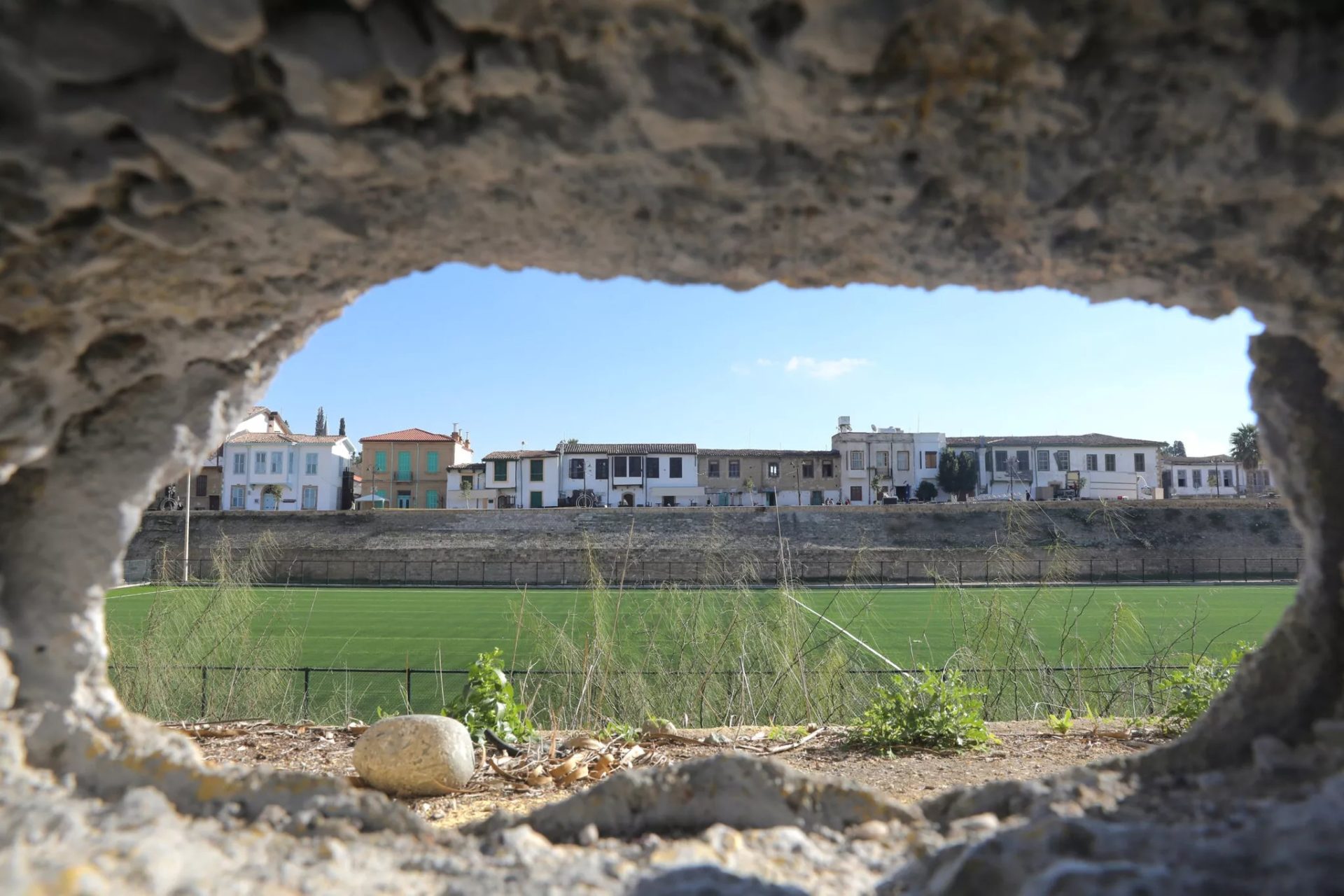
A week after the signing of the EU enlargement Treaty at the Stoa of Attalos in the ancient agora of Athens, which established the Republic of Cyprus as a member state, the occupying side surprised everyone, primarily Nicosia.
They had proceeded with a partial lifting of restrictions on movement across the occupation line. This was the Turkish side’s response to the Republic of Cyprus joining the European Union.
It was the first time since 1974 that Greek Cypriots would cross the occupation line and Turkish Cypriots would enter the free areas. Thousands rushed to visit the occupied territories and their homes.
Queues formed at the Ledra Palace checkpoint. It was 23 April 2003, during Holy Week.
Journalist Christina Kyriakidou wrote the following day in “Phileleftheros”: “In 1974, a massive queue of cars had formed heading towards the free areas. They were fleeing hastily from their homes in Kyrenia, Bellapais, Varosha, Dikomo, Karavas. Yesterday, 29 years later, the same people formed the same queue, only it was in the opposite direction. Not to return permanently to their birthplace, but at least to see them ‘perhaps for the last time’, as one 88-year-old mother said. Back then, parents were driving; now, the steering wheel was in the hands of their children, who at the time of the invasion were either unborn or very young”.
And Phileleftheros photojournalist Andreas Manolis reported on a Turkish Cypriot who was asking about the “Halepi” pastry shop, presumably to visit and buy sweets.
At the same time, he documented what two Greek Cypriot families saw when they visited their village, the occupied Palaiosofos. The church of Saint Paraskevi was without doors and windows, with hay and irrigation hoses inside! These were scenes from that day.
We were experiencing a new reality that needed to be managed. Both at the societal and state level. Without exaggeration and with a grounded approach. The Cypriot Government made it clear, through Government Spokesman Kypros Chrysostomides, that “the wall had not fallen,” nor “had the Cyprus problem been solved”.
And this was the reality. Athens was operating on a different wavelength. The then Prime Minister, Costas Simitis, had stated that “for the first time in 30 years, the Green Line in Cyprus ceased to be divisive”! The then Foreign Minister, George Papandreou, spoke of a “celebration”.
Both, a year later, before even getting their hands on the Annan Plan, were calling for its acceptance. The content? A mere detail for the Greek elite.
The crossing to the occupied areas was happening en masse. It was a significant event. Refugees would see their homes after nearly three decades.
They knew that others were living in their houses, usurping their properties. Some faced ruins; others found new buildings. There were those who saw, walked the streets and neighbourhoods, and never returned.
Others went and have returned several times since. Some never went at all.
It was the first shock. The occupying side believed that through various actions and conditions they set, the breakaway entity would be recognised. This, of course, was not feasible or realistic.
Ankara’s move, implemented by Rauf Denktaş’s puppet regime, created impressions but was a gesture that did little to achieve a solution. It wasn’t aimed at finding a solution. After all, Ankara’s message was that they were “opening the borders,” perhaps hoping to provoke an incident.
Primarily, they attempted to create a sense of normality and… habit. The effort was to “normalise” the situation, turning the occupation of part of the country into… normality.
After so many years, the opening of new checkpoints is still being discussed. The cracks in the wall did not lead to collapse but—alas—gradually to a habit.
The partial lifting of restrictions on movement confirmed that Greek Cypriots and Turkish Cypriots have no problems with each other and relations were and remain good. The problem is the occupation, Turkey.

