


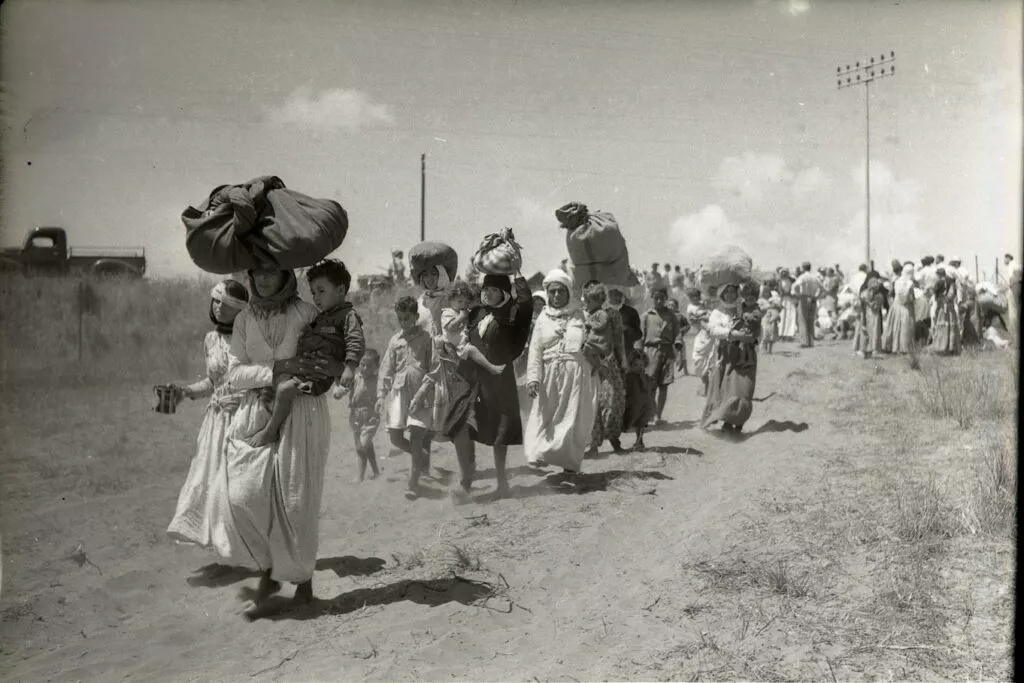
I wonder what these vociferous heralds of hasbara [Editor’s note: Hebrew for the public diplomacy of Israel] walking among us are made of. Does blood flow through their veins?
Do they feel even a twinge of empathy at the thought that the world is lazily watching a methodical extermination in real time? That civilians are being systematically slaughtered by a militarised state and sadistically left to starve, while hospitals are bombed and an entire region is razed to the ground?
Fair enough for Israelis to invoke survival instinct, geoulah, the unbearable transgenerational trauma of the Holocaust, centuries-old antisemitism, and the persecution of their ancestors. But the rest, who function as commissars of certainty, how did they acquire such thick skin?
It’s remarkable—and future historians will hold us accountable for this—how the Western gaze has grown accustomed to seeing Palestinians either as “terrorists” or mainly as second-class victims. Their dead have no names, faces, or stories. They are merely numbers. They don’t even deserve the word “death.” They are simply exterminated. Where might the roots of this dehumanisation lie, this callous utilitarianism, this merciless opportunism? In a sense of historical superiority? In colonialism? In simple ideological rigidity?
It is shocking that such a massive and documented crime, with thousands of dead, wounded, refugees, homeless, starvation, with blatant violation of every notion of international humanitarian law—and not only that—is not being addressed with the same moral and political consistency and sensitivity as other cases, such as Ukraine. It suffices that Israel is a steadfast, powerful, and strategic ally.
Meanwhile, a well-oiled mechanism of “explanation” works around the clock, controlling or heavily influencing narratives, consciences, agendas, and frameworks for discussion. The bloody events have long surpassed “arguments” and “debates.” We’re talking about a genocide broadcast live, with the executioners carrying it out almost with pride and enthusiasm, while the centres of power on the planet whistle indifferently, when not actively supporting it.
Even when it comes to flagrant human rights violations, the slightest criticism—including, obviously, what you’re reading at this moment—is dismissed as “antisemitic,” and those who speak out are cast into eternal fire and outer darkness, or scrutinised for “diminished perception.”
Official governments, societies, collectives, think tanks, or random trolls have convinced themselves that they represent… the good of the ecumene, progress, democracy, freedom. Do they struggle to recognise that they are complicit in crimes against humanity, or do they simply not care? I don’t think it’s ignorance; it’s more likely a choice. A choice that, beyond thousands of human corpses and an uprooting unprecedented in our time, carries a heavy cost in terms of moral cohesion in the West. It cannot but entail a retreat of rational thought, disenchantment with Enlightenment values, a slide into darkness.
Amidst this barbarity, something is beginning to crack. The complete audacity of narrative mechanisms, trying to convince us that pigs can fly and that famine “combats obesity” (sic), has begun to intensify the fractures. I don’t know if there has ever been in history such extensive and open differentiation from Jewish and Israeli intellectuals, both inside and outside Israel, artists, entrepreneurs, scientists, even religious leaders, or ordinary citizens, against this guillotine policy.
Voices, interventions, denunciations, demonstrations, boycotts are increasing. Even major, establishment media, not just The Guardian or Le Monde Diplomatique, but also “fortresses” of neoliberal “orthodoxy” like the Financial Times, have begun to stammer the word “genocide” and “wonder” about our guilty silence.
The images and testimonies are impossible to cover up. They compose a deafening counter-narrative that ruptures the hermetic filter of controlled “explanations.” A major shift is observed among young people, who don’t play the game of hypocritical politeness and equidistance, and react without circumlocutions, half-words, evasions, and disclaimers. The question, of course, is whether this accumulated disgust and anger is enough to reverse the climate, or if a reversal of the climate will be enough to make the right ears prick up.
Reductions and relativisations are a double-edged sword. While they can mobilise moral reflexes, they often function comparatively and equatingly, ending up whitewashing either the past or the present. This happens, for example, when we say that Putin is “the new Hitler” or that Israel is applying “Nazi practices.” By ignoring the historical context, we risk undermining the very tools of international law.
At the same time, it is entirely misplaced and unfair to identify an entire people, such as the Israeli people, with genocidal practices. Just as not all German people identified with Hitlerism and the vision of Lebensraum, or not all Russian people identify with the shameful invasion of Ukraine.
However, patterns of inhumanity can be identified. For the sake of discussion, imagine people in New York, London, or Sydney watching live on their screens images from Auschwitz and Treblinka, with mass executions, crematoria, children being dragged to death blocks. If Jews from the ghetto, Roma from Marzahn, dissidents from Dachau, Serbs from Jasenovac uploaded videos—cries on TikTok. If they wrote poems in blood, if they secretly scratched “we are not numbers” on walls with their nails and uploaded them to stories for us to repost. There would still be some who would swallow the propaganda.
Is this knowledge at our fingertips that we enjoy today a strength or a weakness and a tool for numbing? Do we shudder when we see mothers holding pieces of their child? The overconsumption of horror often produces fatigue, even cynicism. These days, the distance between seeing something and actually feeling it has grown noticeably.
What is certain is that now, despite the blur of over-information and misinformation, there is no room for “I didn’t know.” Even if this awareness is not enough. Even if we now know that the powerful historically count on the self-regulation of the passage of time.
In 80 years from now, the remaining descendants of the genocided will commemorate from somewhere far away the 2nd and definitive Nakba, no longer as a trauma seeking justice, but as an involuntary alibi for the next perpetrator, who will mercilessly bury peoples—first under the ruins and then under silence and oblivion.

