


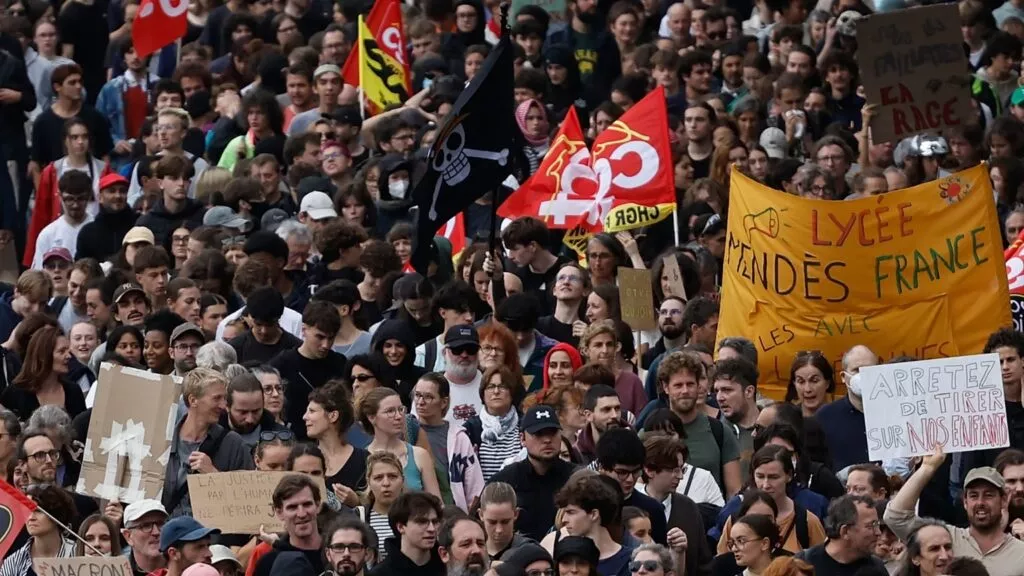
From France to Belgium, Italy and Spain, young people are protesting against a system that has priced them out of a future. The far right’s response is to demonise the left rather than confront its own political failures.
Europe’s political establishment has a familiar response when young people take to the streets: condemn the disorder, demand obedience and blame the usual suspects on the left. It has become a convenient strategy.
Young people taking the streets over the last weeks have been protesting unaffordable housing, wages struggle to keep pace with essential expenses, public services are under pressure and the prospect of a secure future feels increasingly remote. These grievances are not the invention of some shadowy revolutionary conspiracy, they are the consequences of political choices.
And yet, as demonstrations spill into the streets and anger sometimes erupts into violence, Europe’s political elite would rather manufacture an enemy than confront the conditions that brought people there.
A generation denied its future
The unrest unfolding across Europe is not one unified movement, nor does every protest have the same cause. But there is a recognisable thread connecting the demonstrations: the growing gulf between what ordinary people need and what their political systems deliver.
In France, student protests over school conditions and education have intersected with wider anger over the cost of living. In Belgium, demonstrations have brought discontent over living standards and public services into the streets. In Italy, protesters have confronted rising rents, low wages and inadequate public provision. In Spain, housing remains a particularly urgent battleground, with younger generations struggling to secure homes of their own.
Healthcare, housing, jobs and education should be the foundations of a decent life. Instead, too many young Europeans experience them as obstacles in a permanent struggle to stay afloat.
A young professional at the protests told en.philenews, “Now, in Italy, like in most European countries, you have a disproportionately larger and richer older generation, compared to a smaller and poorer and younger generation dictating policies.”
“We therefore spend around 20% of our GDP on the pension system, the largest portion of our welfare expenditure, however, during my studies I just saw continuous cuts in the education system leading to opportunities for younger generations slashed. The optimism of an affluent society my parents had is simply nonexistent in our time,” he added.
It evident that discontent leads these pan-European protests as governments fail to offer convincing answers and solutions. Young people are entitled to ask why they should trust a political class that tells them the economy is resilient while their own prospects deteriorate.
Defending protest does not mean defending violence
None of this requires romanticising every act committed in the streets. Looting shops, attacking people and destroying public buildings are not acts of social justice. Those who exploit demonstrations to steal, intimidate or inflict violence undermine the very causes they claim to advance. Their actions can frighten communities, damage livelihoods and hand reactionary politicians precisely the images they need.
Small businesses and ordinary workers should not be made to pay for the recklessness of opportunists, neither should peaceful demonstrators be expected to defend every act committed under the cover of a protest.
But there is also an equally dangerous dishonesty in allowing images of broken windows to eclipse the grievances of hundreds of thousands of people. Disorder makes for dramatic television, a young person’s inability to afford housing rarely does.
A responsible political response must distinguish between peaceful protest, legitimate civil disobedience, criminal violence and the opportunistic exploitation of public anger. Treating them as interchangeable serves neither justice nor public safety.
Europe cannot police its way out of a political crisis
Europe’s young people need affordable homes, decent work, functioning schools, accessible healthcare and wages that allow them to live rather than merely survive. Most of all governments need to invest in public services and recognise that a society cannot remain stable when an entire generation believes its future has been mortgaged. More police, tougher rhetoric and sweeping accusations against the left may temporarily reassure those who mistake silence for stability.
The choice facing Europe is not between unquestioning obedience and permanent disorder but between confronting the social conditions driving anger and allowing the far right to weaponise that anger against democracy itself.
And the events in Serbia offer a striking example of how that anger can translate into political change. On Sunday night, Aleksandar Vučić conceded defeat in parliamentary elections to the student-led opposition movement, after nearly two years of protests fuelled by demands for accountability and anger over corruption. The result suggests that when young people organise around a demand for change, the ballot box can become a powerful instrument for challenging an entrenched political establishment.
Europe’s political leaders would do well to remember that a protest is not merely a public-order problem, it is a message about the state of society. When young people can no longer afford a home, cannot rely on public services and see little prospect of a secure future, the question is not simply why they are marching but why those in power thought they could carry on as if they would not.
(Sources: European Parliament)
Read more:

