


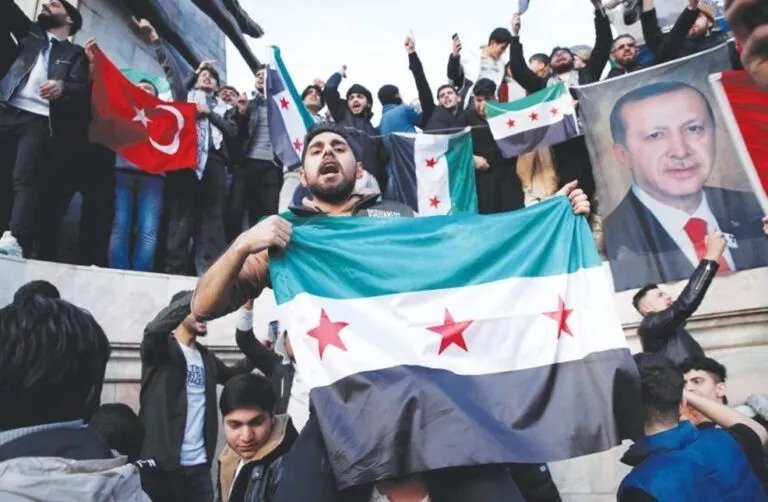
The European Council meeting in Brussels today will focus on Turkey’s role across various domains. EU leaders will examine Turkey’s conduct both under the enlargement chapter and through discussions about the broader Middle East situation, particularly Syria.
Cyprus has already laid the groundwork, with President Christodoulides arriving at the European Council with extensive notes following his recent communications with regional leaders to gather views and assessments about Syria and the wider situation.
The Turkey chapter holds particular significance for Cyprus, both regarding the conclusions’ content (which Nicosia views positively) and Turkey’s actual or attempted role in Syria following the Assad regime’s fall.
Foreign Minister Constantinos Kombos, speaking to Sky News during his Tuesday visit to London, expressed hope that Turkish influence would not worsen the situation in Syria.
He emphasised that “we must ensure that Turkey’s attempted influence in Syria does not create even worse situations”.
Kombos added that “the sensitivities of all other countries in the region must be taken into account”. He referenced attacks against Kurds and described a “very fluid situation” requiring careful handling and appropriate messaging.
When asked by the journalist whether he would support creating a Kurdish homeland in “protected territory”, Kombos responded that “regional stability depends on Kurds being able to exercise their right to self-determination in a way that is constructive for Syria and the entire region”.
He addressed the need to end ongoing attacks against Kurds and called on the international community to ensure a regional balance of power that would guarantee an “inclusive” Syria.
Kombos spoke of a “window of opportunity” in the region that must be utilised, while warning of the high risk of Syria potentially collapsing into situations witnessed in recent years.
“We need an inclusive, open, transparent and autonomous process leading to power transition, certainly without third-party interference”, he noted.
Regarding direct contact with Syria’s de facto new leadership, he advised careful consideration when deemed necessary, without legitimising the new leadership until developments become clearer and assurances of transparent power transition with respect for minority rights are secured.
“We are still at the beginning of this situation… it remains very fluid”, the Cypriot diplomatic chief observed.
When questioned about Russian money flows through Cyprus, Kombos responded that the question pertained to past issues no longer relevant to the Republic of Cyprus.
He referenced the presence of American officials in Cyprus assisting with related investigations and Nicosia’s full alignment with the EU’s 15 sanctions packages against Russia.
On Gaza ceasefire questions, the Cypriot Foreign Minister stated, “There is a need for immediate ceasefire in Gaza and immediate release of hostages”.
He noted the EU’s call to resume negotiations and commented on apparent developments in this regard, hoping for a positive outcome. Referring to events in Gaza, Lebanon, the Red Sea and now Syria, he finally described a “very dangerous situation”.
In preparation for the European Council, President Christodoulides held telephone conversations with Jordan’s King and Egypt’s President.
According to the government spokesman, President Christodoulides and King Abdullah II discussed developments in Syria and the role of Cyprus and Jordan as stability and peace factors. Letymbiotis said the leaders discussed potential joint actions regarding proper management of the unfolding situation in Syria and the region.
They analysed possible implications for neighbouring countries and the EU, considering the meeting held in Aqaba, Jordan, about Syria’s future and ahead of the upcoming European Council where this issue will be discussed.
On Tuesday, President Christodoulides spoke with Egyptian President Abdel Fattah al-Sisi. Their conversation primarily focused on recent developments in Syria ahead of the European Council meeting, where the issue will be discussed following President Christodoulides’s request to the European Council President.

