


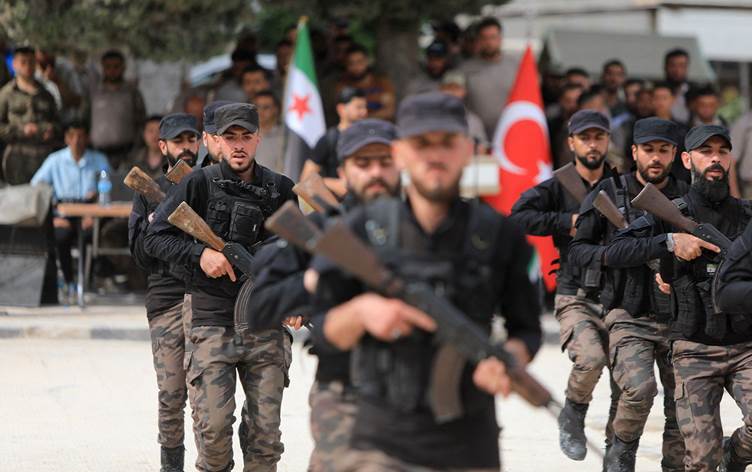
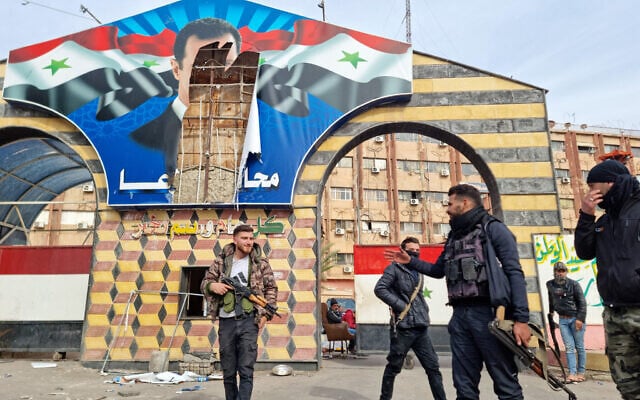
The fall of Bashar al-Assad was thunderous. In less than two weeks, the regime collapsed, creating entirely new conditions for a country that has been embroiled in a devastating civil war for a decade, with enormous human casualties and massive material destruction.
The path forward remains even more uncertain. What’s clear is that the disparate forces that ousted the Syrian dictator must now find common ground, given that their positions and ambitions have different starting points.
In an interview with Phileleftheros, Zenonas Tziarras, Lecturer in Turkish and Middle Eastern Studies at the University of Cyprus, discusses the new challenges emerging and how the removal of a regime that ruled the country for half a century has whetted the appetite of many who are vying for new roles and greater influence. The big question is whether Syria will remain a unified country. “There are decentralising tendencies within the country but also strong views from various international actors about maintaining territorial integrity. In this context, federation is more likely than fragmentation and complete border redrawing,” he says.
At the same time, all players are weighing gains and losses, with developments being influenced by relationships between regional actors and countries like the US and Russia who are claiming roles in the region. For Tziarras, Iran is clearly among the losers in these developments, as is Russia, whose future bases in Syria remain uncertain. On the other hand, developments are positive for Israel, which found an opportunity to further weaken Syria’s military capabilities, and Turkey, which is enhancing its regional power. However, managing the Kurdish issue will be a crucial point for Ankara.
Will Syria remain united or will it break into separate pieces? In case of division, how will the map be shaped, what regions or statelets might we see emerging?
It’s impossible to know exactly what will happen with Syria in the coming period. What we do know is that there are decentralising tendencies within the country but also strong views from various international actors about maintaining territorial integrity. In this context, federation is more likely than fragmentation and complete border redrawing. And while there are thoughts about creating separate zones for Sunnis, Shiites, Christians, Kurds and Druze, the two clearest zones at the moment are between western and eastern Syria. That is, between the Kurds in the east and the transitional government in the west, while we also have the Turkish-controlled zone in the north.
Much will depend on developments on the battlefield (the clearing of territorial zones) and the potential creation of a new constitution. The example of Iraq’s federalisation with the 2005 constitution and the incorporation of Iraqi Kurdistan as a constituent state in the Iraqi federation could be an example of how things might evolve. It’s difficult to imagine a Syria without some guarantee for the Kurds, because both the Americans and Israelis have interests in this.
Who will take power in the post-Assad era? Can all these disparate groups that fought the regime stay united or will we see a new civil war emerging from within a civil war?
It’s clear that the transitional government has been taken over by Hayat Tahrir al-Sham (HTS) and more specifically the Syrian Salvation Government established in 2017 in Idlib. HTS chose to assimilate rather than dissolve the regime’s institutions, thus acquiring a mechanism, albeit truncated, for governing the country. In this way, it avoided alienating those who worked in state institutions, who largely belonged to Bashar al-Assad’s Alawite community, and helped legitimise the new government. The transitional government, which has a mandate until March 2025, bears strong imprints of Syria’s Muslim Brotherhood and therefore – at least theoretically – has support within broader Sunni anti-regime forces. In the coming months, the prospect of holding elections and possibly creating a new constitution will likely be discussed.
The fact that there are dozens of anti-regime forces certainly makes the whole endeavour difficult, but Ahmed al-Sara (Mohammed al-Jolani), leader of HTS, has a history of suppressing those who opposed his project to create the Syrian Salvation Government in Idlib, including Al-Qaeda in its evolved form as the Hurras al-Din organisation. So his intention is to create the conditions for internal security and stability even if this means confronting groups that want to undermine him. This will take time, but we must also remember that the transitional government currently enjoys considerable legitimacy internally because for Syrians it carries the hope of change. There are also already signs of normalisation of HTS’s relations with the Alawites of Latakia and the Sunni forces of the southern front. How Jolani and the new government conduct themselves will be crucial for maintaining or collapsing any stability and positive outlook.
How can Syria’s reconstruction and peaceful governance be achieved when among those claiming dominant positions are jihadists, extremists and people who carry the legacy of terrorism and the Islamic State?
Jolani’s effort to restructure the image and political programme of his movement, seeking to shed the weights of the past, has led him to confront even violently the phenomena of Salafist jihadism and particularly the principle of takfirism, that is, the targeting of individuals and groups because of their religious “apostasy”. The first victims of this approach are Shiite Muslims (as “heretics”), non-pious Sunni Muslims (by Salafist standards), and then non-Muslim communities.
Both the violent suppression of these elements and the systematic issuance of decrees prohibiting such practices have so far differentiated HTS’s practice from Al-Qaeda and the Islamic State, except for some exceptions from groups that operated autonomously. If this approach is maintained and, even more importantly, reflected in the new constitution, there is a possibility that the new regime will be authoritarian and Islamic but with some degree of tolerance towards Syria’s other communities. This is what the transitional government is signalling. Let’s not forget that the need for international legitimacy is enormous and for this purpose, jihadist phenomena cannot be normalised in the new government.
Will Assad’s fall limit Iran’s influence in Syria? What will be the consequences and what does this mean for the balances that had been created in the Middle East?
Bashar al-Assad’s fall doesn’t just limit Iran’s influence in Syria but, in conjunction with the dramatic weakening of Hamas and Hezbollah, it cripples the so-called Axis of Resistance and Iran’s Shiite power projection in the region. We’re talking about the strongest blow that Iranian strategy has received since the theocratic regime took power in 1979. As a result, other players like Turkey, Israel, Qatar and Saudi Arabia are strengthened, as well as American strategy in the region. Generally, Turkey appears to be replacing the vacuum left by Iran in the new balance of powers.
Besides these countries, who else benefits from Iran’s weakening in Syria? And what does this mean for the informal battle for influence with Saudi Arabia and other Sunni states in the region?
Apart from Shiite actors (former Assad regime, Shiite forces in Iraq, Hezbollah, Houthis, etc.), Hamas (which is a Sunni organisation), Russia and China, Iran’s weakening serves all other players. Confronting Iran is among US strategic priorities and one of the reasons they’ve been building a new security architecture in the region in recent years, including through the Abraham Accords – the normalisation of relations between Israel and the Arab world.
Israel appears to be a major winner so far, not only due to Iran’s weakening but also the opportunity it was given to deploy forces in the Golan Heights, in the Disengagement Zone agreed between Israel-Syria in 1974, and along the Syria-Lebanon border. The Turkey-Qatar relationship remains strong and one could say it’s strengthened after the events in Syria, as both countries appear to have influence in the new government. Saudi Arabia and the United Arab Emirates also have important roles in developments despite being opposed to Turkey and Qatar’s interests in Syria due to their traditional concerns about the Muslim Brotherhood and jihadist organisations.
In any case, all Arab, Sunni countries have reasons to want the new government in Syria to succeed (even as an Islamic authoritarian government, perhaps resembling a regime like Saudi Arabia’s) and stability to be restored, whether these reasons relate to confronting Iran, the Palestinian issue, security matters, economics and drug trafficking (where Syria played a major role), or energy markets and routes.
The Kurdish Question remains a puzzle
Without Assad, Russia loses one of its closest allies in the Middle East. Will this undermine its presence and ability to project power in the region?
Russian influence projection in the Middle East is currently in full retreat. The key issue for Russia is to manage to maintain its bases in western Syria (Latakia and Tartus), and for this purpose it appears to be negotiating with the new government in Syria. If it fails to secure them, Russian power projection in the Middle East and Africa will face significant challenges.
Does Assad’s fall strengthen Turkey’s efforts to advance its geopolitical agenda? Why is it considered among the winners?
Turkey is clearly among the winners because with recent developments, the strategic goals it had pursued in Syria since 2011 have largely been achieved. First, Assad was overthrown and a government with strong Muslim Brotherhood influence was established, as Turkey wanted from the beginning. However, the extent to which the new government will align with Turkish interests remains to be seen. Second, it managed to expel Kurdish forces (and around 250,000 Kurdish people) from western Syria to east of the Euphrates. This means Kurdish presence is now largely confined to eastern Syria. Third, it has begun massive resettlement of Syrian refugees from Turkey to Syria, with the cooperation of the new government. This will help Tayyip Erdogan politically within Turkey. Fourth, it played a role (through its involvement with Syrian anti-regime forces) in crippling Iranian influence, which was appreciated by the Americans. Currently, Turkey is the only Western partner with this kind of involvement in Syria. Fifth, Turkey will have a say in how the next day is shaped, both as a Western partner and as a “guarantor power” of Syria along with Russia and Iran through the Astana format. Sixth, it will likely play an important role in Syria’s reconstruction through the involvement of Turkish companies. Beyond these, Turkey’s role is being upgraded within the Muslim World, Eurasia, and in the context of the Palestinian issue. This development can be seen as another step in Turkey’s rise in the international power hierarchy.
What do these developments mean for the Kurds? Are they one step closer to their own autonomous state or will this just bring them more hardships and problems?
The Kurds have already lost territory in western Syria and are under pressure in the east. Turkey’s operations with pro-Turkish forces, which began about three days after HTS’s advance and continue, aim to seal the Turkish-Syrian border with a “security zone” in northeastern Syria that will extend the previous zones Turkey created with its interventions in 2016, 2018 and 2019. This can be imposed by Turkey or serve as a negotiating card. The US and Israel support the Kurds, but they can no longer do so without taking Turkey into account. Turkey doesn’t want a Kurdish statelet, while the Americans and Israelis do.
However, the golden mean might be found in a) which and how much territory the Kurds will control, but also in which Kurds will be at the head of a Kurdish statelet. There has already been a ceasefire agreement for the city of Manbij (west of the Euphrates) where the Syrian Democratic Forces, majority Kurdish, have withdrawn. Turkey’s goal through negotiations with the US is securing its border with eastern Syria, which is why related developments shouldn’t be ruled out. However, Turkey’s main problem is the significant role of Kurdish PYD/YPG forces, an offshoot of the PKK in Turkey, within the Kurdish administration. What Turkey seeks is the removal of these forces it considers terrorist from a potential statelet. It could much more easily coexist with Kurdish forces of different mindsets, such as the Kurdish Democratic Party of Iraqi Kurdistan, whose Syrian branch however has no power.
Read more:

