


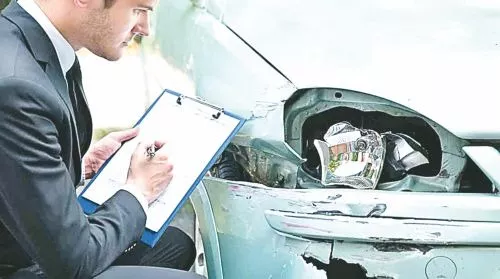
Phileleftheros senior reporter Vasos Vasiliou reports nothing less than ‘shock and awe’, as he uncovers a network of organised scammers from a number of professional groups connected to vehicle insurance, who cooperate and coordinate in orchestrating accidents to share in the compensation, setting up an elaborate criminal scheme.
The operational scope of those implicated in these staged incidents appears to be island wide, but branching out from one province in particular, where the situation appears out of control. Beyond the masterminds organising these deceptions, professionals active in vehicle repair, simply put, garage mechanics, also seem to share in the criminal spoils. According to the Phileleftheros sources, the tentacles of this illicit activity have no limit, with accident “eyewitnesses” reportedly complicit in fabricating accounts to suit the needs of the network.
Insurance companies are estimated to pay out several million euros annually for these contrived accidents. Claims and compensations can reach many thousands of euros in each particular case.
The dark side of vehicle insurance was pushed in the public sphere and began to gain traction following a bill proposed by DISY (Democratic Rally) MP Dimitris Dimitriou. It stipulates the relocation of vehicles in the event of minor accidents, a measure that appears to have garnered the support of the majority of MPs. This is largely due to the anticipated reduction of lengthy time delays for thousands of drivers. Even minor damage incidents currently cause significant traffic congestion and in several cases, road rage, as drivers involved wait for insurance reps.
The proposed bills calls for vehicles to be moved after drivers have photographed the scene, thereby clearing the road for traffic flow.
Responding to further Phileleftheros enquiries, Dimitriou referred to the issue of staged accidents as ‘minor’ and one that should not impede the urgency of alleviating this daily problem, as thousands are late for work, taking children to school and professional appointments. Furthermore, once the road is eventually cleared, there is a risk of further, potentially more severe, accidents occurring as drivers resort to speeding to make up for lost time.
Assuming a smooth progression, the proposal is set to be approved by July, before Parliament adjourns for summer recess.
Cyprus Insurance Association Director General Andreas Athanasiades told Phileleftheros that the professional sector was becoming increasingly concerned about the rising number of orchestrated fraudulent incidents and consequently apprehensive as to whether the option of moving vehicles should be granted in all circumstances.
‘We believe’, he added, that “the relocation of vehicles in minor accidents where a driver hits the vehicle in front, is a significant concession by insurance companies, as these incidents constitute the bulk of collisions’. Athanasiades proposes that removing vehicles from the street is limited to these specific cases to prevent possibility of fraud.
“Insurance Fraud Cases Will Surge”
Athanasiades referred Phileleftheros to the memorandum submitted by the Association to Parliament, which also addresses the “difficulties in implementing” the proposed law (on removing vehicles). The memorandum outlines the following:
“The absence of preconditions for the relocation of vehicles will enable certain individuals to exploit the situation and attempt to evade responsibility by altering or distorting the accident details to the detriment of others. Simultaneously, it is considered a certainty that insurance fraud, a phenomenon that has already reached alarmingly high levels, will rise further.”
“I would prefer not to elaborate extensively, but I assure you that we are facing a serious issue with staged accidents, and the cost amounts to millions”, the Insurance Association Director General further noted.
Two Categories of Staged Accidents
Regarding the modus operandi of staged accidents, Phileleftheros contacted insurance professionals who spoke of two staging categories: those where claims reach up to €10,000 and those where compensation sought ranges from €50,000 to €60,000. The latter typically involves more expensive vehicles and is usually more meticulously orchestrated. In these instances, the two drivers and the garage mechanic (drawing up the inflated damage report) may be involved, along with a so called ‘eyewitness’, willing to perjure themselves.
One aspect that concerns insurers is that some of these vehicles appear to be involved in more than one accident. Following the initial incident, the vehicle is insured with a different company and at some point is involved in another accident, with claims being filed against the new insurer.
Insurance companies cite an issue of communication here. But why? These vehicles are insured for “third-party liability” only, and therefore, in such cases, they are not registered in a single database, making it impossible to immediately recognise a prior accident and take appropriate measures.
Nevertheless, parliament appears determined to proceed as traffic congestion caused by minor accidents has become a daily scourge.

