


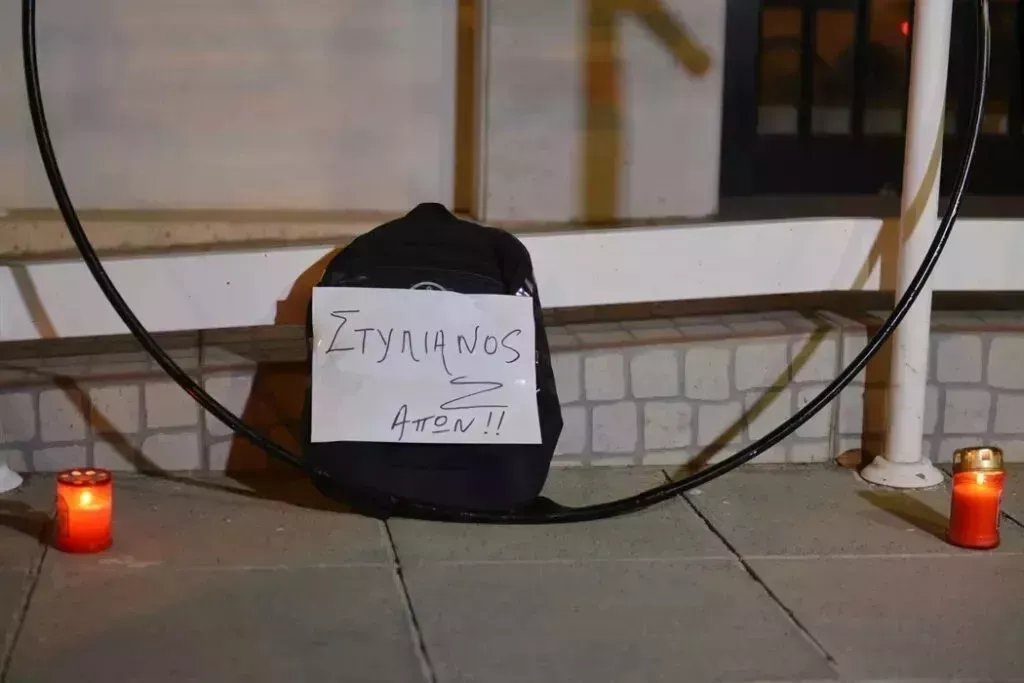
Stylianos, who died aged 14 in September 2019, had told school staff about violence he was allegedly suffering at home, a witness told the Nicosia District Court on Monday.
The witness, A.Th., a former special education liaison officer at his primary school, said school was the only place the boy felt safe. She was testifying at the trial over his death.
According to information reaching the school, the child had allegedly been subjected to physical and psychological violence, she said. She told the court about alleged beatings, reports of animal cruelty in his presence and the school’s repeated efforts to secure support for him.
The school’s role was mainly to help with Stylianos’s learning difficulties, the witness said, but the information reaching teachers showed the need for wider intervention to protect and support him.
She said Stylianos was the only child who grew sad as the end of the school day approached, adding that a child who does not want to go home is telling staff something.
Alleged abuse
The witness said she had been told by the boy’s speech therapist that he had arrived for a session in pain and unable to sit down. According to her testimony, he told the therapist that his father had beaten him with a belt the previous evening, and he had marks from the beating, according to the same account.
Stylianos confided in his teachers, his speech therapist and his carer, she told the court. She testified that he had said his father hit his mother in the stomach when she was pregnant, made him work in the animal pen and drowned lambs in front of him.
Her handwritten notes, submitted to the court, also recorded that the father allegedly hit Stylianos on the soles of his feet so as not to leave marks. She said this information had come from the boy’s teacher.
School as a refuge
The witness also described an incident in May 2013, when, she said, the then head teacher told her that Stylianos had been hit by his father and had left home.
She contacted the Social Welfare Services, and an officer arrived at the school about half an hour later, she said. The officer and the boy’s mother then went to the local police station, where a written complaint was filed against the father.
Stylianos spent the whole night away from home and returned to school alone the next morning. School, according to the witness, was the only place he felt safe.
She said it was the first time she felt the obvious was being done, and that she had sent a letter of thanks to the officer’s supervisor. Similar immediate action should have been taken in earlier cases, she added.
The mother’s response
According to the witness, the mother denied the boy’s accounts of violence and maintained that conditions at home had improved.
Handwritten notes of a meeting on October 17 recorded that Stylianos said he preferred the days he went to school. The same notes recorded the mother as saying that her husband did not hit her, had not kicked her in the stomach and had not drowned lambs.
The witness said the mother called Stylianos a fantasist. According to her notes, the mother had been told in a conversation that her attitude was making the child appear to be a fantasist.
The mother told those involved that they were trying to break up her family and did not want to report her husband, as she feared the consequences for herself and her children, the witness testified. Efforts were made to persuade the mother to leave her husband with the children, but she did not agree, believing she would not be able to cope with the difficulties she would face.
Psychological support
The mother had initially been persuaded to take Stylianos to a clinical child psychologist, the witness said, but at a later multidisciplinary meeting on December 3 she was recorded as refusing to take him to a child psychiatrist.
The witness said it had been found in November 2014 that the boy still needed psychological support, which the mother was not providing. The mother told her the family had financial problems and could not even afford fuel to take him to the psychologist.
The witness said she was in regular contact with the school about the boy’s condition but saw no real change, which she attributed to the parents’ attitude.
Complaints about welfare officer
The witness also complained about the handling of the case by Social Welfare Services officer F.K., the third defendant. She said she found it difficult to reach her and often received a reply only after several days.
When she informed the officer of an incident involving Stylianos, the officer replied that she would now see what to do, and the response was not immediate, the witness told the court.
Asked by the prosecution whether she had complaints about the officer’s handling, she replied: “Yes. She did not do what I felt she should have done for this child.”
She added that she often could not reach the officer by phone and that in several cases the officer called her back days later, raising her concern that it might by then be too late.
A bundle of her handwritten notes was submitted to the court, recording the boy’s behaviour, family circumstances, difficulties in working with the parents and contacts with the relevant services.
The hearing will continue on November 4, 2026, at 11am.
Information from Cyprus News Agency

