


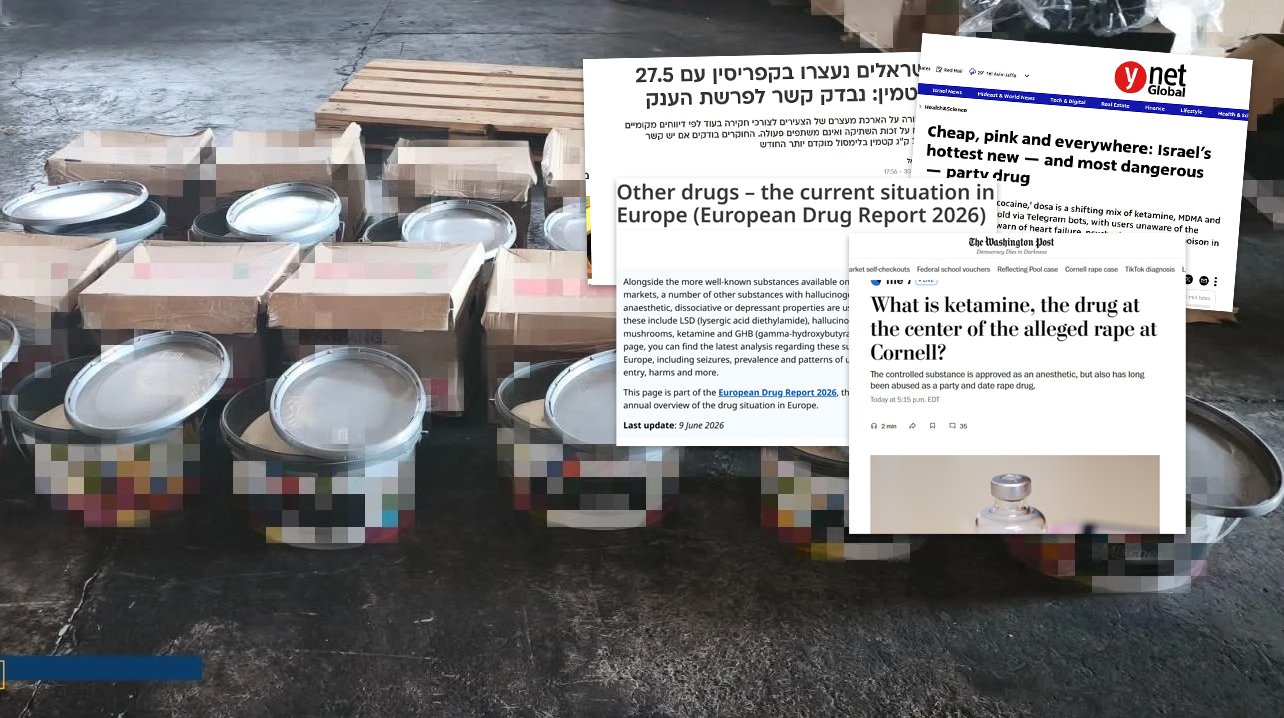
Cyprus’s Anti-Drugs Unit (YKAN) has clear indications that two ketamine seizures in Limassol last month are linked, according to information obtained by Phileleftheros. One of the two was the largest ever recorded on the island.
Evidence has emerged supporting the theory that the traffickers in both cases are connected, the newspaper has learnt. Meanwhile, suspicions are growing of an organised ring moving ketamine through Cyprus to Israel, possibly to make “pink cocaine”, or tusi, for the Israeli market.
Investigations so far show the ketamine came from Germany and reached Cyprus through a port. Shipments then appear to leave the island on luxury yachts for Israel. There, the drug is believed to be used to make pink cocaine, a dyed powder often taken at parties. Israeli media reports support this, including a Yedioth Ahronoth story on February 22. They also show that ketamine and pink cocaine use is a matter of public concern in Israel.
Ketamine, the key ingredient in pink cocaine, is a Class B depressant and one of the so-called date rape drugs.
The cases
On September 12, YKAN found about 126.9 kg of ketamine at two homes in Limassol, along with smaller amounts of other drugs. It arrested four people: two Israelis aged 53 and 51 and two Palestinians aged 50 and 31. Two days later, the investigation led to a Limassol warehouse holding about 260 kg more, bringing the total to about 390 kg.
On September 29, the 50-year-old Palestinian and the two Israelis were sent for trial before the Criminal Court. The trial is set for December 3.
The same day, 17 days after the first seizure, YKAN found 27.5 kg of ketamine in a Limassol flat. The flat also held 776 g of mephedrone, 269 g of MDMA, 172 g of cocaine, 377 g of cannabis and about 10,000 euros. YKAN arrested two Israelis aged 23 and 24, who had arrived in Cyprus on September 20. On September 30, a court remanded them in custody for eight days.
The cases have also been reported in Israel. On September 30, the news site walla.co.il published a detailed account of the developments and arrests.
The first seizure amounted to about 800,000 doses, according to figures YKAN head Christos Andreou released on September 15. Phileleftheros compared that quantity with a ketamine case decided by an Israeli court, and estimated the haul could be worth up to 25 million euros. The newspaper described this as a conservative figure. Drug prices vary by market, and the value would rise if the ketamine were turned into pink cocaine.
On October 2, The Washington Post reported on a 2024 rape case at Cornell University in the US in which ketamine was allegedly involved.
EU wastewater data
Ketamine use is rising in Europe and has put law enforcement on alert. Phileleftheros cites this as one reason the Cyprus seizure has international significance. The latest wastewater analysis by the European Union Drugs Agency (EUDA), published in March, found that ketamine and cocaine use is rising sharply while MDMA use is falling steeply.
The EUDA found that “9 cities, located in Belgium, Cyprus, Lithuania, Hungary and Slovenia, reported no detection of ketamine residues”. Cyprus and Italy recorded far lower amphetamine levels than other countries, with the highest levels in northern and central Europe.
Methamphetamine was traditionally concentrated in Czech and Slovak cities. It is now also present in cities in Cyprus, Germany, Spain, Lithuania, the Netherlands, Norway and Turkey, the agency said.
The analysis tested wastewater from 115 cities in 25 countries, serving 72 million people. Samples were taken daily for a week between March and May 2025, and were tested for five stimulants and cannabis. All six substances were found in almost all participating cities.

