


By Nikos Kotzias, Former Minister of Foreign Affairs of Greece*
The UN records of the Crans-Montana dinner, published in Cyprus, rest on notes Espen Barth Eide made on the final evening—with deliberate choices. He has no hesitation putting his own views into UN Secretary-General António Guterres’s mouth.
Eide tries retrospectively to appear neutral, yet he’s known for his special relations with Turkey. Unfortunately, the Republic of Cyprus allowed him to remain a UN negotiator-mediator despite Greece’s objections. He harmed not only the negotiation itself but also its truths.
The Çavuşoğlu-Guterres quarrel
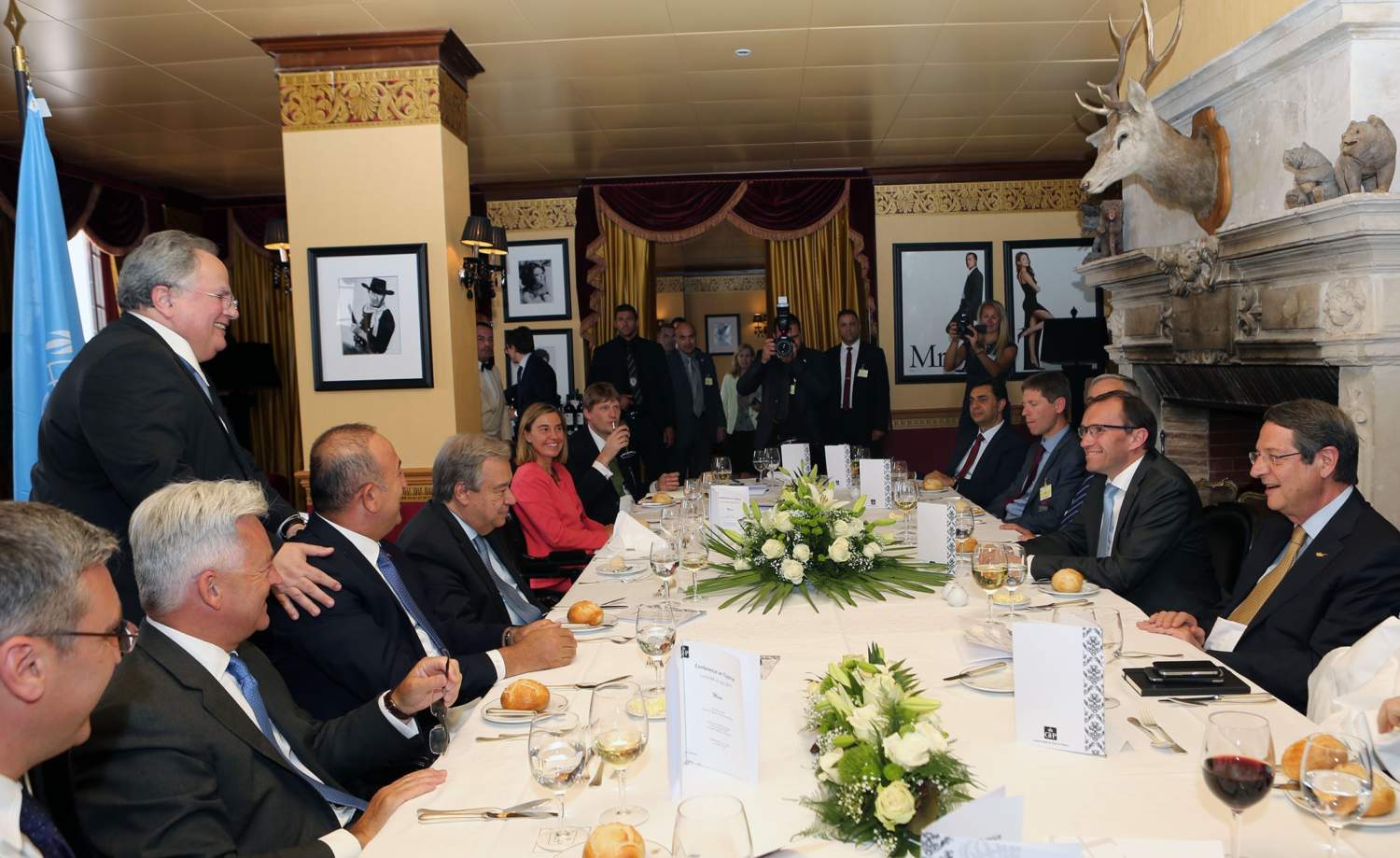
Eide’s main “correction” erases the intense confrontations between Çavuşoğlu and the UN Secretary-General, when the former called the latter a liar. This quarrel was why Guterres declared the negotiation over. During dinner, the UN SG invoked Çavuşoğlu’s agreement from their bilateral meetings at Crans-Montana—abolishing guarantees and adopting a withdrawal procedure for occupation troops.
Çavuşoğlu had received new instructions that afternoon from Ankara-Erdoğan, under pressure from the far-right MHP connected to the “Grey Wolves” who prevented an emerging agreement. Instead of admitting he’d changed position or received new instructions, he insisted he never said what Guterres claimed.
For half an hour, the UN SG insisted the exchanges were exactly what he’d presented. Eventually, Guterres closed the negotiation with irony: apparently, according to the Turkish Foreign Minister, he—the UN Secretary-General—hadn’t understood what he heard, so further conversation was pointless. Eide conceals this lengthy episode entirely. He conceals the most substantive incident and dialogue of Crans-Montana.
Eide “absolved” Turkey
Eide seeks retrospectively to rewrite reality and absolve Turkey from responsibility for the dinner’s “dissolution”. He doesn’t manage to hide substantial aspects of reality: Turkey wanted to maintain, if not expand, what it considered existing intervention rights, and keep the occupation army in Cyprus. Çavuşoğlu had the apparent consent and encouragement of Akıncı, to whom the Turkish FM variously expressed satisfaction.
Eide also tries to hide the UN SG’s central idea. What was this? Adopting the “Kotzias proposal” from 2015—that at the end of whatever agreement, with whatever timetable, Cyprus would become “a normal State”. This central idea, which António Guterres persistently supported at dinner and stated publicly many times, has vanished from these notes-“records”. Nothing is accidental.
What Eide didn’t erase were Çavuşoğlu’s “red lines”. The most likely reason: Çavuşoğlu requested it to ensure Turkey’s far-right coalition partner would be satisfied. Even in Eide’s notes it’s revealed that for Turkey, maintaining guarantees and keeping the occupation army constituted its immovable “red line”. The personal attacks against me from various people in Cyprus serve not simply Eide’s and Turkey’s narrative but above all the Turkish far-right—absolving them de facto from responsibility for the dinner’s outcome.
Goal: a normal state
The question for the SG was how we’d reach “a Cyprus as normal state member” of the UN. His thinking: Cyprus couldn’t continue under a third-party guarantee regime that possessed “intervention rights” or occupation troops. Cyprus would be the common homeland of Turkish Cypriots, Greek Cypriots and all other Cypriots—no longer a state under occupation or where fear of “guarantee” abuse hung over it.
Everyone had agreed on this the previous day and at lunch before dinner. The Turkish FM, however, backed down with new instructions from Ankara. Precisely because this agreement appeared to exist, Cyprus and Greece proposed establishing “a special mechanism monitoring implementation” of Turkish troop withdrawal, combined with abolishing the guarantee treaty and a separate text from the SG. All three proposals established a mechanism monitoring occupation troop removal—not monitoring something different, like the euro’s progress.
Consequently, Eide lies when his notes claim I opposed creating such a committee. We’d already submitted Greece’s proposal for its establishment and operation, similar to the UN SG’s. Twice, the foolishly acting Eide presents me as disagreeing with my own proposals regarding the occupation army and mechanism that I’d submitted at Crans-Montana.
Monitoring Committee
What was the real difference at Crans-Montana regarding the Monitoring Committee? First: what would its object be, who would participate, through what procedure. The UK and Turkey wanted to participate as regular members. Cyprus’s and Greece’s view: since the committee’s work was monitoring Turkish troop withdrawal (all Crans-Montana texts are listed in my book N. Kotzias: Cyprus 2015-2018, 175-267), the guarantor powers couldn’t participate as full members—they, particularly Turkey, would be subject to this committee’s control. Never in the International System are the inspected also inspectors. Another difference: the committee’s rights regarding knowledge and control of armaments.
The second significant difference: institutional connection. Turkey wanted any monitoring committee to supplement the Treaty of Guarantee, which shouldn’t be abolished. Conversely, the UN SG’s, Greece’s and Cyprus’s proposal: abolish the Treaty of Guarantee and withdraw occupation troops through a gradual process (as Greece’s two proposals stated, and the one submitted at Crans-Montana). This should be monitored regarding armaments leaving, where remaining forces would concentrate each time—for example, new personnel restrictions at Turkish bases in each phase, or abolishing a series of bases in each phase. Consequently, Eide talks nonsense in paragraph [10] claiming Greece didn’t want another treaty beyond the guarantee one, like “control and monitoring”, which we’d newly proposed in writing hours earlier with full terms and operating conditions.
The invitation to guarantor powers
My enemies claim we allegedly didn’t help the UN SG establish his proposals for abolishing guarantees, removing occupation troops and establishing a monitoring committee. They simply reproduce, even unwittingly, arguments from the known centres. First: all our proposals helped the goals he set. Second and most important: the UN SG’s positive positions didn’t emerge from enemies of Greek positions but from steady diplomatic groundwork we’d done for two years—we’d convinced him to adopt a large part of our proposals. I always refer to the international aspect of the Cyprus issue, where we had a say from the Treaties (Alliance, Guarantee, struggle against occupation). We never formulated thoughts or proposals on the internal aspect, which would constitute interference in the Republic of Cyprus’s affairs. Hence the stupid accusation that “Greece and Kotzias” dealt exclusively with the Cyprus issue’s international aspect (occupation, guarantees) is idiotic.
Two days before dinner, at the morning session, Eide announced he’d invited the three guarantor power prime ministers to Crans-Montana because the negotiation had allegedly advanced so much their presence was needed to close (see beginning and paragraphs 31, 34, 36 and 37 of his notes). His own proposal, in cooperation with the British Deputy FM against the British FM himself. The Greek and Turkish prime ministers had already spoken and rejected it, as did the British PM after consulting Boris Johnson. Johnson had spoken with me beforehand—we’d agreed it was Eide’s classic manipulation. The proposal was rejected at the session’s start by all sides.
What does Eide do retrospectively? He “falsifies time”. He persistently shows in his notes as if this proposal was made for the first time at dinner and as if it was the SG’s idea. Double fraud: (a) the proposal he’d made and which was rejected well before Guterres arrived at Crans-Montana, he moved to the dinner timeline, whilst (b) he presented it as if it “came out” of the SG’s mouth.
Troop withdrawal
The discussion regarding troops and my position: we must agree on occupation troop withdrawal. Regarding what the Treaty of Alliance provides, leave that to be examined at the end if needed by the prime ministers (not as Eide claims in paragraph [23]) after we’d closed all other issues. We would insist on its abolition.
In paragraph [12], Eide adds the word “immediately” regarding occupation troop removal—deliberately putting it in my mouth to serve Turkey. A word I didn’t use. Our proposal for a “Friendship Agreement” (Kotzias, 2018:217-240) and the proposal we submitted that day foresaw, logically, gradual withdrawal of Turkish occupation troops. “Immediately” didn’t mean the whole army leaves at once in one day. It meant starting withdrawal immediately—which would be gradual—whilst simultaneously having a binding time horizon with calculated duration for its termination and completion. It would be literally idiotic to suggest tens of thousands of troops leave immediately, here and on the spot. Practically impossible. And precisely because withdrawal would happen gradually with a clear end date, the monitoring mechanism we proposed was necessary. If occupation troops could “disappear” at once, such a mechanism wouldn’t be needed and we wouldn’t have made the proposal.
Abolishing the Treaty of Guarantee
Let me note: the SG didn’t say remove the “unilateral” intervention right, as Eide claims. According to the UN SG, no such right existed—abolish the Treaty of Guarantee (an observation also valid for paragraph [20]). Nor did the SG say troops should remain, as Eide cunningly presents in paragraph [14].
Paragraph [24] doesn’t record the real discussion. I asked Çavuşoğlu directly: does Turkey wish to maintain an army and what it considers the right to intervene in Cyprus? I also asked the Turkish FM whether he understands that his insistence on this issue negates the goal the SG adopted for “Cyprus as a normal state”. This was the essence of our conversation. After Çavuşoğlu’s answer, I explained once more: I’m not asking all troops leave at once. But I proposed that at the end of whatever process there shouldn’t be an occupation army in Cyprus—not one soldier. Çavuşoğlu pretended not to understand and repeated that keeping an occupation army is a red line, which from now on would allegedly be friendly towards Greek Cypriots, as allegedly the guarantee regime also would be.
That’s all for now. More in the book being written about the Cyprus issue.

