


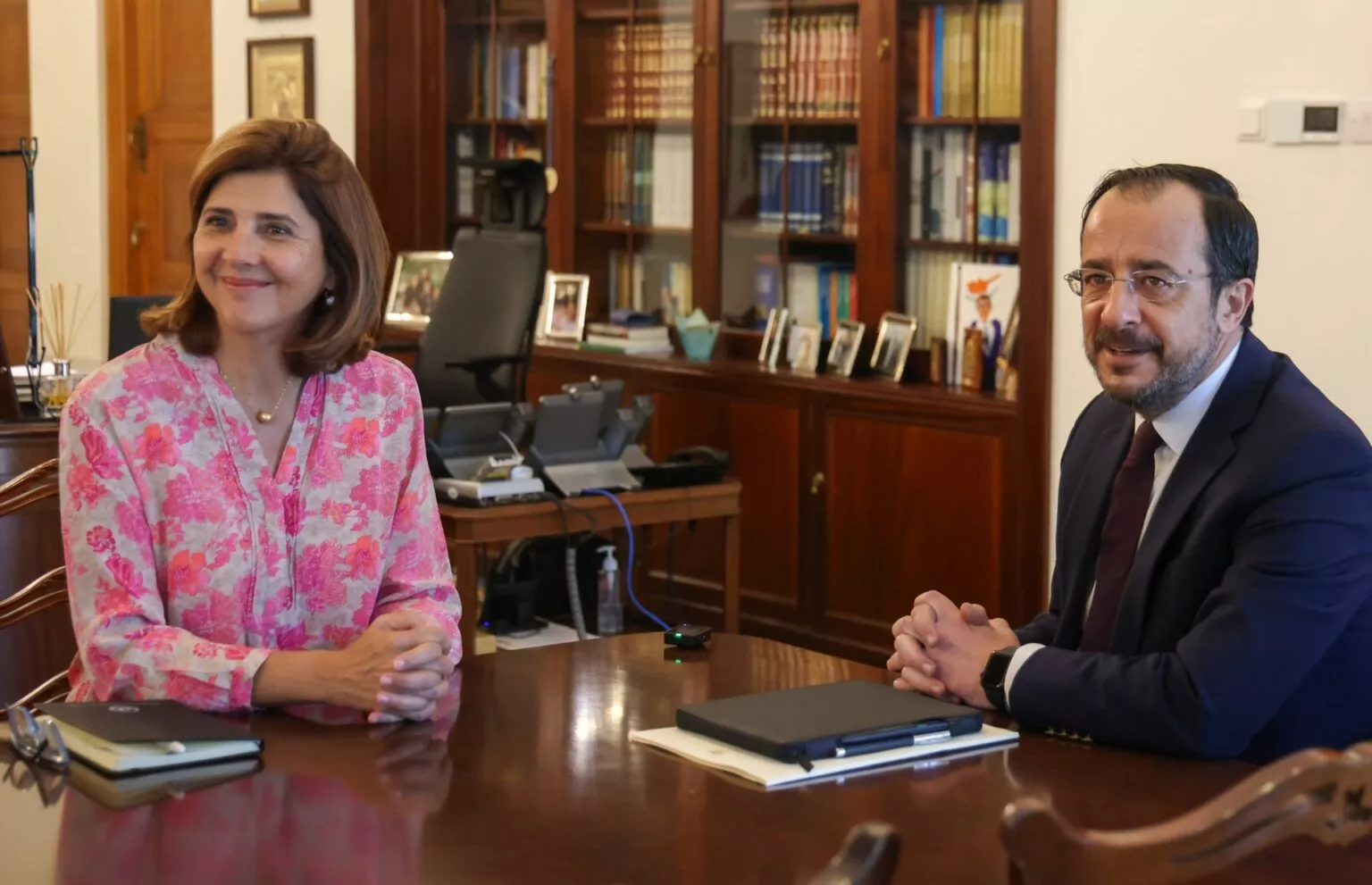
UN envoy Maria Angela Holguin Cuellar concluded her first round of contacts on the Cyprus issue with limited tangible progress, signalling a long-term process that could extend discussions for at least another year.
Holguin Cuellar’s week-long visit to Cyprus, followed by brief meetings in Turkey and Greece, failed to provide significant momentum to the peace process. The UN Secretary-General’s personal envoy demonstrated no urgency, with her next Cyprus visit scheduled for early July before the informal five-party meeting.
The envoy’s approach suggests maintaining a prolonged process designed to keep Cyprus negotiations active for an extended period.
Minimal advancement achieved
During her Cyprus stay, Holguin Cuellar’s meetings divided into three phases: sessions with leaders, negotiators, and diplomats. She spent time listening rather than actively discussing the Cyprus issue.
Comparing the results of Holguin Cuellar’s extended Cyprus visit with a brief Geneva discussion last March reveals no positive developments. Progress failed to advance even marginally towards the direction requested by the UN Secretary-General in March.
President Christodoulides demonstrated readiness to engage in substantive dialogue, according to sources. Turkish Cypriot leader Ersin Tatar used the opportunity for blame-shifting tactics aimed at blocking prosecutions against property usurpers.
A joint meeting with negotiators lasted three hours but produced no results. This marked the first time Holguin Cuellar requested to meet both sides’ negotiators simultaneously, though she only listened to detailed presentations from each side without further discussion.
Return scheduled within a month
The UN envoy showed no urgency for results, planning to return in early July. Initial expectations suggested the first contact round would include all stakeholders—Cyprus, Turkey, Greece, Britain, and Brussels—but this approach has changed.
Olguin plans to visit Brussels and London in late June before returning to Cyprus for final contacts ahead of New York meetings. This pace suggests the Cyprus process will not accelerate beyond current speeds.
Minimum possible outcome expected
All parties appear likely to attend the next informal five-party meeting in New York with minimal results related to confidence-building measures agreed in Geneva last March.
Only the bicommunal youth committee establishment has been implemented and progresses adequately among agreed measures. Cemetery restoration has begun on both sides, with environmental protection showing some advancement.
More challenging measures—opening new crossing points, demining, and the photovoltaic park—remain undeveloped. Given the pre-election period in occupied areas, dramatic developments in these three areas appear unlikely under current circumstances.
Turkish side maintains bargaining approach
The Turkish side maintains its tactical approach, preferring to negotiate until the final moment. No moves are expected before July’s informal meeting, keeping the process alive while awaiting face-to-face meetings with UN Secretary-General António Guterres.
Last March, the Turkish side remained negative until meeting the Secretary-General, then appeared conciliatory by accepting the youth committee establishment. Other agreements either followed predetermined paths or emerged from UN proposals that could not be rejected.
Nicosia continues pressure
Nicosia remains the only party with genuine intention to engage in comprehensive Cyprus discussions. This became evident in Geneva and during Holguin’s visit to Cyprus.
Despite limited visible results, the Republic of Cyprus will continue pressing all directions to achieve maximum outcomes. President Christodoulides recently referenced pre-Geneva efforts, attributing results to Nicosia’s actions rather than Turkish side stance changes.
Christodoulides appears likely to maintain this approach for the New York stage, seeking more substantial outcomes beyond a simple five-party meeting with the Secretary-General.
Upcoming meetings scheduled
The next informal five-party meeting in late July remains the only confirmed future event beyond Olguin’s activities. The Secretary-General will likely schedule the next leaders’ meeting at that session’s conclusion.
A September meeting in New York appears probable, though timing may prove challenging due to the General Assembly and Tatar’s proximity to “elections.”
The earliest post-“election” meeting would occur in November if the UN wishes to maintain momentum. This depends on the next Turkish Cypriot leader, though Tatar appears unlikely to lose unless Ankara desires change.
A new multilateral meeting before year-end and 2026 entry remains possible, considering Cyprus’s EU presidency significance.
EU presidency position clarified
Given past Turkish side use of Cyprus’s EU presidency as justification for avoiding talks, Nicosia has clarified its position to the UN that both presidency duties and negotiations can proceed simultaneously.
Cyprus noted that both sides maintain negotiators capable of producing results while clarifying that parliamentary elections will not negatively affect dialogue continuation.
These factors extend the Cyprus issue timeline by a full year before potentially enabling substantive discussions. Nicosia estimates that productive use of this period could enable genuine negotiations resumption within 2026.
Brussels visit considered pivotal
Nicosia views Holguin’s Turkey and Brussels contacts as significant. Turkey’s role in Cyprus decision-making is acknowledged, demonstrated again in Geneva when Turkish Foreign Minister Hakan Fidan led discussions with Tatar.
However, Holguin’s Brussels visit and meetings with institutional officials and EU Cyprus envoy Johannes Hahn are considered crucial. This will reveal whether the UN envoy will cooperate with Hahn to break the Cyprus deadlock and advance substantive negotiations.
The meetings will indicate whether the UN intends to change its EU approach regarding Cyprus. Previous UN representatives working for the Secretary-General showed reluctance to include EU involvement. Olguin has not indicated different intentions, though closer cooperation targeting results remains possible.
Following Brussels meetings, Hahn’s next moves toward all interested parties are expected to be determined.
Read more:

