


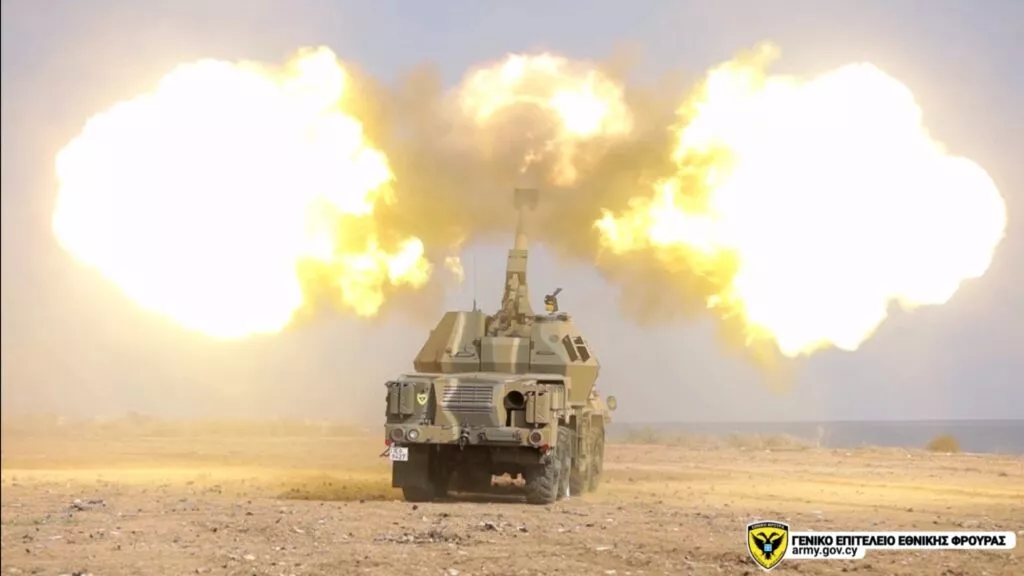
Cyprus’s defence posture continues to be shaped by the balance of forces against the Turkish occupation troops, with the National Guard’s doctrine remaining overwhelmingly defensive because of the demographic and numerical superiority of Turkish forces.
Given that the occupying army can draw, at short notice, on almost unlimited matériel and manpower, the National Guard has had to focus not on matching numbers but on creating conditions that would impose a high cost in the event of hostile action.
A key part of that approach has been anti-tank capability. Since the 1990s, the National Guard has developed strong anti-armour capacity through systems such as the French RAC 112 APILAS and HOT missiles, as well as the Franco-German Milan system. That arsenal has since been strengthened further with Israel’s latest-generation SPIKE LR2 missiles and the French Akeron MP anti-tank system.
These systems allow the National Guard to engage targets at long range with high accuracy, a capability that is especially valuable in Cyprus, where any flashpoints would, if needed, emerge over distances of only a few dozen kilometres.
The island’s limited size also shortens the reaction time for armoured and mechanised formations, making speed and flexibility more important. That explains the shift towards wheeled armoured vehicles.
As previously reported by Philenews, the National Guard general staff and the defence ministry are examining the possible acquisition of French VBMR Griffon and Serval VBMR wheeled armoured vehicles through the SAFE regulation, while American wheeled armoured vehicles from U.S. stockpiles are also under consideration.
Developments may also arise over the upgrade of the VAB vehicle fleet. La Tribune reported discussions with French company Arquus on upgrading about 80 vehicles, while another proposal from a different country is also said to be on the table. No decision has been taken so far.
If these plans are implemented, the National Guard’s mechanised forces are expected to become more mobile and more flexible than in the past.
Drones are now essential at every level and each team, platoon and company should have its own aerial surveillance capability through unmanned aircraft.
Drawing lessons from the war in Ukraine, even a low-cost device worth a few hundred euros, can prove decisive for defenders and deadly for enemy forces.
Within that framework, the National Guard has moved into the drone era. Although its first unmanned aircraft purchase came in 2019 with the Israeli Aerostar Tactical UAS, there is now a need for larger numbers at a lower cost.
A few months ago, Swarmly Aero donated the first two H-10 Poseidon unmanned aircraft to the National Guard artillery command, which is expected to be equipped with many more drones of the same type.
The push is not expected to centre on just one type of UAV or drone, but on a range of systems for different missions. The National Guard also plans to acquire unmanned surface vessels for naval command, while loitering munitions are also expected to enter the equation, giving it highly accurate strike capability.
Based on these plans, the National Guard is expected in the coming years to continue moving towards Western and NATO standards, taking on the characteristics of a mobile force with heavy firepower.
This picture also includes Cyprus’s multi-layered air defence umbrella and the modern strike capability against ships and surface units provided by the upgrade of Exocet missiles to the Block 3 version, with a strike range of 200 kilometres.
Several issues remain open, including personnel shortages, though these are on a path to being addressed through recent government decisions aimed at attracting more contract soldiers.
There is also an urgent need to resolve the problem of the National Guard’s tank fleet since it will, in the coming years, approach the point of obsolescence. On that front, discussions are underway and the preferred option appears to be Israeli Merkava battle tanks, specifically the Mk III version.
Members of the House defence committee recognised the soundness of this planning during their latest meeting and the current composition of the committee, which is expected to change after the election of the new House, has worked closely with the National Guard general staff and the defence ministry, away from party-driven considerations, with national defence as the sole priority.
(photo from National Guard)

