


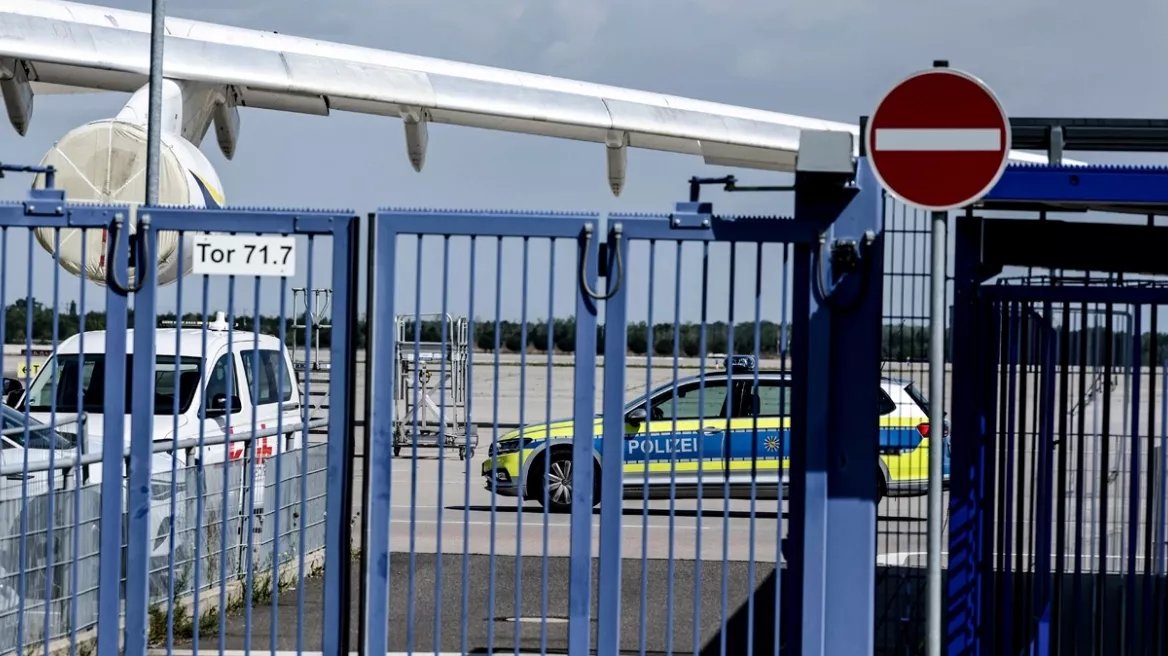
Ambassadors from all 27 EU member states have held closed-door talks in recent weeks on how to respond to a large-scale hybrid attack that could cause multiple casualties, Politico reported, after an attempted drone attack at Leipzig/Halle airport in August that Germany blamed on Russia.
Citing European diplomats and officials, Politico said EU capitals were now preparing for a scenario that until recently remained largely theoretical, and that the discussions had intensified after the Leipzig attempt came to light.
The attempted attack, using drones carrying explosives, targeted cargo planes at the airport. European Commission President Ursula von der Leyen said that, had it succeeded, it could have caused enormous damage and loss of life, describing it as an attack by Russian operatives on EU soil using “military-grade material”.
Talks without phones
The ambassadors have met in a ‘restricted format’, with no mobile phones or aides in the room. At a recent meeting, the discussion focused specifically on the possibility of an attack with a large number of casualties, two diplomats said.
The EU already has a ‘hybrid threats toolbox’ to coordinate its response to cyberattacks, sabotage, election interference and other actions below the threshold of conventional war. The question now is what would happen if such an attack caused dozens of casualties, or more.
“We have to be prepared for something serious,” a European diplomat said, adding that the Leipzig incident had shown that a very serious event that could cause multiple casualties could no longer be ruled out.
The European Council has already called on member states to urgently strengthen their resilience to hybrid attacks, including sabotage, cyberattacks and strikes on critical infrastructure.
Recent incidents
Concern in Brussels is being fuelled by a series of incidents that European and NATO authorities regard as hybrid actions.
On Tuesday, several sailors were reported missing after drones sank their ship in the Black Sea, according to Bulgarian authorities.
That followed the Leipzig airport incident, a suspicious fire at a ground station in Poland that handles Starlink communications, and a plot to plant incendiary devices at commercial transport hubs across the EU and the UK, alongside regular airspace violations.
The EU says Moscow has stepped up sabotage, cyberattacks, disinformation and other covert operations against European countries since Russia invaded Ukraine four and a half years ago. The European Council has condemned such actions and called for closer, more targeted cooperation on critical infrastructure.
Teija Tiilikainen, director of the European Centre of Excellence for Countering Hybrid Threats, warned that the more dangerous the means used to test Europe’s readiness and response, the greater the risk of casualties. “At some point, intentionally or unintentionally, this is what happens,” she said.
Response plans
Discussions in Brussels are already focusing on practical steps that could be taken after a major incident. Scenarios under consideration include deploying rapid response teams, immediately releasing EU funds to the country hit, and deciding how the leaders of EU institutions should communicate developments and decisions to the public.
The key question, however, is who would be in charge of the response.
Role of NATO
The talks have met resistance in some European capitals, which believe the bloc risks straying into territory that traditionally belongs to NATO, the transatlantic alliance that has been the pillar of European security for 80 years.
The European Council has repeatedly stressed that strengthening European defence must complement the alliance and that NATO remains the foundation of collective defence for its members.
Oana Lungescu, a former NATO spokesperson who now works with the British security think tank RUSI (Royal United Services Institute), warned that creating parallel mechanisms could confuse decision-makers. In a crisis, she said, time is critical and any overlap could delay the response.
A clear division of labour would be more effective, she said, with NATO handling intelligence sharing and military deterrence, and the EU taking charge of civil protection and political crisis management.
Moscow, experts say, is not particularly interested in whether the response comes through the EU or NATO. “Frankly, Putin doesn’t care whether decisions are taken by Coreper 2 or the NAC,” Lungescu said, referring to meetings of EU ambassadors and NATO’s decision-making body, the North Atlantic Council, adding that Moscow did not think in those terms. What matters for Europe, experts say, is a clear, fast and coordinated reaction.
Von der Leyen’s proposal
The discussions coincide with von der Leyen’s efforts to strengthen the EU’s role in security. An ’emergency security protocol’ has been proposed, through which member states could coordinate during a major crisis. The proposal, together with the idea of a ‘European Security Council’, is expected to form part of a wider European security strategy.
Several countries counter that the EU already has mechanisms it can activate. One is the Integrated Political Crisis Response (IPCR), which allows the rotating EU presidency to call emergency meetings involving, where necessary, experts from NATO, the UN and other organisations.
Paris precedent
In the event of a major attack, the final decision on how to respond rests primarily with the country hit. After the 2015 terror attacks in Paris, France triggered Article 42.7 of the Treaty on European Union, the mutual assistance clause, for the first and so far only time. Its activation, however, was a political decision by Paris and did not lead to a unified European military mobilisation.
The question for Brussels now is how such a system would work if the next incident were not a terrorist attack in the classic sense, but a hybrid action that left several people dead, where blame was disputed or hard to assign officially.
Fear of leaks
There are also concerns about the security of the EU’s own discussions. Diplomats say several governments avoid sharing highly sensitive information at EU meetings for fear of leaks to the media or to third countries.
A diplomat from an eastern flank country said their government was particularly wary of sharing classified information at meetings of permanent representatives.

