


Three years after that nightmare of a day, the most disturbing lesson of October 7 concerns not Israel, but the West.
Hamas invaded to bring it to its knees: to shatter its sense of security, ignite a regional war, derail normalisation with the Arab world, and, consistent with its ideology, take another step toward the Jewish state’s destruction.
The regional explosion Hamas sought never materialized. And Israel, however deeply wounded, did not collapse.
It regrouped, fought back, and significantly reduced Hamas’s operational capabilities. Analyses by the Combating Terrorism Center at the U.S. Military Academy at West Point likewise conclude that the attack failed to trigger the wider regional war the terrorist organisation had hoped to unleash.
Yet October 7 achieved far more than even its architects may have imagined in one arena: the West.
No tanks or rockets were necessary. Instead, images of war, false stories, words, and slogans did the job—feeding the uninformed and naive, eager for moral sermons on social media. Additionally, much of Western society was ready to see a massacre of Jews through the lens of their killers’ supposed justifications, rather than from the victims’ perspective.
The most revealing detail of that is the timing. That matters. It demolishes the convenient explanation that all this began as a reaction to images from Gaza.
Antisemitic incidents surged immediately after October 7—on the day of the massacres and the day after, before Israel had even begun extensive military operations in Gaza. There were celebrations, too.
In Britain, a record 4,296 incidents were reported. Even in 2024, the total remained at 3,528, with the monthly average still nearly double its pre-attack level. In the United States, 9,354 antisemitic incidents were recorded in 2024—the highest annual total on record.
Part of the West did not even wait for Gaza.
Jews were being attacked because they had just been slaughtered.
Here lies the most consequential legacy of October 7.
Hamas is an offspring of the Muslim Brotherhood. That lineage is a historical fact, not a rhetorical label. But the broader Islamist plague need not adopt Hamas’s operational structure to exploit politically what Hamas set in motion.
The French government, in its report on the Muslim Brotherhood and so-called political Islam, describes a strategy of infiltrating society and its institutions to gradually establish a parallel ideological order.
The mass riots by “students” in France are the latest example.
And this is precisely where the West proved vulnerable.
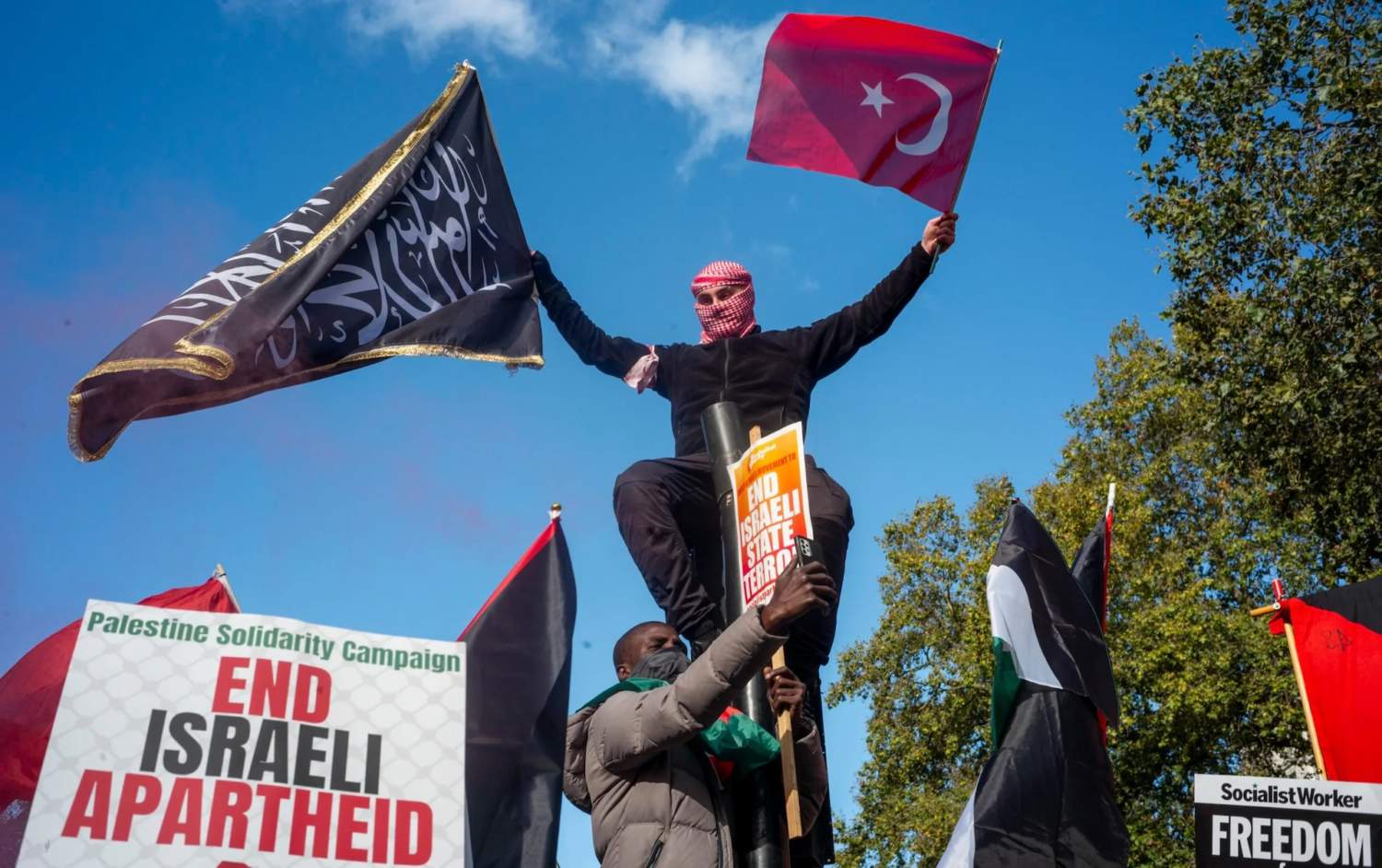
On campuses, in the streets, across social media, and in parts of the public debate, the word “Hamas” could be lost beneath an ocean of euphemisms, while Zionism was steadily transformed from a political idea into a slur.
Not every demonstration was antisemitic, nor was every criticism of Israel an expression of hatred toward Jews. But a climate emerged in which antisemitism once again gained social license, disguised as an “anti-Zionism” directed at Jews.
All Jews, indiscriminately. That is what it has become: antisemitism, this time, dressed in the language of “resistance,” “decolonisation” and “justice.”
This is far more dangerous than a terrorist with a gun.
Israel knows it has enemies. It has an army, intelligence services and borders.
The West, by contrast, struggles even to recognize an ideological assault when it employs the West’s own vocabulary, universities and freedoms.
Perhaps this is the great irony of October 7: Hamas failed to destroy Israel. But it exposed how easily the West can be penetrated by an ideology it still refuses to name.
Unlike Israel, the West has yet to understand that it has been attacked—and is being overrun. Nor does it, sadly, seem capable of recognising this.

