


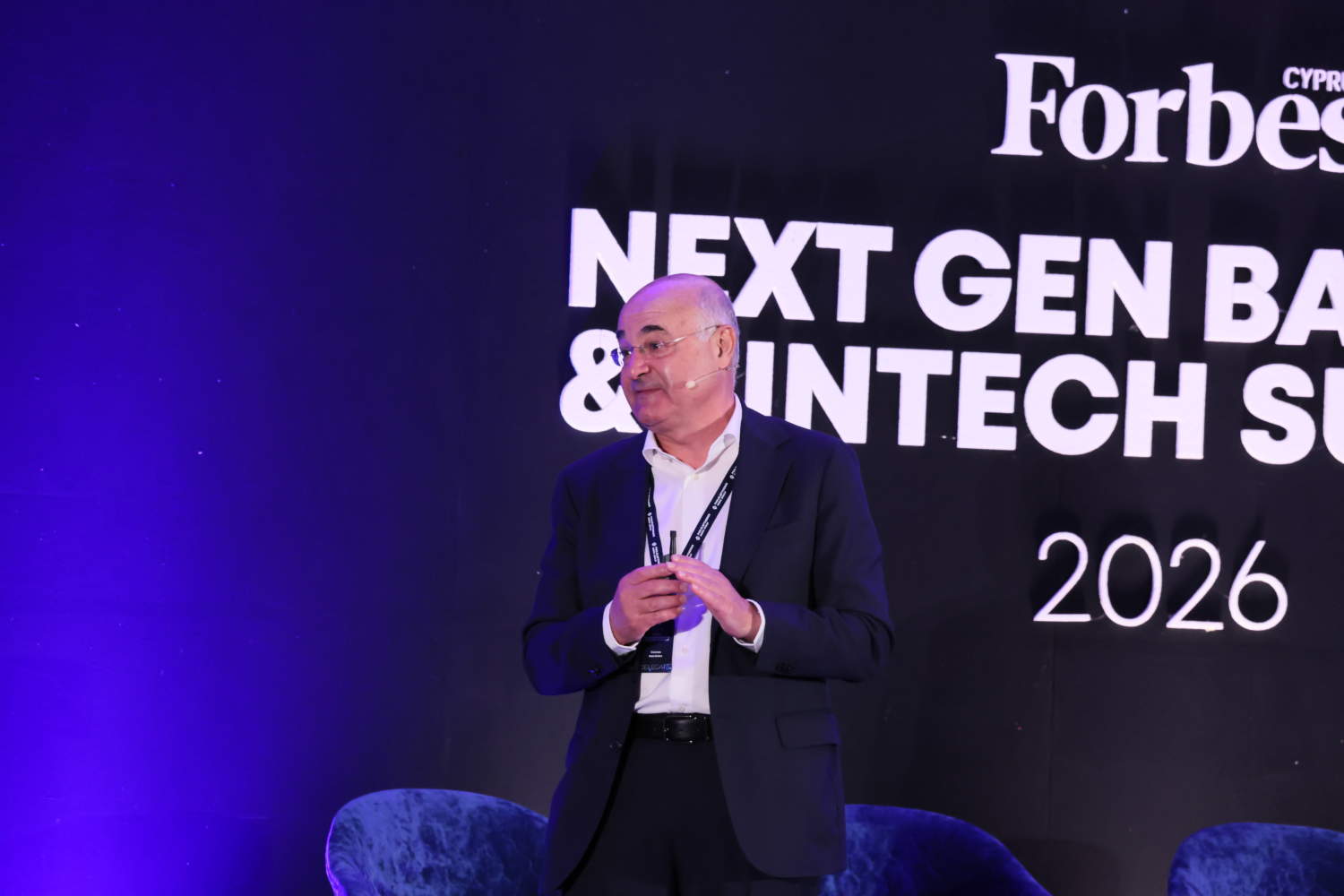
Traditional banks have won the first wave of competition against financial technology companies and are likely to retain their central role in the financial system, despite the rapid growth of digital challengers, London Business School professor Costas Markides told a banking summit in Limassol on Tuesday.
Speaking at the Forbes Cyprus Next Gen Banking & Fintech Summit, organised by Phileleftheros Media Group in cooperation with Capital S.A., Markides argued that fintech companies had transformed banking services without displacing established institutions.
“The banks, the big banks, have really won that war,” said Markides, Professor of Strategy and Entrepreneurship at London Business School.
He explained that the first wave of the fintech revolution, spanning roughly the past 20 to 25 years, had been characterised by companies taking individual services traditionally offered by banks and providing them more quickly, cheaply and conveniently.
Digital payments, foreign exchange transactions and self-directed investment were among the areas where fintech companies had achieved considerable success.
However, traditional banks had retained their advantage in more complex services, including mortgages, business lending and wealth management.
“FinTech has not taken the whole banking relationship away,” Markides said.
The challenge of becoming customers’ main bank
Markides identified what he called the “second account phenomenon” as a fundamental obstacle to fintech companies seeking to challenge established banks.
He said many customers, particularly younger people, had opened accounts with digital providers such as Revolut but continued to use traditional banks for their salaries, mortgages and other major financial commitments.
While fintech businesses had succeeded in attracting younger customers and capturing everyday spending, established institutions continued to control the deeper and more valuable banking relationships, he argued.
The next phase of competition would therefore centre on whether digital challengers could persuade customers to make them their principal banking provider rather than a secondary account.
Markides predicted that only a relatively small number of fintech companies might achieve that transition, while most would remain specialist providers operating alongside traditional banks.
He described the likely outcome as a hybrid financial system, rather than the wholesale replacement of established banks.
Why established banks have retained their position
The professor argued that traditional banks had responded to technological disruption more effectively than commonly assumed.
Rather than allowing fintech competitors to take over the industry, established lenders had adopted innovations through acquisitions, partnerships and improvements to their own products.
Services such as peer-to-peer payments, digital customer onboarding and automated investment advice had increasingly become part of mainstream banking.
Markides cited Belgium’s KBC as an example of an established bank that had embraced digital technology and artificial intelligence to improve customer services.
He also drew parallels with the pharmaceutical industry, where major companies had survived competition from biotechnology start-ups by acquiring, partnering with and incorporating their innovations.
A major obstacle for fintech companies attempting to expand, he argued, was access to capital.
Becoming a full-service bank requires sufficient funding to absorb credit losses, fraud and operational risks while investing in compliance, customer support and infrastructure.
Established banks, by contrast, already possess substantial customer deposits and the financial resources needed to support expansion.
Markides also argued that innovative technology alone was insufficient to guarantee a company’s success.
“What wins the battle is the business model,” he said, stressing that smaller competitors needed business strategies capable of challenging institutions with substantially greater resources.
Big Tech and AI pose new challenges
Despite his confidence in traditional banks’ ability to withstand fintech competition, Markides warned that major technology platforms could pose an even more significant strategic challenge.
Companies such as Apple and Amazon did not necessarily need to become banks themselves to influence how customers accessed financial services, he explained.
By controlling digital platforms, customer interactions and purchasing data, they could direct users towards financial products supplied by their chosen banking partners.
This could leave traditional banks providing financial infrastructure while technology companies controlled the relationship with customers.
Markides also identified digital money, including stablecoins, as a potential threat to banks’ deposit relationships.
Artificial intelligence, meanwhile, represented both an opportunity and a challenge for the entire financial sector.
He stressed that technological advances were not exclusive to fintech start-ups and that established banks could also adopt AI to transform their operations.
His overall assessment was that fintech companies would continue generating innovations, while larger financial institutions would remain well placed to adopt those ideas and make them available to mass markets.
Read more:

