


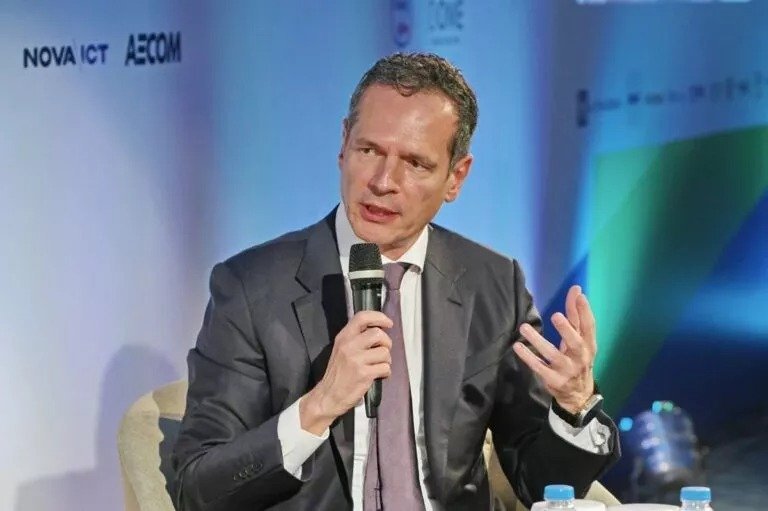
The majority of media outlets in Greece hold the Cypriot Government and the Cyprus Energy Regulatory Authority (CERA) largely responsible for the failure to reach an agreement on the funding of the Cyprus-Crete electrical interconnection and Cyprus’ participation in the share capital of the company Great Sea Interconnector, which will continue as the project’s implementing entity.
However, a recent article published by mononews.gr launched a personal attack on the CEO and Chairman of IPTO (Independent Power Transmission Operator), Manos Manousakis, blaming him for the impasse.
According to information from Greece, Manousakis will not be present at today’s meeting in Nicosia between IPTO representatives and the leadership of CERA, where they aim to persuade the latter to amend its decision (dated July 2, 2024) regarding the non-approval of the commencement of the levy collection from consumers for the recovery of the implementing entity’s expenses, starting from January 1, 2025.
The mononews.gr article claims that Greek Prime Minister Kyriakos Mitsotakis has taken the upper hand in negotiations with the Cypriot Government (he will be visiting Cyprus on the July 20), although sources from philenews indicate that IPTO, as a private law company with the Greek State as the majority shareholder and a strong Chinese shareholder (24%), still maintains control over the negotiation process, leveraging the political influence of the Greek Government.
It is a fact, however, that Manousakis’s behaviour towards Cypriot officials at various levels has, from time to time, elicited strong reactions, of which the Greek Government has been well aware.
Here is an excerpt from the mononews.gr article:
‘The tragic failure of IPTO’s Chairman, Manos Manousakis, regarding the important issue of the Crete-Cyprus electrical interconnection, valued at 2 billion euros, ultimately forced Prime Minister Kyriakos Mitsotakis to take initiatives and assume direct control.
The Prime Minister, following Manousakis’s resounding failure, had two recent telephone conversations with the President of Cyprus, Nikos Christodoulides, in an attempt to ease Nicosia’s opposition and ensure the continuation of the project.
“As you can understand, the discussions have reached a critical stage. The fact that they are now taking place at such a high level indicates that Manousakis has failed miserably, despite assuring us that he had found a solution with Nicosia. Inevitably, Mitsotakis had to take charge,” a source close to the Prime Minister revealed.
Although the Christodoulides government seemed completely opposed to the idea of participating in the share capital of Great Sea Interconnector (as reported by philenews months ago, the Cabinet decided to participate pending viability studies), Manousakis, as insiders say, “fed Athens false hopes” by claiming that it was only a matter of time before the Cypriots changed their stance.
Manousakis even travelled to Cyprus to present the cost-benefit analysis for the Greece-Cyprus electrical interconnection to a hostile audience, as expected and was “shown the door” by the Cypriots.
After failing miserably and realising the deadlocks in his intervention, Manousakis belatedly conceded that unless CERA’s decision is amended, the project cannot proceed.
CERA determined that payments for the project would only commence upon its completion and not during the construction phase, as IPTO desires, which is considered unprecedented, and Manousakis attempted to impose this.
Nicosia is facing significant pressure from multiple quarters to facilitate the construction of the Great Sea Interconnector. However, the Cypriot government is not inclined to treat the examination of the cost-benefit analysis as a mere formality.
Additionally, several parties defend CERA’s decision, despite it being highly displeasing to Manousakis, who, as many in Athens and Nicosia say, “lives in his own world”.
For instance, Charalambos Ellinas, arguably the top energy expert in Cyprus, openly and publicly criticised Manousakis, stating that he finds it “very strange” for the IPTO Chairman to claim that the project will not be viable following CERA’s decision.
Commenting on this claim by Manousakis, Dr. Ellinas asserted, “This is a 2-billion-euro project, while the recovery of costs from Cypriot consumers amounts to approximately 25 million euros per year. I do not believe that a 2-billion-euro project will become unviable just because of 25 million euros annually. If that is the case, then Manousakis and IPTO have a problem, and they are doing something wrong”‘
(philenews/information from mononews.gr)

