


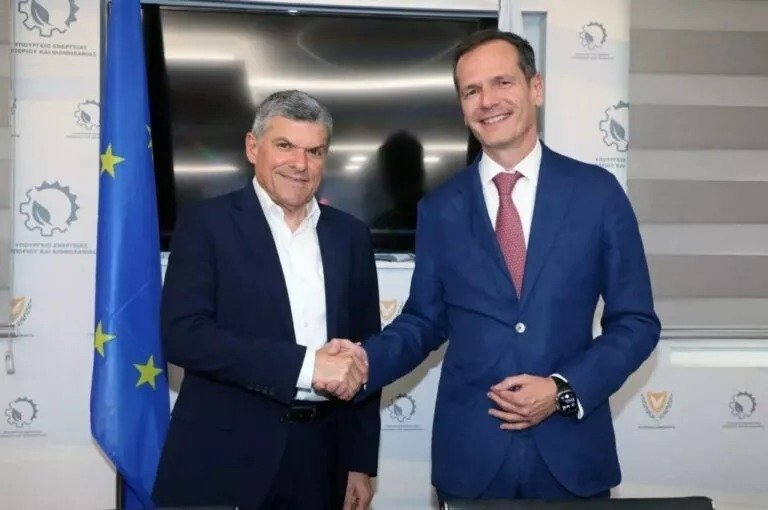
The Minister of Energy, Commerce and Industry has received the comprehensive cost-benefit analysis for the Great Sea Interconnector (GSI), a proposed electrical interconnection project linking Cyprus with Greece (Crete).
The analysis was presented today by IPTO (Independent Power Transmission Operator), the project’s implementing body. IPTO is also scheduled to meet with the Cyprus Energy Regulatory Authority (CERA) next week.
Minister Giorgos Papanastasiou, confirmed that Cypriot consumers will begin contributing to the project’s construction costs starting January 1, 2025. This levy is set at 0.6 cents per kilowatt/hour.
He highlighted the project’s importance, stating that without the interconnection, excess renewable energy production in the coming years would likely go to waste due to limitations in domestic consumption, even with expensive storage solutions.
Following the meeting with IPTO, the Minister acknowledged that the government has yet to fully examine the analysis. He noted that the study, provided in both print and digital formats, prioritises the potential impact on Cypriot electricity consumers.
The government will now await assessments from selected entities, with an expectation of receiving preliminary recommendations within the next two months.
This will inform Cyprus’s final decision on the project’s future.
The Minister acknowledged the tight timelines, particularly concerning securing funding for construction materials like cables. However, he stressed the importance of thorough evaluation, emphasising that any decision should consider the project’s long-term operation over the next 30-40 years.
Regarding the timeframe for sharing the study with evaluators, Papanastasiou confirmed it would happen “in the coming days” due to last-minute adjustments to the terms of reference.
He mentioned a previous presentation based on a preliminary study and the Ministry’s feedback requesting further detail, which the final analysis incorporates.
The Minister explained that the Ministry will transmit the study and terms of reference to the chosen entities. These entities will first assess the comprehensiveness of the study, with their evaluation costs depending on the information provided.
The European Commission, which is contributing €657 million to the project, has not set a firm deadline for Cyprus’s decision according to the Minister. However, discussions with the Commission’s energy department suggested a preference for a decision by mid-August.
The Minister expressed confidence that a reasonable extension request for the evaluation would be accepted by the involved parties. He downplayed concerns about losing the funding, believing the Commission would recognise Cyprus’s commitment to a proper evaluation.
Finally, addressing the project’s impact on the electricity market, Papanastasiou emphasised that without the interconnector, Cyprus’s Ministry of Energy anticipates a surplus of renewable energy production in the coming years.
This, combined with conventional generation, would exceed domestic consumption capabilities, even with energy storage solutions. Consequently, some of this renewable energy would have to be rejected.
The GSI project is thus seen as crucial for integrating renewable energy sources and optimising Cyprus’s energy infrastructure.
(information from CNA)

