


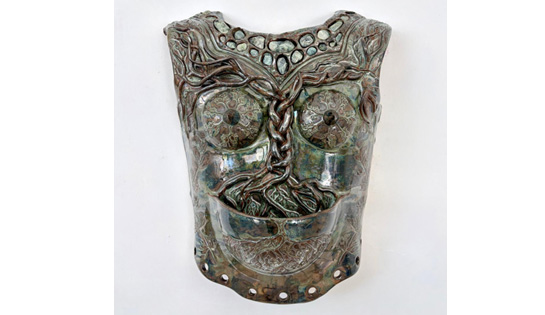
The Edit Gallery presents Carriers, a solo exhibition of new ceramic sculptures by British artist Hannah Rowan, developed during a period of research and production in Limassol.
Opening: Friday, September 18, 2026, 18:30–21:30
Exhibition runs: September 18–October 17, 2026
Where: The Edit Gallery, 1 Agias Zonis Street, 23 Nicolaou Pentadromos Centre, 3026 Limassol
Working hours: Wednesday–Friday, 15:00–19:00; Saturday, 10:00–13:00
About the exhibition
At the centre of Carriers is the act of carrying: to hold, contain, protect and nourish. Rowan’s clay torsos take the form of vessels, breastplates and protective shells, exploring the relationship between bodies and the environments they inhabit.
Drawing on pregnancy, breastfeeding and the transition into motherhood, the works consider how bodies sustain more-than-human life. References to placentas and milk ducts merge with botanical and marine forms: ribs become aloe vera leaves, milk ducts bloom like flowers, and branching patterns echo roots and nervous systems. Through these connections, Rowan extends questions of care and interdependence beyond maternal experience to the exchanges that sustain all living beings.
Protection and vulnerability coexist throughout the series. The sculptures evoke armour shaped around the female body, yet their ceramic material remains fragile. Lustrous, shell-like glazes recall oysters, whose shells accumulate traces of the waters they inhabit, so that both body and shell become records of their surroundings.
About the artist
Hannah Rowan (b. 1990, Brighton, UK) is a British artist based in New York. Her multidisciplinary practice spans sculpture, installation, performance, video and sound, working with ceramic, glass, metal and water to explore intimacy, impermanence and the relationship between bodies and ecological systems. Her research has taken her to sites ranging from the Arctic Circle to the Atacama Desert. She holds an MA in Sculpture from the Royal College of Art and a BA in Fine Art from Central Saint Martins, and her work is held in public and private collections including the Dakis Joannou Collection and the Anthropocene Collection at MUSE – Science Museum, Trento.

