


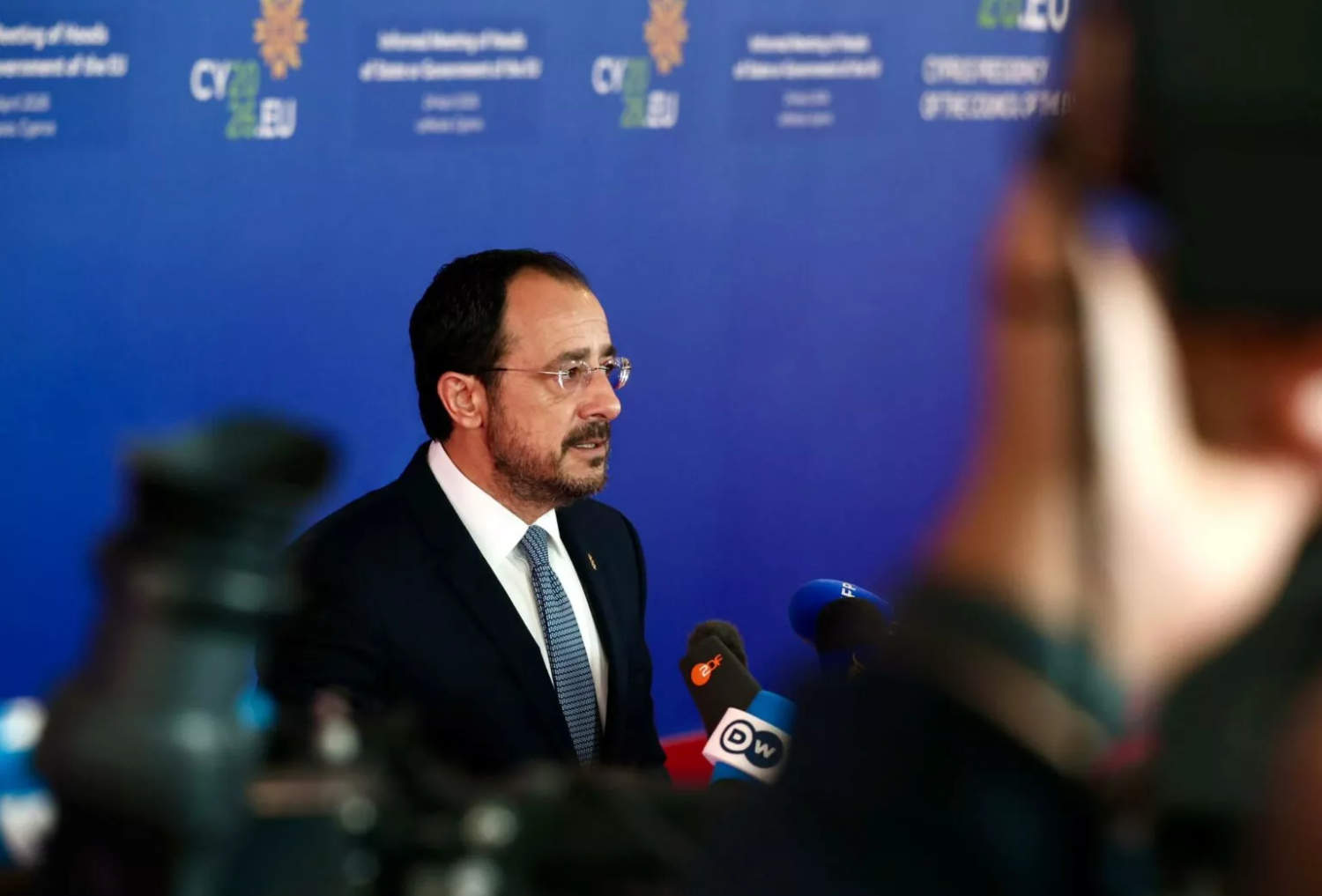
EU leaders agreed on Thursday night that the European Commission will prepare a response plan for situations in which a member state activates Article 42.7 of the EU Treaty, President Nikos Christodoulides said on Friday, describing the outcome as a significant step towards giving the mutual defence clause operational substance.
Speaking to journalists on arrival at the Filoxenia Conference Centre, Christodoulides said all member states — both NATO members and non-NATO countries — recognised the need for an operational plan. “If, let’s say, France activates Article 42.7 — which countries will be the first to respond to the French government’s request? What are the needs of the government or country activating Article 42.7? All of this will be included in a plan, so that if and when a member state activates Article 42.7, we have an operational plan ready to implement,” he said.
On energy, Christodoulides said leaders discussed the issue from two angles on Thursday night. On short-term measures, he said leaders decided to refer the discussion to finance ministers, with two ECOFIN meetings scheduled for May — a regular session on May 5 and an informal meeting in Cyprus on May 22 and 23 — to return with specific proposals on immediate energy crisis measures. On the longer term, he said the goal remained achieving an Energy Union, with the energy network identified as a priority, and expressed hope that a general approach agreement could be reached by June.
On the MFF, Christodoulides said he expected a political rather than technical discussion, and that the presidency’s goal was to present a mature negotiating framework with specific figures to the European Council by June. He also said he was pleased to sign the “One Europe, One Market” roadmap alongside the Presidents of the European Commission and European Parliament, describing it as setting concrete timelines and targets to strengthen EU competitiveness.
On regional cooperation, Christodoulides said Thursday’s discussions made clear the EU needed to do significantly more to strengthen and strategically upgrade its relations with countries in the region. He said the Mediterranean Pact was an important first step but more was needed, and that Cyprus had specific proposals to put forward at Friday’s regional summit with leaders from Egypt, Jordan, Lebanon and Syria and the Secretary-General of the Gulf Cooperation Council.
Asked about specific steps, he said the EU needed to begin discussions with Lebanon on a strategic and comprehensive agreement, and to engage more with Syria through a gradual approach — with sanctions relief conditional on the Syrian government’s response. He added that he planned to visit the UAE, Qatar and Saudi Arabia next week to brief Gulf leaders on the summit and discuss next steps.
Mitsotakis: Cyprus defended during US-Israel-Iran conflict
Greek Prime Minister Kyriakos Mitsotakis, also speaking on arrival, said the informal summit was taking place at a critical moment and used the opportunity to call for a substantive upgrade of Article 42.7.
Mitsotakis said Greece and other European countries had stood by Cyprus when it came under attack during the US-Israel-Iran conflict. “I would say that was the first practical demonstration that Europe can, on its own, stand by member states of the European Union that are under threat,” he said.

He said he had long advocated for a meaningful upgrade and activation of Article 42.7 — the mutual assistance clause that obliges member states to aid any member state that comes under attack — and welcomed the fact that the issue was now firmly on the European Council agenda. He said Greece would use its EU presidency in the second half of 2027 to advance the discussion further.
On the MFF, Mitsotakis said leaders would also have the opportunity to assess the economic impact of the prolonged conflict in the Gulf.
On the domestic situation in Greece, he said the Greek government had stood by its citizens within its fiscal limits, pointing to the country’s surpluses, falling debt and strong growth rates as indicators of economic health. “I know very well that Greek citizens are being tested by the prolonged cost-of-living crisis, on top of which great economic uncertainty has now been added,” he said, adding that the government would support citizens without making promises it could not keep and without disrupting the fiscal balance it had built.
(information from CNA)

