


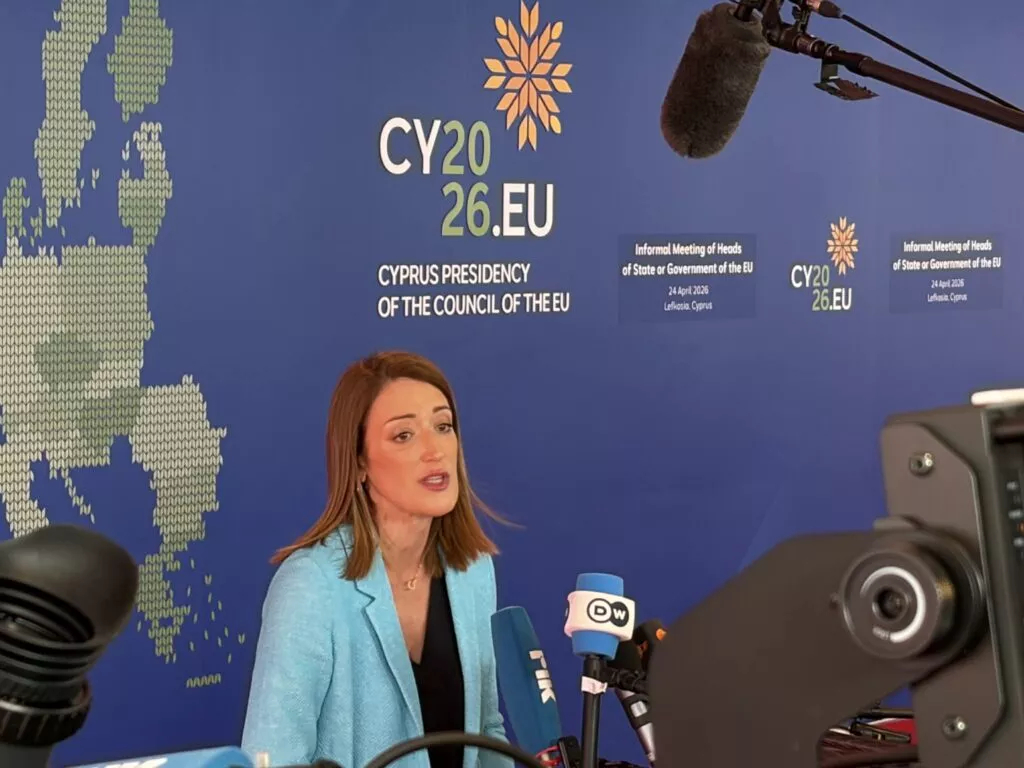
European Parliament President Roberta Metsola warned EU leaders on Friday that the bloc’s current budget cannot meet the scale of challenges it faces, and called on them to consider new funding sources as negotiations over the next Multiannual Financial Framework opened in Nicosia.
Speaking on arrival at the informal EU summit, Metsola said rising crises and the servicing of existing debt would require “new money.” She said the European Parliament would adopt its position on the MFF next week and was ready to begin negotiations with member states. She called on leaders to take a fresh look at own resources, saying the existing EU budget was not sufficient for the range of challenges the Union faces.
The Parliament is seeking a 10% increase in the MFF. Pressure is also expected to be applied to avoid delaying the discussion until the Council of the EU sets an overall figure — a delay that could affect plans to present a negotiating box at the June European Council.
Metsola set out three priorities. First, the “One Europe, One Market” roadmap, which she said could contribute to faster and more effective decision-making and reduce single market fragmentation.
Second, on energy, she acknowledged measures already taken to ease costs for citizens but said the EU needed to move beyond temporary fixes, calling for investment in networks and energy infrastructure and a more strategic approach to long-term autonomy.
“Now is the moment to secure the strategic autonomy we have been discussing for decades,” she said. Third, on the Middle East, she stressed the need for security and stability, saying European citizens should not bear the cost of a crisis they did not create.
On Ukraine, Metsola welcomed the approval of a €90 billion loan, the twentieth sanctions package and broader EU measures, saying they provided economic support and political momentum. She also welcomed an extended ceasefire with Iran. “Ukraine needs financial help and it needs momentum, and Europe is providing both,” she said.
The MFF: what is at stake
EU leaders entered on Friday the first substantive negotiating phase of the 2028-2034 Multiannual Financial Framework — a budget approaching €2 trillion. For the first time at leaders’ level, discussions are focusing on scenarios for new own resources as proposed by the European Commission.
The Commission’s proposal, presented in July 2025, includes new revenue streams from the Emissions Trading System, the Carbon Border Adjustment Mechanism, a tobacco tax, an e-waste levy, and a corporate turnover contribution — though the last of these does not appear to enjoy broad support among member states.
The repayment of joint NextGenerationEU debt adds further pressure to find stable funding sources. The central question is how to finance a budget expected to cover new demands in competitiveness and defence without any significant political appetite for increasing national contributions.
Friday’s discussion is expected to give political direction ahead of the presentation of a negotiating package at the June European Council. The target remains a final agreement by the end of 2026, before political developments in France and Italy make the process more complex.
Read more:

