


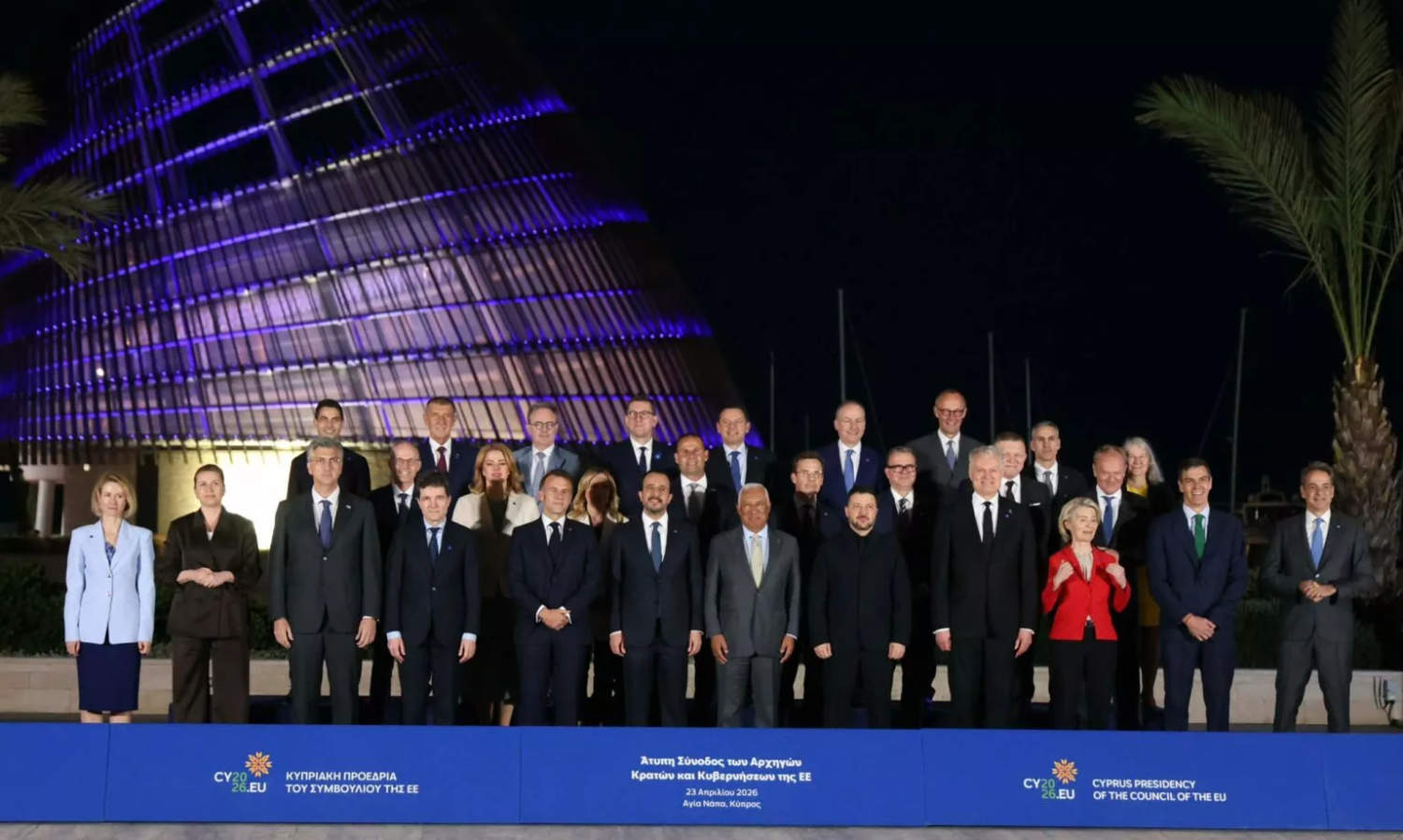
European Union leaders opened the first informal European Council summit under the Cypriot presidency at Ayia Napa marina on Thursday evening, with discussions centred on defence, energy and the EU’s response to geopolitical pressures.
President Nikos Christodoulides welcomed heads of state and government from 24 member states, Ukrainian President Volodymyr Zelensky as a special guest, European Council President António Costa, and European Commission President Ursula von der Leyen. Hungarian outgoing Prime Minister Viktor Orbán and Austrian Chancellor Christian Stocker did not attend.
Speaking to journalists on arrival, Christodoulides said the two-day agenda confirmed the priorities of the Cypriot presidency: strengthening relations with neighbouring states, securing EU energy autonomy, and giving operational substance to Article 42.7 of the EU Treaty — the mutual defence clause.
On Friday, he said, a summit with regional leaders would take place to advance strategic relations following the announcement of the Mediterranean Package, going beyond an exchange of views to agree concrete steps.
On defence, Christodoulides said Cyprus would present a specific plan addressing what should happen when a member state activates Article 42.7 — which states could offer immediate assistance, what kind of help would be needed, and how responses should reflect the geography and threat profile of the country concerned.
He noted the clause was first activated by France in 2016 following the Paris terrorist attacks, and said the goal was to agree an operational roadmap.
On energy, he said the Commission president would present immediate measures to address rising energy costs, while leaders would also look at the longer-term goal of achieving an Energy Union. He described both tracks as essential to reaching full EU energy autonomy.
Asked about Ukraine, Christodoulides said the Cypriot presidency had completed all preparatory work and stood ready to open negotiating chapters if the political conditions allowed. On Iran, he said the EU’s active involvement was indispensable to any de-escalation effort.
Zelensky, speaking to journalists at the marina, called for European production of critical weapons systems and addressed Ukraine’s broader defence needs. He said he expected contacts with Hungary’s new president soon.
On Cyprus, he said Nicosia had stood by Kyiv from the start of the presidency — on economic support and sanctions against Russia alike — and predicted the two countries would build stronger ties.
The presence of the Kyrenia II vessel at the summit drew comment from Government Spokesman Konstantinos Letymbiotis, who said in a post on X that the ship carried strong European and national symbolism.
He said it conveyed a message that Cyprus’s memory and identity remain undivided, and that the island’s European future is inseparably linked to ending the occupation and restoring its unity under EU principles and values. The original wreck lies in occupied Kyrenia.
More than 350 journalists were present at the press centre at Ayia Napa marina. The Philoxenia Conference Centre will accommodate up to 420 reporters on the second day.
Police announced enhanced security measures and traffic restrictions across Nicosia, Larnaca and Famagusta districts for the duration of the summit, with intermittent road closures on urban roads and on the Nicosia-Larnaca and Larnaca-Ayia Napa motorways. Drone use was banned across Cyprus for the two days. A NAVTEX notice was issued for Ayia Napa marina from 4pm to 11pm on April 23.
Read more:

