


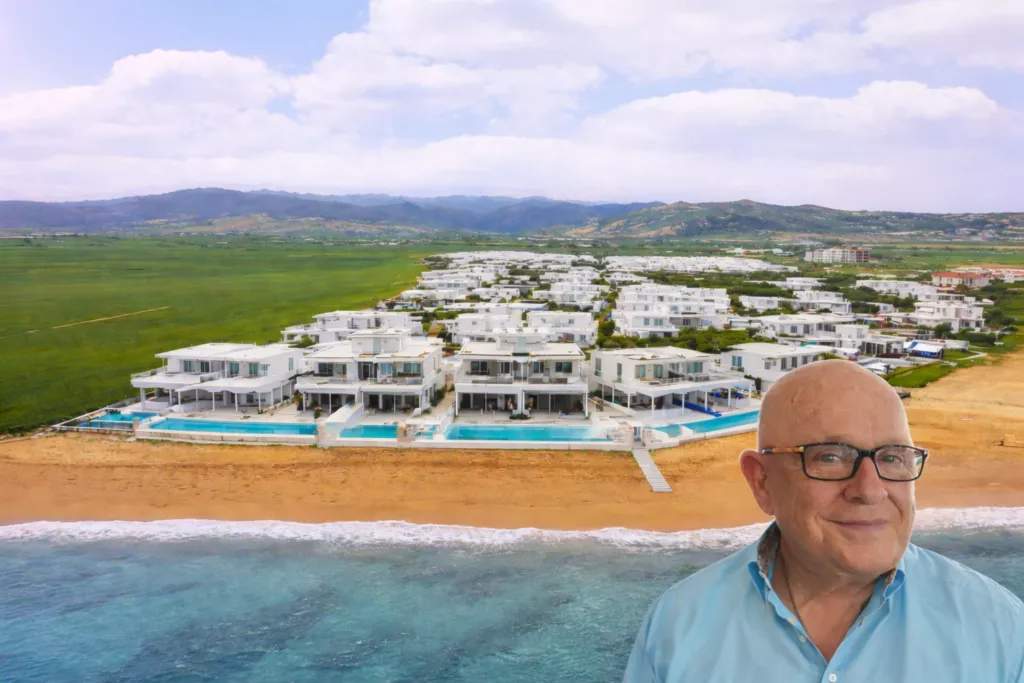
Convicted criminal Shimon Aykut has built thousands of villas, hotel complexes, and luxury developments across the occupied territories—all on stolen Greek Cypriot land.
To grasp the scale of the destruction and the sheer reach of the criminality, just visit his company’s website, “Afik Group,” and watch the developments sprawl all the way to the sea in Kyrenia, Famagusta, and Karpasia.
This Turkish-Israeli businessman, who made tens of millions from the theft of land belonging to refugees violently driven from their properties, got off lightly when he faced Cypriot justice.
Let’s recap. Despite the gravity of the charges, Aykut was sentenced to a mere five years in prison for illegally appropriating 40 plots of occupied land covering 385,969 square metres. Let’s also remember that of the 242 charges he faced, 202 were dropped—including those relating to money laundering.
Now, citing “reasons of public interest,” the Justice Minister has reportedly agreed on behalf of the government to Israel’s request to hand him over to serve the remainder of his sentence there—which, of course, amounts to setting him free.
Israeli support for Aykut’s “plight” took many forms—newspapers described during the trial how he was “paying for a political situation he’s not responsible for”—and the pressure applied behind the scenes was enough to do the trick.
Diplomatic relations with Israel were evidently deemed a higher “public interest” than the historic opportunity the Republic of Cyprus has in its hands: to crack open the issue of property appropriation in the occupied areas, not just for this particular criminal but for all of them.
To launch, in other words, a battle to halt Turkey’s dangerous push to set its occupation in concrete—literally—by flogging off land seized by force.
In September 2024, Oz Karahan, on behalf of the Green Movement and the Union of Cypriots, handed police a bulging dossier containing dozens of names and details of companies linked to property appropriation in the occupied territories.
To this day, however, nothing has come of it. Just the odd reassurance from the Foreign Minister that “files are being prepared,” “new cases are being investigated,” and arrests aren’t ruled out.
From the outset, the Republic of Cyprus has seemed utterly at sea over the appropriation issue, giving the impression it’s holding something bigger than it knows how to handle.
Not legally, mind you—the crimes are crystal clear—but politically. It’s no coincidence that the government’s reluctance coincides with the constant invocation of “goodwill” in the talks, as if tolerating illegality were some sort of diplomatic currency.
We’re not talking about a “worrying dimension” of the Cyprus problem that can be swept under the carpet of international balance-of-power games. We’re talking about the permanent redrawing of the map of Cyprus.
The construction boom on stolen land is the final act of what began with the invasion, the colonisation, and the militarisation of the occupied territories. And the question isn’t just when our land will be sold off for good to Turkish and foreign investors—it’s whether there will ever be the political courage to accept our own responsibility.

