


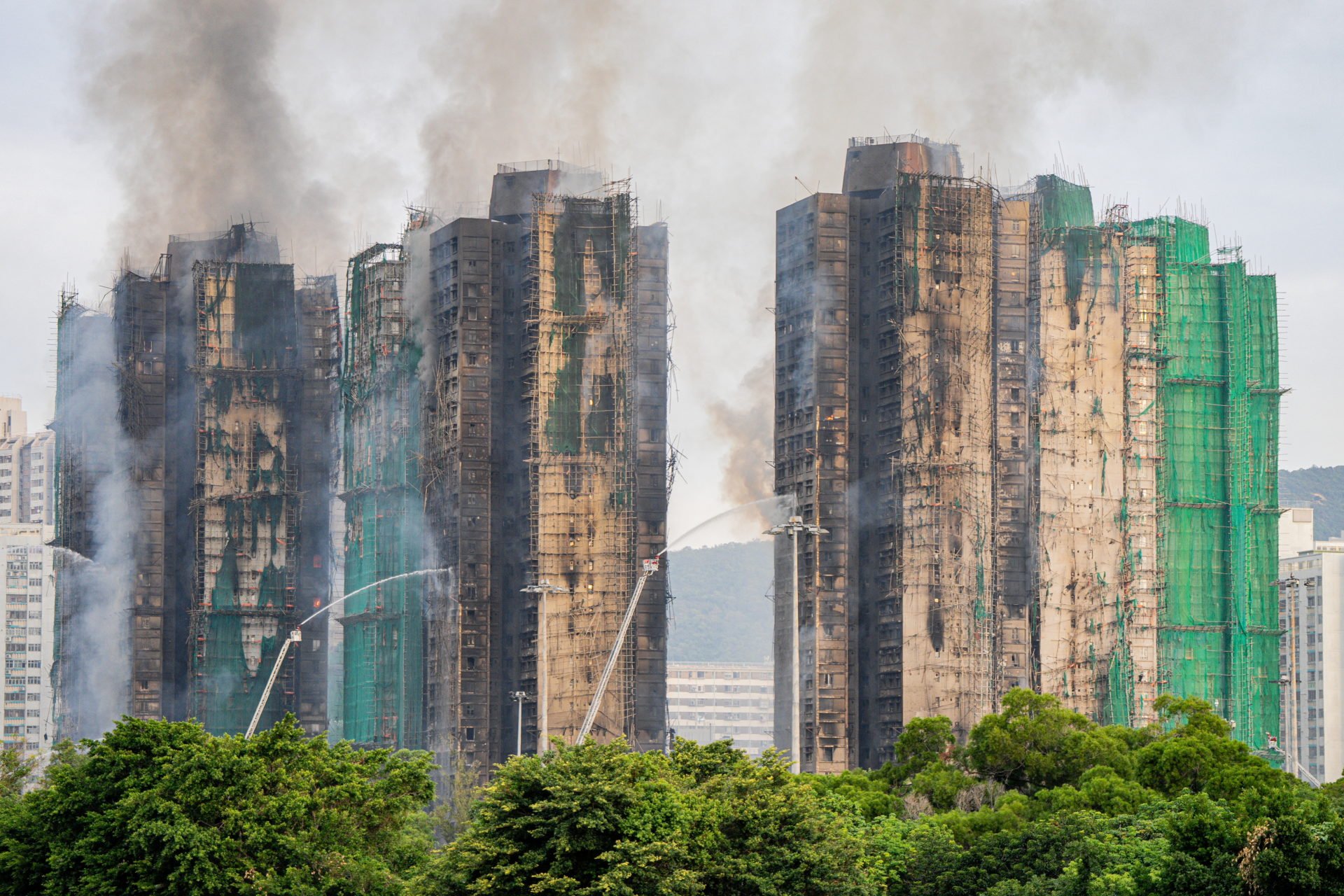
At least 128 people have died in a massive apartment complex fire in Hong Kong, with around 200 still unaccounted for as authorities ended rescue efforts on Friday.
The blaze tore through seven of eight residential towers at the Kwong Fuk estate in Tai Po on Wednesday afternoon, becoming one of the deadliest fires in the city’s history.
Authorities recovered 108 bodies from the buildings, with another 16 remains still trapped inside the charred structures. Hospital deaths brought the toll to 128, Security Secretary Chris Tang told reporters on Friday. A further 79 people sustained injuries, including 11 firefighters responding to the emergency.
Identification efforts have proven difficult, with 89 bodies yet to be named. Around 200 residents remained missing as of Friday afternoon.
No alarms activated
Fire Services head Andy Yeung acknowledged a catastrophic safety failure residents had reported for days: alarm systems never activated in any of the eight towers during the disaster.
Authorities pledged enforcement action against the contractors responsible for the safety systems.
Extreme heat inside the buildings continues hampering recovery work. Temperatures in some areas still exceed 200C, forcing crews to wait before accessing certain sections. Officials estimated evidence collection would require three to four weeks.
Peak temperatures during the blaze reached 500C, Yeung said, making upper floors particularly difficult to reach. Narrow corridors packed with belongings forced firefighters to clear each unit individually across multiple floors.
Polystyrene foam fuelled spread
Investigators believe highly combustible polystyrene foam installed in every lift window served as the primary accelerant driving the fire’s ferocity, Tang said.
The inferno began in the lower section of Wang Cheong tower, igniting protective mesh before reaching the foam and entering the building. Shattering windows from intense heat allowed flames to jump between units, amplified by strong winds and falling debris from burning scaffolding.
The eight-tower Wang Fuk Court complex housed over 4,600 residents and was undergoing extensive renovations. Workers had wrapped the buildings in bamboo scaffolding covered with green mesh netting.
Labour department records show the contractor received repeated written warnings about fire safety following inspections over the past year that found unsafe practices. The most recent check occurred on 20 November.
Despite the warnings, authorities had assessed overall fire risk as relatively low and found the scaffold netting met flame-retardant standards, the labour department said.
The majority of fatalities occurred in just two of the seven affected towers, whilst most survivors emerged from the remaining buildings.
Families search for answers
Distraught relatives gathered at the adjacent community centre throughout Friday morning to identify victims pulled from the destroyed buildings. Officials have released few victim names publicly, and Tang declined to provide demographic breakdowns of confirmed deaths.
One man, identifying himself only as Mr Lau, said he presumed his parents had perished. Fighting tears, he told reporters he lacked any information about their fate and simply wanted confirmation either way to end his anguish.
A tenth-floor resident whose family survived said neighbours remained unaccounted for. She described avoiding all media coverage, desperate for normalcy but finding it impossible to achieve.
Migrant workers among victims
Indonesia’s consul general Yul Edison arrived Friday to assist with victim identification. Indonesian domestic workers occupy many flats in developments like Wang Fuk Court. At least one Indonesian citizen died in the fire, Edison confirmed.
The Mission for Migrant Workers reported 11 Indonesian domestic helpers missing from the 119 known to reside in the complex. Philippine consular officials said one Filipina domestic worker remained missing, one suffered injuries, and 24 were safe.
A crowdsourced online platform has compiled resident reports for each building, mapping individual flats with known occupant details.
Reports from the fire’s origin point in block F described a 41-year-old man vanishing at 4.45pm, his final message indicating he was stuck between the 25th and 26th floor stairwells. Another entry documented the deaths of a 60-year-old man, a 90-year-old woman and their 40-year-old Indian domestic helper on the 11th floor. Four people died in a single apartment eight floors higher.
Investigation and arrests
Police and anti-corruption officers are probing the fire’s cause. Authorities arrested three individuals connected to the construction firm handling the multi-year renovation project.
The tragedy has intensified demands for tougher construction sector fire safety regulations.
Lee Kwong-sing, who chairs the Hong Kong Institute of Safety Practitioner, noted no statutory requirement exists mandating flame-retardant materials, according to broadcaster RTHK. Current guidance appears only in labour department practice codes, making compliance voluntary and violations technically legal, he said.

