


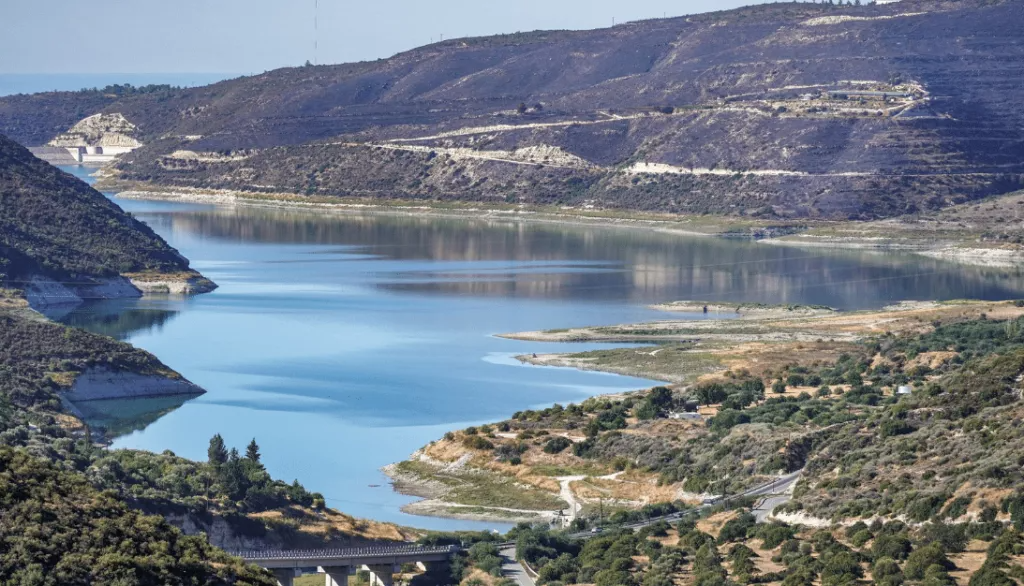
Τhe government disbanded its dam maintenance team in 2015 due to economic pressures, leading to widespread facility failures, including the destruction of the Mavrokolymbos dam in Paphos.
The revelation emerged during testimony before the House Audit Committee. Team members either retired or were transferred to other departments within the Water Development Department, leaving critical infrastructure without systematic upkeep, the committee heard.
The crisis reached a peak in January when Mavrokolymbos dam, built in 1966 with a capacity of 2.18 million cubic metres, suffered major structural failure due to corroded components and had to be completely drained.
Parliamentary committee exposes decade of neglect
Akis Kikas, representing the Audit Office, told the committee that, based on a Water Development Department report to the Agriculture Minister for 2023-2024, no systematic maintenance is being carried out on dams, particularly regarding electromechanical installations.
“Some valves have not been opened for years and questions arise about whether they will function in an emergency,” Kikas stated during the committee hearing. The maintenance team is being reconstituted but requires seven new staff members to operate effectively.
Scientific and Technical Chamber (ETEK) president Constantinos Constanti warned that five other dams built using identical technology in the 1950s and 1960s – Germasogeia, Polemidia, Argaka, Ayia Marina and Pomos – could suffer the same fate as Mavrokolymbos. These facilities have a combined capacity of 19.5 million cubic metres.
Desalination plant inefficiencies cost millions
The parliamentary investigation also uncovered significant problems with Cyprus’s desalination infrastructure. Kikas revealed that the EAC desalination unit operates but lacks proper distribution infrastructure, forcing clean water through contaminated pipelines before requiring costly additional filtration.
The plant produces 60,000 cubic metres of water daily, with much of it requiring filtration after contamination during distribution – an inefficiency that unnecessarily increases operational costs.
The water shortage threatens Cyprus’s tourism sector, which accounts for 13.5% of GDP, with the government now subsidising private desalination plants for hotels to ensure they have adequate summer supplies.
Read more:

