


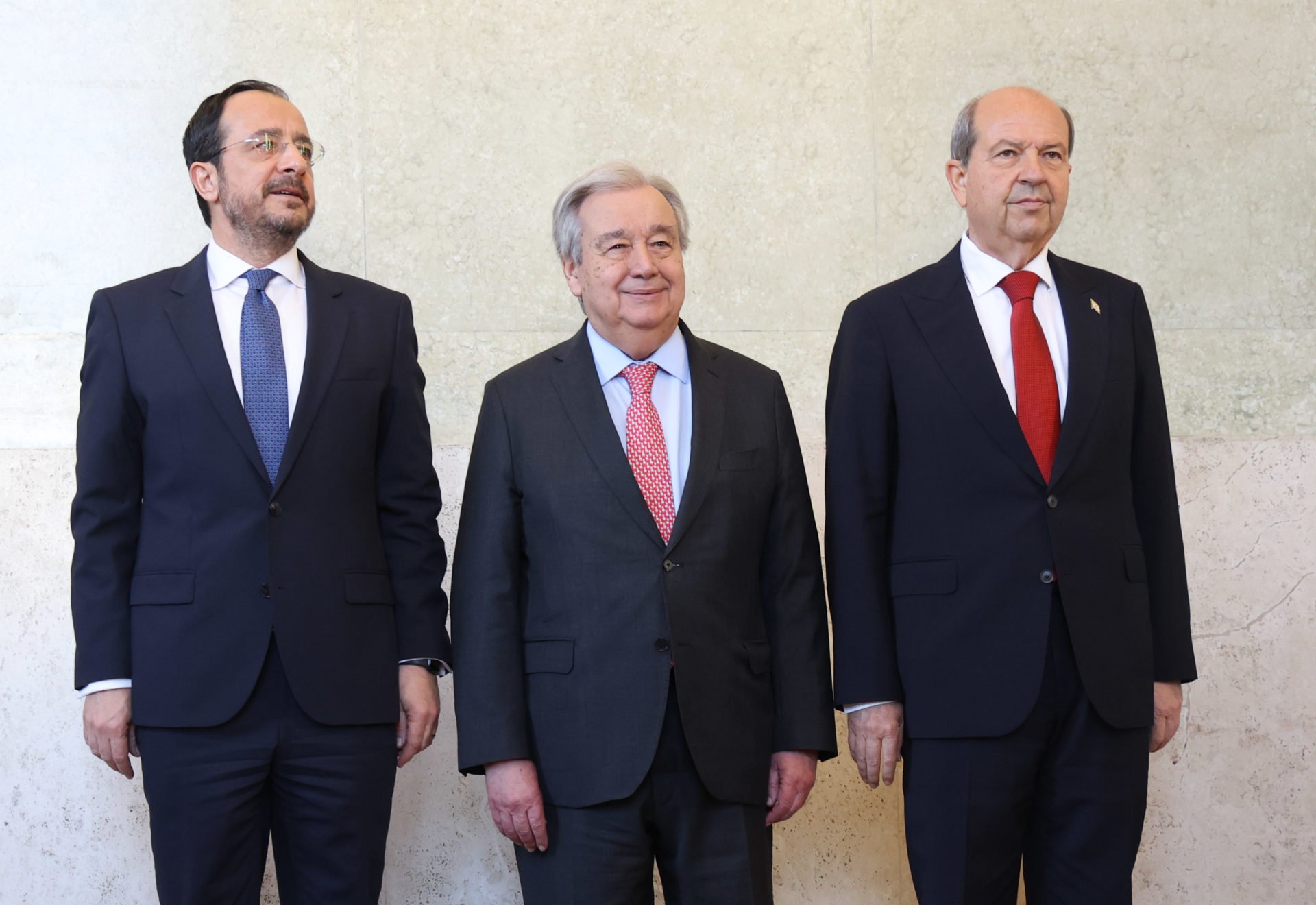
A second round of informal talks on the Cyprus issue will take place on 16-17 July in New York, but prospects for meaningful progress remain minimal to non-existent.
The upcoming illegal elections in the occupied north to select a new Turkish Cypriot leader, combined with Turkey’s stance, severely limit any chances of even modest forward movement.
The second informal five-party meeting will unfold under the shadow of the elections in the occupied north, with expectations that Cyprus negotiations will remain stagnant until at least October. This assessment emerged from the latest National Council session, reflecting the political leadership’s consensus.
Turkish Cypriot leader Ersin Tatar has been consistently negative towards any initiative aimed at restarting negotiations, believing this entirely obstructive approach will achieve some form of recognition. His actions have always been guided by Turkey—something he admitted during April and May meetings with President Christodoulides.
During their April discussion about checkpoints, Tatar told President Christodoulides that decisions regarding crossing points belonged to the army, not him. In their second meeting a month later, the occupation leader repeated that such decisions were not his to make.
Even more revealing about his role in the occupied areas was Tatar’s relationship with Turkish President Recep Tayyip Erdoğan. When President Christodoulides sought to understand Erdoğan’s positions on issues under discussion during their 5 May meeting, the Turkish Cypriot leader revealed he had not asked Erdoğan anything about Cyprus, adding a particularly telling comment: “You don’t ask Erdoğan questions. You answer them.”
The United Nations privately acknowledges that prospects for progress are minimal whilst Tatar leads the Turkish Cypriot side, with officials seeing difficulties advancing matters until October. Consequently, the UN appears to be pursuing two directions: maintaining the process that began last March despite modest results, hoping for improved conditions in autumn, and making overtures to Turkey, which could contribute positively even after the elections.
UN envoy María Ángela Holguín’s contacts in Brussels and Paris demonstrate that EU-Turkey relations remain a significant factor for the international organisation regarding elements that could influence the Cyprus issue. This contradicts assessments from various quarters, including within Cyprus, that more active EU involvement would create obstacles to UN efforts.
Nicosia, following President Christodoulides’ tactical approach, intends to exploit every opportunity for direct contact with the Turkish side. The President held a private meeting with Turkish Foreign Minister Hakan Fidan in Geneva and may attempt similar engagement in New York.
French President Emmanuel Macron’s account of his NATO summit meeting with Erdoğan proved particularly revealing. Notably, Erdoğan himself raised Cyprus with Macron, despite previously responding negatively when asked about the issue. Erdoğan reportedly told Macron he wanted to bring Turkey closer to Europe, with the French President indicating that Cyprus would remain an obstacle even if all technical issues were resolved.
Erdoğan appeared ready to resolve the Cyprus issue but made peculiar demands: he suggested removing Cyprus from UN purview whilst Turkey remained on the island. Macron reportedly responded that Cyprus could not be removed from UN jurisdiction and asked what exactly Erdoğan meant by “Turkey remaining in Cyprus”, receiving no answer.
The March informal five-party meeting in Geneva achieved agreement on specific confidence-building measures: opening four crossing points, demining, establishing a technical committee for youth, environmental and climate change initiatives including impacts on mining areas, solar energy in the dead zone, and cemetery restoration. Additionally, participants agreed to appoint a new Cyprus envoy and schedule another informal five-party meeting for late July.
Achievements include establishing the youth committee, beginning cemetery restoration work, and environmental dialogue. María Ángela Holguín returned as the UN Secretary-General’s personal envoy, though the meeting was rescheduled from 22-23 July to 16-17 July due to diplomatic positioning from the Turkish side.
However, several issues remain stalled. Regarding checkpoints, Tatar insists only on opening Mia Milia (apparently the limit of what the occupation army permits), whilst rejecting Christodoulides’ proposal to open Ledra Street. For the photovoltaic park, Tatar demands separate connections for the two electricity networks, remaining intransigent despite Holguín’s efforts, including bringing her own technical expert to demonstrate separate interconnections were unnecessary. The Pyla agreement remains stagnant despite achieving very specific accord with Ankara’s assistance, again due to Turkish Cypriot approach.
Given this climate and the complicating factor of occupied area elections, expectations for New York remain extremely low. The meeting will likely provide a general situation review and maintain the process until October’s elections. The UN Secretary-General wants to continue efforts, preventing the Turkish side from rejecting invitations regardless of public statements. He will likely seek commitment from all five parties for another meeting after the occupied territories’ elections, possibly mentioning separate meetings with interested parties in September during the General Assembly, though this timeframe would preclude an informal five-party meeting.
Political leadership, unable to physically accompany President Christodoulides due to scheduling conflicts, will participate via videoconference before and after the second informal five-party meeting. During the latest National Council session, party leaders shared their assessments of the situation:
Annita Demetriou (DISY) said positive developments were needed, even at confidence-building level, noting that any decisions would be beneficial. She highlighted the importance of appointing Han and improved Cyprus-Britain relations compared to the past.
Stefanos Stefanou (AKEL) observed that Geneva had made clear the difficulty of implementing agreed measures. He noted it was obvious that Tatar does not decide on most issues and considered it inevitable that the UN would seek to maintain the process.
Nikolas Papadopoulos (DIKO) said special difficulties in implementing Geneva agreements had been anticipated. Given Tatar’s insistence on two states and the elections, he considered implementation difficulties predictable, making talk of resuming negotiations premature.
Linos Papagiannis (ELAM) argued that regardless of who wins the Turkish Cypriot leadership election, Turkey’s Cyprus policy would remain unchanged. He advocated withdrawing from the demining agreement and closing the checkpoints.
Nikos Anastasiou (EDEK), in his first appearance as EDEK leader, noted that everyone recognised efforts to keep the process alive. He emphasised that the negotiation acquis should be clear and comprehensible.
Marios Garoyan (DIPA) expressed the view that New York would be a “maintenance” process, underlining the absence of substantial movement whilst highlighting the usefulness of maintaining a communication channel.
Stavros Papadouris (Movement of Ecologists-Citizens’ Cooperation), also in his first appearance as party leader, spoke of the need for a realistic assessment of the situation, expressing the view that nothing substantial would be decided in New York.
Read more:

