


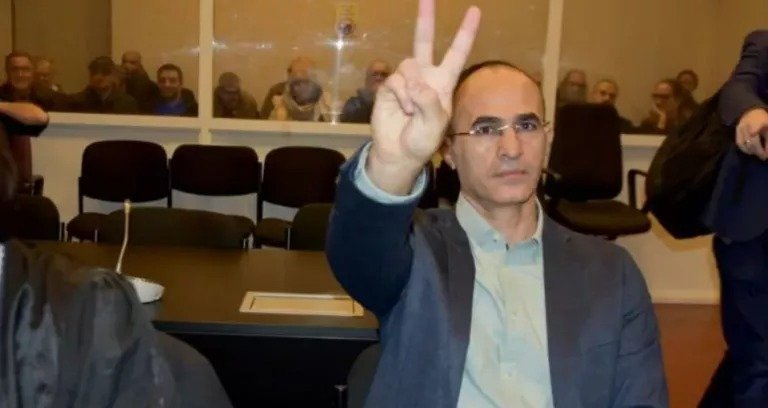
Kenan Ayaz was finally able to continue his speech at the Hanseatic Higher State Court on Tuesday, August 19. In a packed courtroom, the Kurdish activist chose to speak more about Kurdish history and the struggle of his people, rather than his personal case.
After all, as he reiterated in both the Cypriot and German courts, it is not just him on trial in these proceedings but an entire people. During the last hearing, Kenan, who has been detained for a year and a half, first in Cypriot and then in German prisons without any proof of guilt against him, spoke about the Kurds’ resistance to forced assimilation and their displacement in the 1920s and 1930s.
He described the brutal war against the population of Dersim: “From 1937 to 1938, one of the largest and most brutal massacres in the history of humanity took place in Dersim with the genocidal attacks of the Turkish state. Tens of thousands of Kurds in and around Dersim were slaughtered with guns, bayonets, and chemical gases.”
Ayaz pointed out that the pogrom in Dersim was not a suppression of a rebellion but a premeditated massacre, as part of the genocidal campaign against the Kurds.
“If genocide is understood as the deliberate and systematic destruction of a racial, religious, political, or ethnic group, then this is the definition of genocide,” he emphasised and added: “All the characteristics of colonialism are present, but there is a practice that goes beyond colonialism and aims at the eradication of Kurdish existence. Incidentally, the characteristics of this practice are defined in all international laws. Its name is genocide.”
Ayaz also noted that NATO, of which Turkey became a member in 1952, supported this genocidal policy, as well as the creation of guerrilla units that systematically terrorised the Kurds.
He also described the massacre in the Zilan Valley, the suppression of the Ararat uprising, and the occupation of Cyprus.
“Between 1960 and 1970, the Turkish state established paramilitary organisations such as JITEM, organised them against Greek Cypriots, and carried out secret operations and massacres. They turned the island into a bloodbath,” he stated before the German court.
The European hegemonic powers, particularly Great Britain, supported this occupation policy, which has now lasted for fifty years.
Kenan reiterated that “the PKK was officially founded on 27 November 1978 as a legitimate act of self-defence against genocide, and a month later, a systematic massacre took place in Maraş by the state and urban fascist militias.”
“Initially, the homes of Alevis were marked with an ‘X’ days before the fascist militias carried out brutal attacks against defenceless people. Countless people were massacred and violently displaced from their homes,” he added.
The Kurdish activist pointed out that in 1997-1998 a new peace effort was initiated by the PKK and Ocalan, but an international conspiracy, led by the USA and Britain, thwarted it. That was when Ocalan fled to Syria and then to Europe, before being arrested in Kenya, with the well-known involvement of Athens.
Before that, the withdrawal of Kurdish guerrillas from the Syrian border and a ceasefire by Ocalan had already taken place, while the EU responded by placing the PKK on the list of terrorist organisations.
As Ayaz pointed out, the EU’s “terrorist list” is mainly responsible for the fact that the Republic of Turkey has been conducting a genocidal war for 40 years, with tens of thousands of people losing their lives and millions forced to migrate.
If the EU had not declared the PKK a terrorist organisation and had not denied the Kurds their legitimacy, the Kurdish issue would have been resolved a long time ago. The Turkish state has exploited the exclusion of the PKK as a terrorist organisation by the US and Europe.
The legal proceedings against Kenan Ayaz continue on 2 September.
This man insists on resisting for human freedom, while the Cypriot authorities, instead of moving heaven and earth for his release, are trying to forget him. Likely under the influence of Turkey. But Kenan will return, and together we will continue the struggle for the freedom of Kurdistan and Cyprus, his second homeland.

