


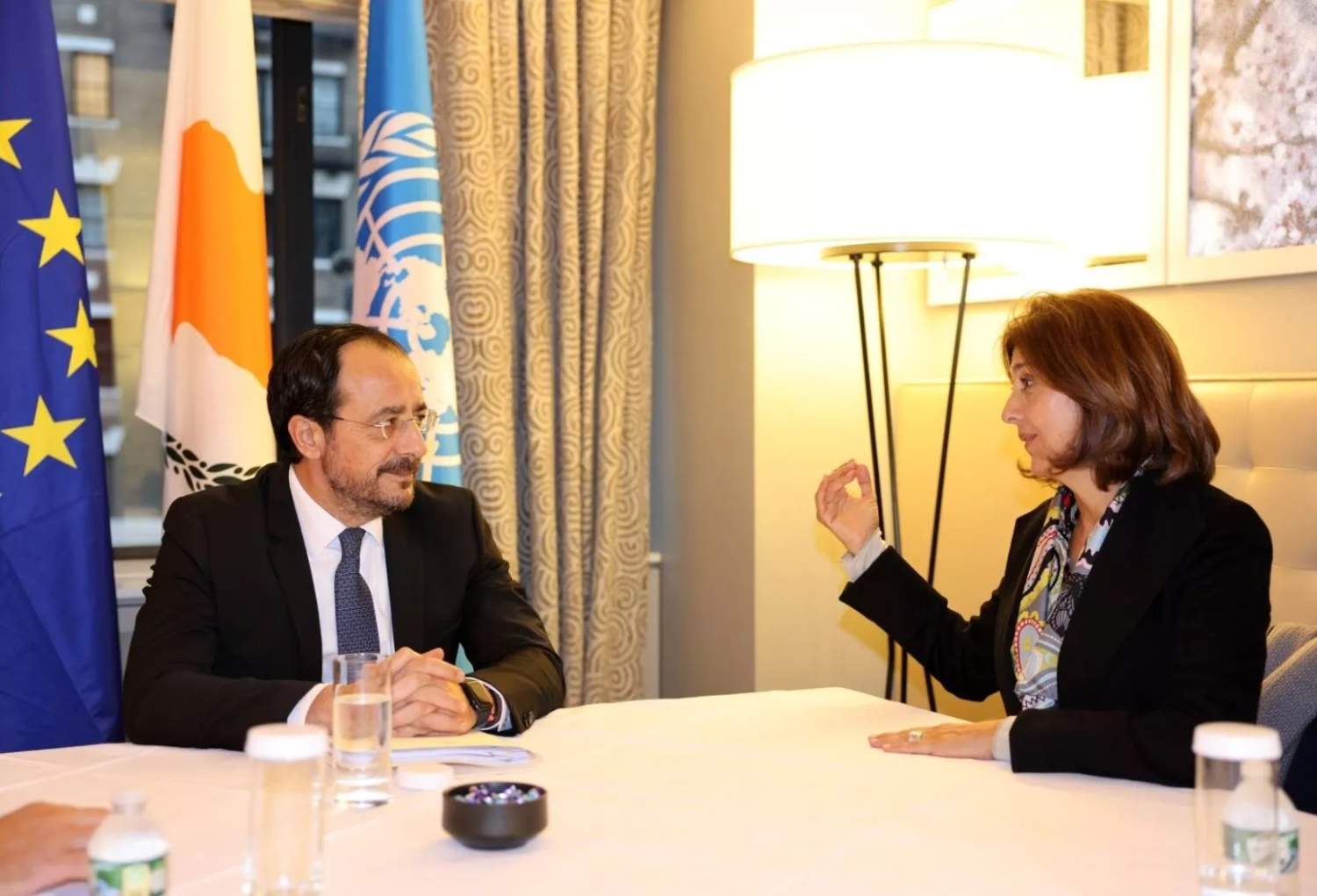
UN envoy María Ángela Holguín is making what may be her last visit to Cyprus before her contract ends at the end of the year. Expectations are low, as she has shown no intention of pressing for a resumption of substantive negotiations.
Holguín, the UN Secretary-General’s personal envoy, meets President Nikos Christodoulides at 12.30pm on Friday and Turkish Cypriot leader Tufan Erhurman on Monday. A joint meeting of the three is scheduled for 9 November. She has not said what she will do in between, or how she will spend the roughly 10 days she is due to stay on the island.
Friction over blame and confidence-building measures
Friday’s meeting is the first since Holguín’s recent remarks in which she blamed both sides equally for the lack of progress on the Cyprus problem and left Turkey out of the picture entirely.
In the same remarks, she made clear that her aim is to complete her mission, even if that means only a modest agreement on low-politics issues such as confidence-building measures (CBMs).
Nicosia insists that the priority remains a resumption of substantive talks, and that CBMs cannot substitute for that effort. This is how it interprets what UN Secretary-General António Guterres said during his visit to the island last summer and afterwards.
Holguín, however, does not appear to be on the same wavelength. She has chosen to read Guterres’s positions the way the Turkish Cypriot side does. That side puts CBMs first in order to ensure the parties do not sit down at the negotiating table before Guterres’s term ends.
The Greek Cypriot side was not pleased with Holguín’s recent statements. Christodoulides may raise them on Friday, particularly the equal apportioning of blame for the deadlock.
In public, however, the president has kept to the low-key tone he agreed with Erhurman at their last meeting. Asked on Thursday, as Holguín arrived, whether he saw a window of opportunity for substantive talks to resume, he said: “As far as it depends on me, I will do everything possible for that window of opportunity to exist.”
“While I do not play down the difficulties, the challenges, the problems, I am constantly here with new ideas, new approaches, always within the agreed framework, so that we succeed in opening that window,” he added.
Christodoulides had earlier described the coming days as important for the Cyprus problem and pinned hopes on Holguín’s visit and the joint meeting with Erhurman. The question is whether Holguín will work with the two leaders during her stay to produce a result.
Eyes on the Secretary-General’s chair
Holguín’s attention has clearly been on Guterres’s job for some time, as she believes she could succeed him. What she has been conveying recently through political figures in Cyprus points clearly to her intentions.
Cypriot media have given heavy coverage to a possible Holguín candidacy for UN Secretary-General. Foreign media, including outlets that specialise in UN affairs, do not appear to have mentioned her name. Foreign diplomatic sources did not rule out that Holguín herself was fuelling the speculation.
No candidacy has been formally submitted. According to what she has let be known, however, she appears to be banking on deadlock in the race to succeed Guterres, believing she could emerge as the figure who brings the succession to a successful conclusion.
The impasse at the UN has opened the way for late candidacies, but Holguín’s name is absent outside Cypriot reports. Lana Nusseibeh of the United Arab Emirates has entered the race, prompting a backlash from Latin American states.
In a letter to the Security Council, the Community of Latin American and Caribbean States (CELAC) protested that Nusseibeh’s entry came just as support was forming around a Latin American candidate.
A new vote is expected next week, after the previous one, scheduled for 23 October, was postponed.
Who would nominate her?
A candidacy needs the backing of at least one member state. Holguín served as foreign minister in the Santos government in Colombia. But Colombia now has a new elected president, Abelardo De La Espriella, who comes from the opposite side of the political spectrum, and there is no sign Bogotá is promoting her.
Backing from the United States was a scenario floated at one point. That too raises questions, such as whether US President Donald Trump would put forward someone De La Espriella does not support.
On the other hand, CELAC’s objection to candidates from outside Latin America leaves a glimmer of hope for Holguín’s ambitions.

