


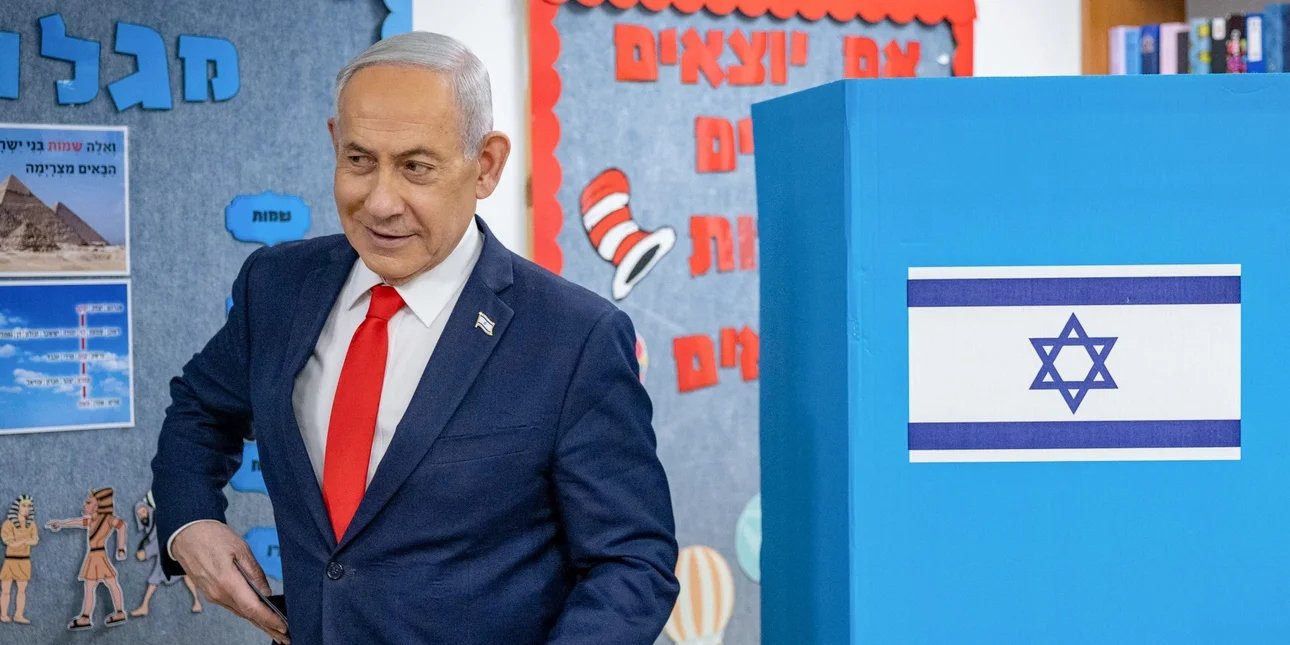
Israeli Prime Minister Benjamin Netanyahu’s Likud party escalated unproven claims on Thursday that Arab-led parties had rigged the election, possibly with foreign help. Final results showed his bloc had lost its parliamentary majority, the Associated Press reported.
Results released by election officials early on Friday gave Netanyahu’s bloc 53 seats in the 120-member Knesset. At its peak in the previous parliament, the bloc held 68 seats. The main opposition won 48 seats and Arab-led parties took the remaining 19. A coalition needs 61 seats to govern.
The count is complete, but the results must still be certified and presented to President Isaac Herzog next Wednesday.
Probe into alleged interference
Likud had been questioning the role of Arab-led parties since exit polls on Tuesday pointed to a setback for Netanyahu. The party sharpened its attacks after the head of the election committee, Supreme Court Justice Noam Sohlberg, said serious suspicions of foreign interference had been brought to his attention.
Sohlberg said he could not verify the claims. Because of their gravity, he asked the Shin Bet security agency to investigate, and the committee wants the agency’s findings within a week.
Likud then issued a statement declaring: “The elections in Israel have been stolen!” Without offering evidence, it said the alleged interference was intended to enable a foreign takeover of parliament and bring down the right-wing government.
According to Israeli media, Likud members pointed the finger at Qatar, which many Israelis regard as a backer of Hamas. Qatar quickly rejected the allegations as absurd and dangerous.
Election authorities moved to contain the fallout. The commission said the inquiry was based on classified intelligence. Its acting director general, Dean Livne, said the probe would not affect the final results and was not aimed at any section of the population.
In a separate letter, the committee said claims of systematic breaches of electoral integrity had no basis. The Shin Bet said its investigation was not intended to cast suspicion on citizens who had voted lawfully.
Opposition accuses Netanyahu of delegitimising vote
Netanyahu’s main rival, former military chief Gadi Eisenkot, said Likud was trying to discredit the results because it had lost. He mocked the interference claim, saying he was glad Netanyahu was finally condemning Qatari involvement in Israel. Netanyahu has long faced accusations that former senior aides took money from Qatar.
Netanyahu has suggested it would be treasonous for Eisenkot to ally with Arab parties. Those parties could give Eisenkot the support he needs to unseat the prime minister.
Yair Golan, leader of the Democrats, accused Netanyahu of running a smear campaign against the will of voters, particularly Arab voters. The Arab-led Joint List said Netanyahu was trying to steal the election.
Mansour Abbas, head of the Arab-led Ra’am party, welcomed the investigation. He said his party had no connection to the case and accused Netanyahu of incitement.
Herzog described the situation as sensitive and called for a full investigation. He warned against tainting an entire community for exercising its democratic right to vote.
Arab citizens make up about 20% of Israel’s population. Arab voters turned out in unprecedented numbers, driven in part by Likud’s campaign portraying Arab-led parties as a threat to the country.
Coalition talks ahead
Netanyahu remains in office while parties try to build a majority. If he loses power, he would face continued scrutiny over long-running corruption allegations. An inquiry would also almost certainly be launched into the security failures behind the Hamas-led attack of 7 October 2023.
Eisenkot has said he is open, with conditions, to working with Arab-led parties. Until 2021, no Arab party had ever joined an Israeli government, and that partnership was short-lived.
Even outside a coalition, Arab-led parties could back opposition moves in the new parliament, such as electing a new speaker. Ahmad Tibi, number two on the Joint List, told Army Radio that the opposition had approached the party about replacing the speaker. He said the Joint List would support the bloc’s candidate.
Small rallies backing a coalition that includes Arab-led parties were held overnight in Tel Aviv and Jerusalem.
If repeated attempts to form a government fail, Israel would hold another election early next year. Herzog and Eisenkot have both said they want to avoid that outcome.
(information from AP)

