


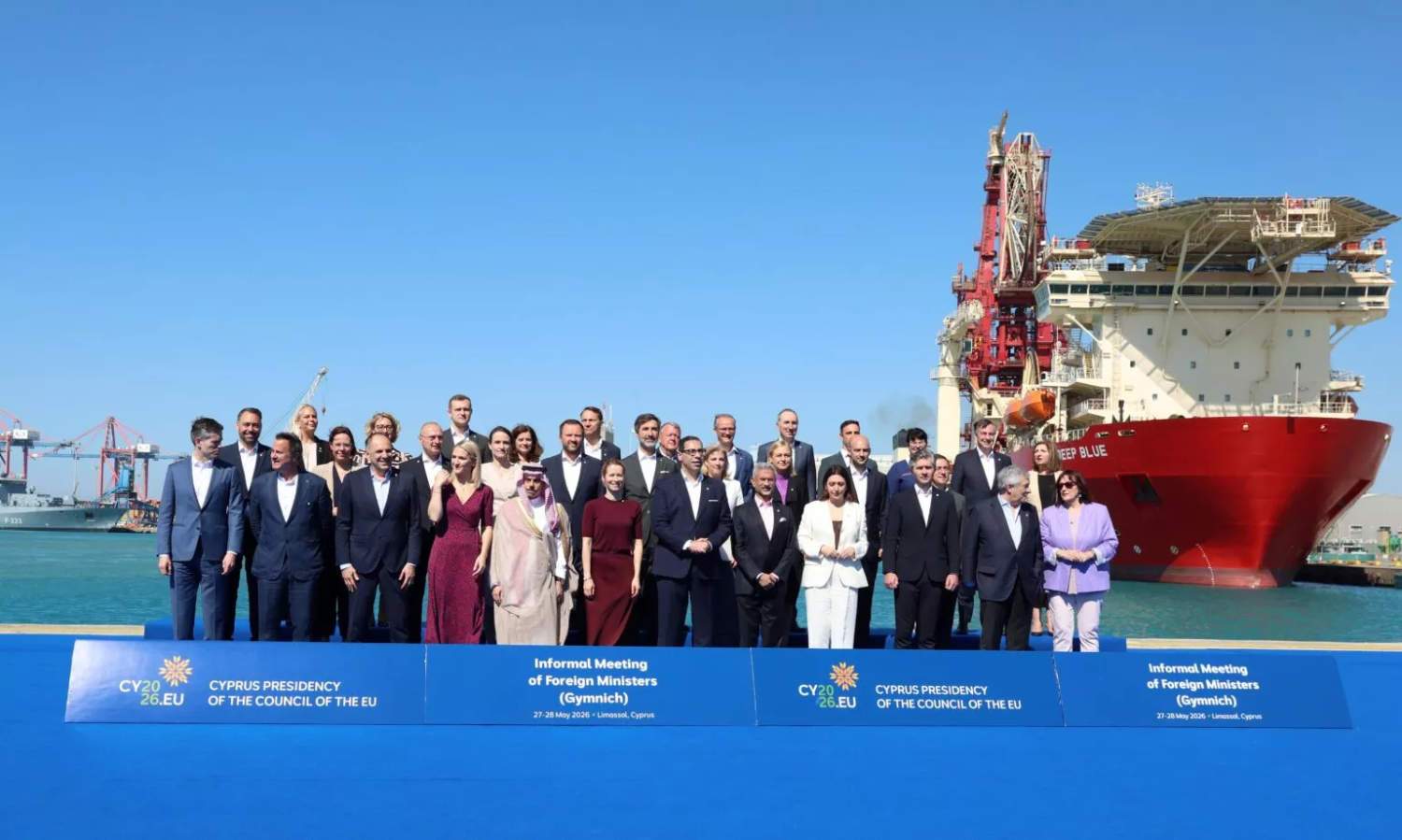
Cyprus brought the foreign ministers of India and Saudi Arabia to an informal EU foreign affairs council in Limassol this week, using its EU Presidency to broaden a meeting that might otherwise have focused almost entirely on Ukraine, according to Phileleftheros sources.
The presence of Indian Foreign Minister Subrahmanyam Jaishankar and Saudi Foreign Minister Prince Faisal bin Farhan bin Abdullah Al Saud was the result of a deliberate Cypriot diplomatic strategy, diplomatic sources told Phileleftheros.
The Cypriot Presidency had set out from the start to bring the EU and the wider Middle East to the same table — a goal it pursued in two stages: at the informal European Council in April, which included leaders from Egypt, Jordan, Lebanon and Syria, and now at the Limassol Gymnich with the Saudi foreign minister.
Jaishankar’s invitation followed Christodoulides’s official visit to New Delhi the previous week, where the Indian minister had met both the President and Foreign Minister Konstantinos Kombos.
Diplomatic sources told Phileleftheros that Nicosia was satisfied that the two ministers’ presence sent a message to EU partners about the role Cyprus can play in the wider region.
What was on the table
The meeting was co-chaired by Kombos and EU High Representative for Foreign Affairs and Security Policy Kaja Kallas. According to the Foreign Ministry, the agenda focused on developments in the Middle East and Russia’s ongoing aggression against Ukraine. The first session, attended by Jaishankar and Prince Faisal, centred on the situation in the Middle East and broader regional developments, covering maritime security, freedom of navigation, international law and supply chain resilience.
EU foreign ministers also discussed Gaza, the West Bank, Lebanon and the Hormuz Strait crisis. European diplomatic sources expressed concern to Phileleftheros about rising ship insurance costs in the Hormuz area and potential knock-on effects for the European economy. Those same sources said that even if the crisis de-escalates, normalisation of maritime transport and insurance coverage could take considerable time. Food and fertiliser supply chains and the risk of fresh migration pressures from wider regional destabilisation were also raised.
Kombos and Kallas speak
At a joint press conference, Kombos said the meeting had reaffirmed that the EU “remains united in its determination to protect its interests, uphold its principles and strengthen its role as a credible geopolitical actor,” adding that Cyprus would continue working towards that goal until the last day of its Presidency.
On the Hormuz crisis, Kombos warned that markets would need to be addressed after the war ends, saying it appeared they “will not return soon to the normal that existed before the war.”
On Ukraine, Kombos said ministers had a very frank discussion on the principles that should guide the EU’s position, based on a document prepared by Kallas, adding: “We continue with our intention and will to increase pressure on Russia.”
Kallas said there had been strong unity on defending European interests, supporting Ukraine and increasing pressure on Russia. She described the situation in the Hormuz Strait as dangerous, adding that any US-Iran agreements would need to be followed by deeper and more detailed talks. “The EU can contribute with technical expertise on nuclear talks, for example,” she said, adding that the EU was helping protect freedom of navigation through Operation Aspides.
On Lebanon, Kallas said a return to full-scale war was a real possibility. On Ukraine, she said Russia was still showing no genuine interest in peace, and that the EU would never be a neutral mediator between Russia and Ukraine. “Europe will never be a neutral mediator between Russia and Ukraine, because we are on the side of Ukraine and we rely on our own core security interests,” she said. She added that Russia must stop its sabotage operations, cyberattacks and airspace violations across Europe.
On Article 42(7) of the EU Treaty, Kallas said the goal was to develop a kind of handbook for how the article could be used, covering different scenarios including an attack on a NATO member that is also an EU member, or an attack on an EU member that is not in NATO.
Behind closed doors
Community sources familiar with what was discussed at the Gymnich told Phileleftheros the proceedings were difficult. The substance was the EU’s positions in the event of actual negotiations on Ukraine. Questions raised included what role the EU would play and what status its representative would hold.
Nicosia’s position is that these decisions should be taken at the level of EU leaders rather than foreign ministers, with an emphasis on their binding nature, according to the sources.
Within the EU, at least two schools of thought have emerged, the sources said: one that views the start of negotiations on a Ukrainian settlement positively, and a harder line that sees Russia’s position as weakening and therefore considers the moment wrong for talks.
There are also differing approaches and open questions about the EU’s role in any future Ukraine conference, the sources said. Some member states are cautious about premature discussion of a possible EU mediation role without first establishing a clear common European position on the terms, framework and objectives of any future process.
On a possible 21st sanctions package against Russia, the Cypriot Presidency appears ready to help open discussions but is not expected to have enough time to push it through in the roughly thirty days remaining before the end of its term, according to the sources.
Israel in the frame
Relations with Israel appear to be entering a particularly delicate phase, with several member states focusing attention on the country, according to Phileleftheros sources. Two broad approaches emerged in discussions: an embargo on products from Israeli settlements in the West Bank, and sanctions against specific Israeli political figures. Sources said the second measure was considered easier to implement, while the first presented significant legal and technical difficulties.
What didn’t get discussed
The agenda also included the further strengthening of European strategic autonomy — particularly in defence, energy security and critical infrastructure protection. There was not enough time for an in-depth discussion and the issue will be taken up at the next Foreign Affairs Council in Luxembourg. Outstanding questions remain about the role of the European External Action Service and how each member state manages its relations with countries from the United States to China.

