


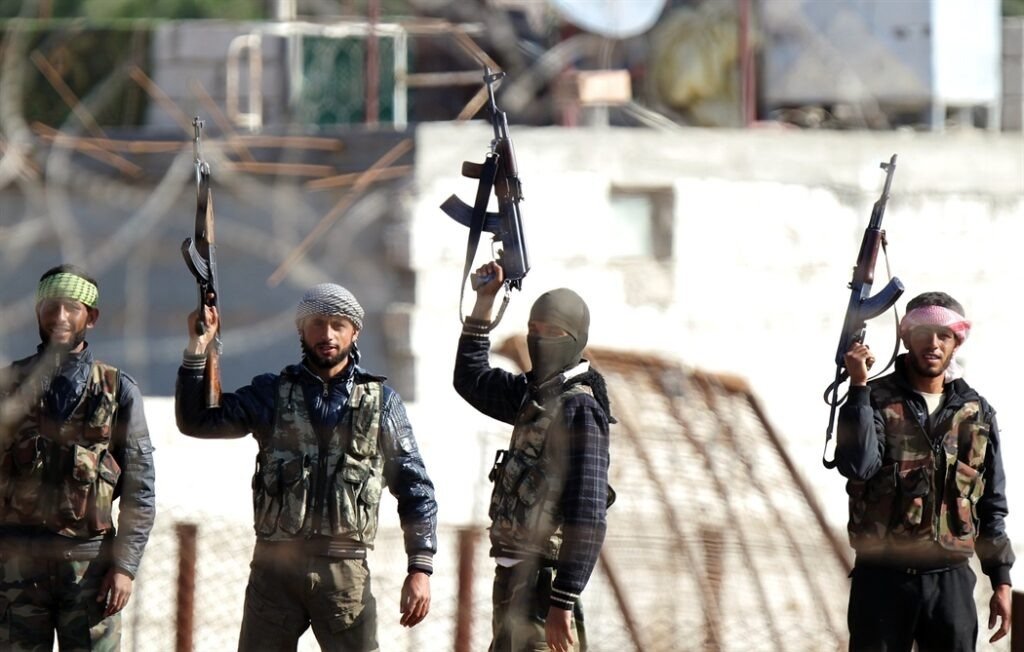
The jihadists might as well have been on a holiday outing. In just eleven days, they advanced and overthrew the Assad regime. It’s clear that the ‘stars aligned’ for this regime change.
What happens next is harder to predict – especially when all those who conspired, overtly or covertly, or showed tolerance towards former adversaries, will want to secure their interests and, if possible, control in the region.
What path will Syria take? Will it remain a unified country, or will it fragment? What about the Kurds? Could this open the door to the declaration of a Kurdish state, given the facts on the ground? The Kurds already control a large portion of Syrian territory.
It’s clear, however, that occupying Turkey would react to such a development – they’ve already warned of military intervention. Turkey already has troops in the country and controls territory, while backing mercenary forces that have long fought against the previous regime. The Kurds are already facing jihadist attacks with support from Turkish air forces. The Turks want to eliminate any prospect of a Kurdish state, whether independent or within a Syrian federal structure.
It’s worth noting that while the Kurds were fighting jihadists, Western powers (particularly the US) encouraged them with promises. Now we’ll see whether they meant what they said or will abandon the Kurds as they have in the past. We’ll soon know if the Kurds will once again become ‘collateral damage’.
Turkey now presents itself as one of the victors in Syria. One could argue that Turkey has achieved its long-sought upgraded role, both militarily and diplomatically. Furthermore, it’s clear that Turkey is positioning itself for the aftermath – both as a guarantor (occupying) power, having perfected this role in Cyprus (!), and in the reconstruction effort. That’s where the real bounty lies, just as it will be in Gaza. First death, levelling, destruction – then reconstruction.
Western powers, who opposed Syria’s previous regime, are now assessing the aftermath, hoping to avoid losing control of the situation as happened in Libya. The repetition of the ‘Libyan model’ – civil war and prevailing chaos – is clearly one of the most likely scenarios. For now, as the situation unfolds, attention is focused on the extremist Islamic organisation with Al-Qaeda roots, Hayat Tahrir al-Sham (HTS), and its leader, Ahmad al-Saraa (better known by his pseudonym Abu Mohammed al-Golani). The key question is how they will operate. Although Golani is a designated terrorist with a $10 million US bounty on his head and his organisation is blacklisted, such things can change. Al-Golani has opened channels of communication with various international players. He has Turkey’s backing, though they don’t appear to control him.
The ‘Arab Spring’ is back in the spotlight, with the Muslim Brotherhood at the helm of a levelled Syria. The region faces the prospect of a widespread, devastating war.
The major power brokers are present as always, believing their presence will lead to Syria’s ‘renaissance’. For now, we’re watching a ‘memorial service’, with the risk that civil war will continue with different protagonists.
The civil war, which began in 2011, resulted in 300,000 deaths and millions of refugees. In a destroyed country that continues to face bombardment from Israel and Turkey, while internal conflicts rage even after the regime’s fall, attention for now will focus on the actions of previous rulers – showcasing prisons and describing behaviours, executions, and torture of opponents. Meanwhile, al-Golani, clearly hoping to curry favour with powerful players for the time being, will appear ‘reformed’. Libya isn’t far off as a comparison.

