


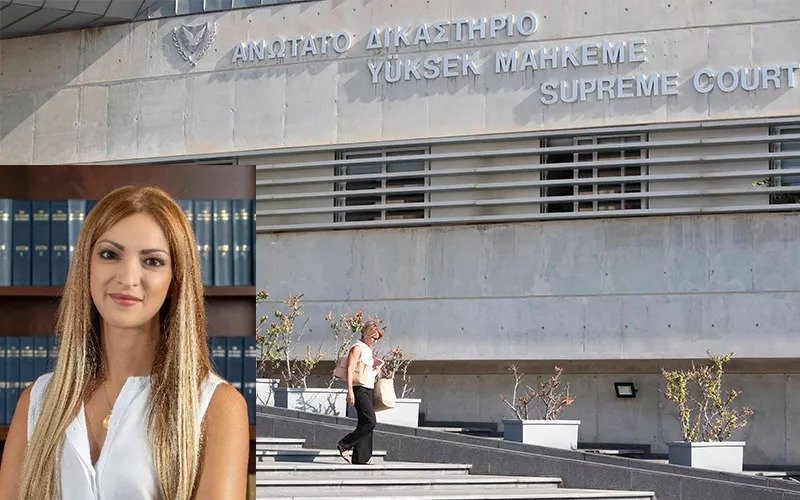
The reasons for Doria Varoshiotou’s dismissal are precisely those that public opinion instinctively grasped from the outset.
The Supreme Judicial Council’s decision was made public by her lawyer Achilleas Demetriades. We carefully examined it. The arguments and legal references are expertly crafted, justifying her non-legitimisation at first instance.
However, the general impression is that Varoshiotou held her own views and defended them, leading to her being deemed reactionary and disobedient.
Reading the decision brought to mind comments by Christos Clerides, an experienced lawyer and former president of the Bar Association, who remarked on the dismissal: “We want judges who are incorruptible, honest and upright, who have the courage of their convictions” and “no judge should be punished for their decisions”.
It appears Varoshiotou was punished both for her decisions and for having the courage of her convictions. Whilst her incorruptibility, honesty and integrity remain unknown, the Judicial Council’s decision contains no reference questioning these characteristics.
Two issues predominate as alleged establishment errors: her refusal to allow Panikos Stavrianos to testify in the death inquiry for Thanasis Nicolaou, and her handling of instructions from the District Court President regarding two other death inquiries.
Regarding the second case, the decision states she initiated procedures not provided for by law, revealing that her “real purpose” was “to publicise the President’s approach, as she understood it, to demonstrate that she was right and that the President had acted wrongly, even improperly”.
If the procedures she initiated are indeed not legally provided for, this is naturally significant, although she based them on legislation she cited. The Supreme Court judges’ opinion (here as the Judicial Council) carries more weight than that of a probationary judge.
However, how is the assertion that she acted to publicise the President’s approach proven? Judges require evidence, testimony and proof to decide cases – is their subjective opinion sufficient here?
The other issue, concerning Stavrianos’s testimony, states that “errors of such form and intensity reveal, by themselves, beyond inadequacy in handling the procedure before her, deficient legal training and understanding on her part”.
If this is accurate, however, the question becomes different. Why was such an important death inquiry, which occupied all of Cyprus and engaged the European Court of Human Rights and investigative committees, assigned to a probationary judge?
Who decided this? Does the person who assigned it bear responsibility? Inadequacy and deficient legal training, yet they assigned her one of the most difficult cases. Something is indeed wrong, but this concerns court administration, not Varoshiotou.
Substantively, however, such a categorical reference lacks foundation. When she issued her decision refusing Stavrianos permission to testify, she read a multi-page decision filled with legal arguments.
The decision was neither superficial nor unsubstantiated. She referenced the European Court of Human Rights ruling, Stavrianos’s role for which both the ECHR and criminal investigators assigned responsibility, and explained in detail why he had nothing new to add in the third death inquiry.
The Supreme Court, to which Stavrianos appealed, decided that Varoshiotou erred in refusing his testimony, but this did not overturn the substance of her decision – that death was due to strangulation.
How many other judges does the Supreme Court identify as making errors? Recent reporting highlighted serious judicial errors, but none faced consequences. Only Varoshiotou was punished for such issues – remarkable indeed.
The Judicial Council cites additional matters, including a letter she sent on 23 June 2025 (days before her dismissal) “attributing to the Supreme Court and Supreme Judicial Council that they are negatively disposed towards her due to the findings she issued in the Death Inquiry for Thanasis and her refusal to execute ‘the order’ of the Administrative President”.
This too is considered a crime of establishment. How dare a judge attribute “foreign motives and vindictive” behaviour to Supreme Judges? That she had the audacity to do so directly rather than behind their backs should have been appreciated.
However, ordinary citizens hold different values from judges.

