


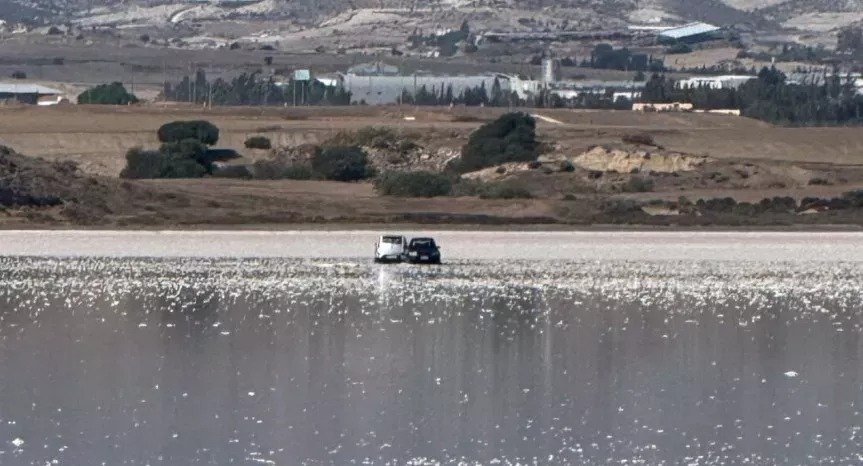
Two cars stuck in Larnaca Salt Lake! The news went viral, sparking a flood of reactions—and no shortage of sarcastic commentary.
It all began when a driver took their vehicle into the protected wetland, only to get stuck and find themselves well and truly trapped. The farce reached its crescendo when a second driver turned up to help—and promptly got stuck as well.
The two vehicles remained marooned for days as rain turned the salt lake bed into a muddy quagmire, rendering any rescue operation both fiendishly complicated and eye-wateringly expensive.
The owners were slapped with a €2,000 fine by the relevant authorities, and they’ll be footing the bill for the extraction too—expected to come in at around €5,000.
That’s the estimate from Larnaca Municipality, which will be handling the operation with the help of a private company equipped with heavy-duty cranes. It’s thought the recovery will take two to three days, with the cars being hauled out on ropes.
This isn’t an isolated incident. Larnaca Municipality, the Environment Department, and the Game and Fauna Service have all expressed alarm at illegal vehicle incursions into the protected wetland. They’ve warned that measures will be taken to ensure such incidents aren’t repeated.
Yet it’s blindingly obvious that despite the guidance, the awareness campaigns, and the signage dotted around the area, some people simply couldn’t care less—and they go ahead and trash the environment, even if it’s just for a laugh.
The long-suffering Larnaca Salt Lake—part of the NATURA 2000 network and protected under the Ramsar Convention, a site of exceptional importance for wildlife and waterbirds—has been battered before.
In previous years, it sat next to a shooting range whose pellets ended up in the water, poisoning the flamingos. It took a pile of dead birds, along with complaints and protests, before anything changed.
Of course, the case of Larnaca Salt Lake is hardly the only example of public indifference towards the environment. The scandals are endless!
Citizens and businesses squander water in wetlands, wreck beaches, encroach on protected areas and endangered species, and attack sea turtles. All of it in the name of profit, convenience, or personal gain.
The state—which ought to be setting the proper example—must take action. Awareness-raising and public information should be constant, particularly in vulnerable areas, and punishment for offenders must be severe and unrelenting.

