


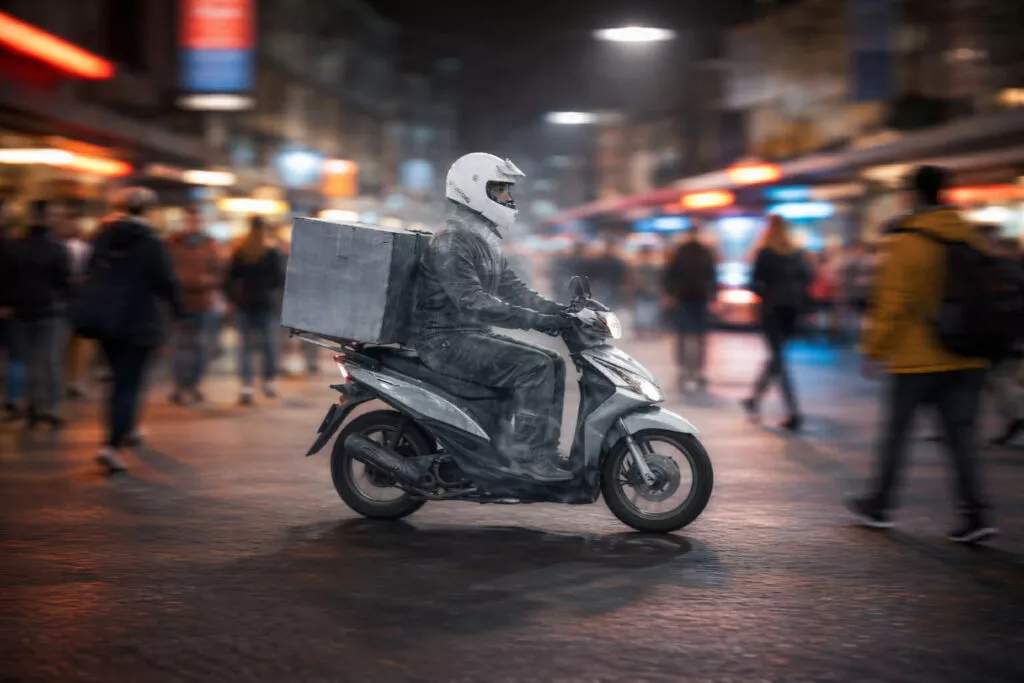
“Hello.” “Thanks.” “Goodbye.” An exchange that feels like it never really happened, with someone whose name you didn’t catch, and the package is handed over.
The door closes. You sink back into the sofa. The “other one” vanishes, on to the next run, the next delivery, the next exchange that will feel like it never happened, with the next recipient, who won’t remember his name either.
He is the “stranger.” The one who lives in society’s in-between spaces, swallowed by anonymity. The backbone of entire sectors of the economy, yet somehow invisible. The indispensable presence in our homes, caring for our children, our elderly.
The worker on factory floors, building sites, public works projects. In the fields, the farms. No recognition of his contribution. No one stopping to ask how each fresh catastrophe lands on him. What are the living conditions of migrant workers on the livestock farms hit by foot-and-mouth disease? What about Morzok, Hisa, Ezat and Maged, who died in the fire in Odou? Do you even remember their names?
Last week, the people behind a food delivery app went on strike for six days. Their demands were basic: fairer pay, protection from racist attacks, theft, and vandalism. In return, they faced threats, intimidation, and the prospect of being blacklisted from future work.
The riders we pass every day on the streets, in our office blocks, at our front doors took to those same streets, called out a system built on exploitation, and then went back to work. Empty-handed. Not a single demand met. Not a day’s pay for the days they were out.
All this while the public conversation about labour has been consumed by the hotel industry, bus driver walkouts, and teacher protests. The riders’ struggle passed without a murmur. Not one political party, not even the progressive ones, found the time to stand with these workers.
On the social media pages where campaign posts have been pouring out ahead of the elections, there was not a single line spared for the delivery workers.
Whatever version of events the company put forward, whether the contract was breached or not, whether pay was cut or not, whether the fault lay with middlemen or a tweaked algorithm, whatever the official “truth” turned out to be, nobody wanted to stand in solidarity with their fight for fairer pay, for basic job security, or even just for protection against the violence that has quietly become a routine feature of their working lives.
Nobody stood up for an end to this modern form of servitude, endured simply to survive, in a foreign country. Our country.
They are, you see, the “foreigners.” The “others.” And the deepest form of oppression we visit upon them is not the excess profits of every businessman who exploits them, nor even the hardships they absorb so that our food arrives hot, on time, without us having to shift from the sofa.
The deepest oppression is the refusal to acknowledge that they exist at all. And their resistance, the act of demanding to be seen, is at once the most obvious thing in the world and the most radical. A fight for visibility in a society that has made a habit of looking the other way, the better to enjoy the view.

