


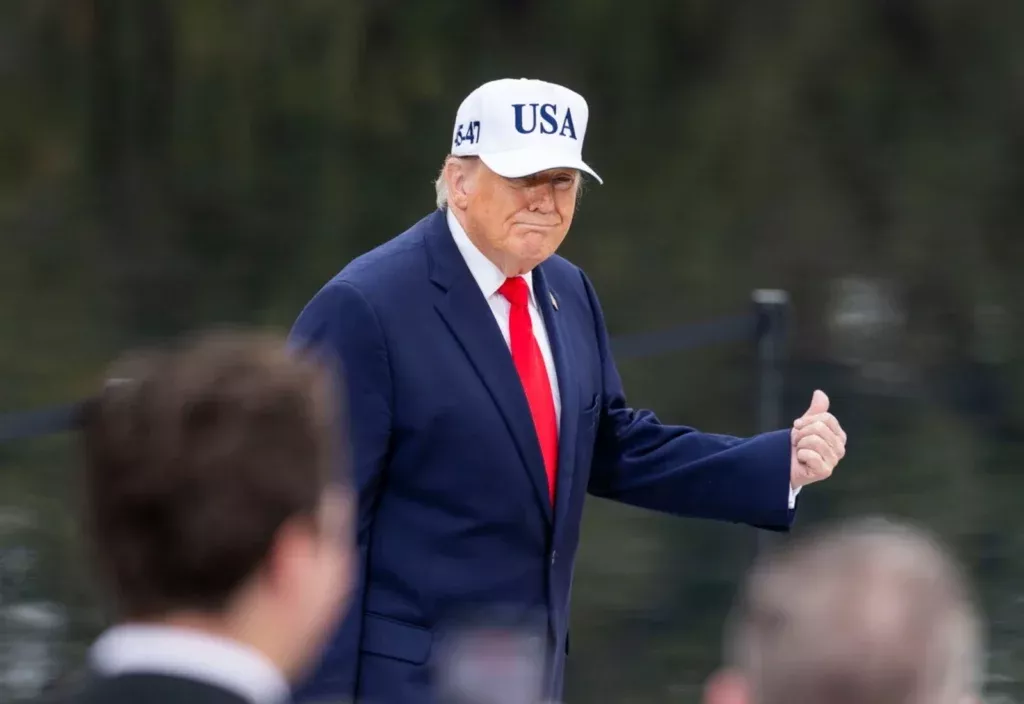
Did Trump lose? Certainly, the US election result and the rout of the Republican Party send a powerful message, not only to the American President but to the whole planet.
That is because Donald Trump’s erratic way of seeing politics and reality was becoming fashionable, and Trumpism was hardening into a doctrine. It is a doctrine that has found fertile ground in many other countries, Cyprus included.
Trumpism is, of course, a political syndrome, inseparable from grandiosity and the cult of personality. His party suffered a resounding defeat, yet he believes it was down not to his policy choices but to the fact that… he was not on the ballot himself.
That reading captures a view of politics now shared by quite a few politicians. It may be a symptom of a society turning its back on politics. Or, conversely, it may be a consequence of ideological and political identities weakening and collapsing. Either way, it is tied to the parties’ failure to meet citizens’ expectations, and to society’s disillusionment with parties and politicians.
This is a political philosophy that treats politics and the exercise of executive power as running a business, and that begins and ends with slogans. It is a logic that teeters on the edge of the absurd and the unrealistic. It thrives in the gap that has opened between politics and the citizen: on one side, a politically disengaged society; on the other, a political system in a permanent crisis of credibility.
We do not know whether the election result marks the end of this cycle in the US. What is certain is that it sends strong political messages, not only about the country’s own political landscape but about developments internationally. The American vote does not necessarily reward the Democrats’ policies.
It is, however, a clear rebuke of Republican policies as pursued by the Trump administration. That is the message from the ballot box, however the American President chooses to read it.
So why did they do it?
According to the first political analyses published by US and international media, including Reuters, the Associated Press and the Washington Post, Americans’ voting behaviour appears to have been shaped by a number of factors.
The first is the cost of living. A large part of American society used its vote to register its discontent over the high prices of consumer goods and energy, which weigh on households every day.
The second is tariffs. Presented as a way to protect the American economy, they risked achieving the opposite of what was intended. Rather than working solely in favour of domestic production, tariffs may pass part of the cost on to consumers, deepening fears of further price rises.
The third is the war in Iran and wider US foreign policy in the Middle East. Developments in the region are deepening uncertainty, with possible consequences both for international security and for the American economy.
Beyond these factors, the analyses also point to other elements. Among them are lower turnout among younger voters and part of the traditional voter base, and the Republicans’ excessive identification with the President’s personality.
He argues that his party lost because he was not the candidate. Analysts, meanwhile, note that it may have been precisely this identification that contributed to his electoral failure.
So the real question is not only whether Trump lost, but whether the political logic he stands for has been defeated. That logic is the belief that politics can be conducted through slogans, personal displays of power and promises with too little to show for them in people’s everyday lives. The message is not for the US alone but for the whole Western world.

