


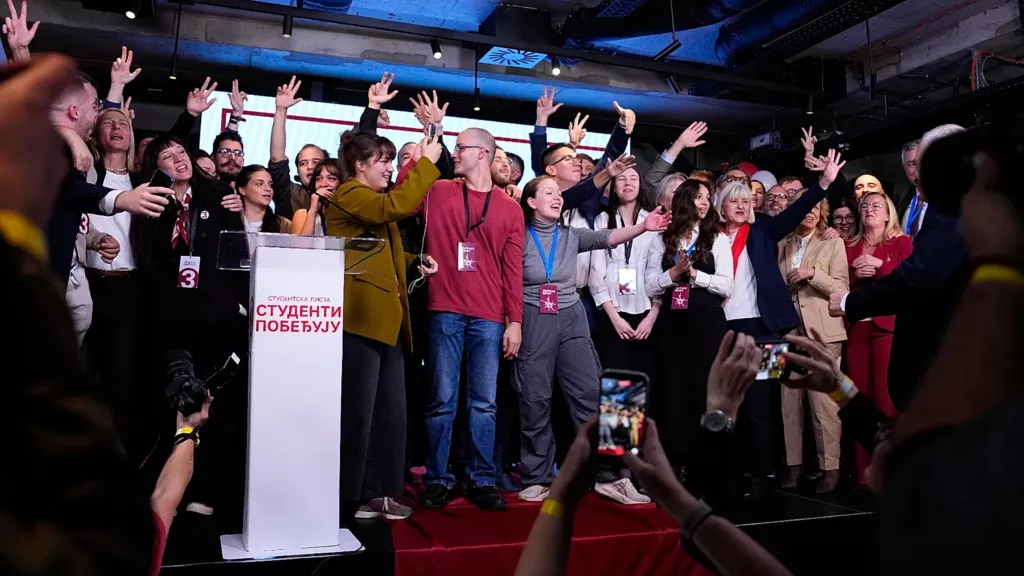
The Student List’s victory in the election of 25 October 2026 cannot be read through a Cold War lens. The movement, Studentska lista – Studenti pobeđuju, won about 52.7 per cent of the vote against 39.2 per cent for Aleksandar Vucic’s bloc, a historic political upheaval. For the first time after 14 years of dominance by the Serbian Progressive Party, a movement born of social protest has won a parliamentary majority.
Yet today’s Serbia cannot be understood apart from its traumatic past. The break-up of Yugoslavia, the nationalisms, the wars of the 1990s, the tragedy of Srebrenica and the NATO bombing of 1999 left deep scars on society. Then came international isolation, political disappointment and a painful transition to an economy that did not keep its promises to everyone. The fall of Slobodan Milosevic in 2000 raised hopes of democratic renewal, but it did not secure a lasting break with patronage politics and the concentration of power.
That unfinished business was dragged back into the spotlight by the Novi Sad disaster on 1 November 2024, when a canopy collapsed at the railway station and killed 16 people. Anger over who was to blame, and over corruption, turned into an unprecedented student movement that swept across the country and brought people together across traditional party lines.
Its strength lay not only in its numbers but in its form. There were the assemblies, the silent protests and the marches of hundreds of kilometres. There was the insistence on non-violence and the solidarity of local communities. Collective protest became an everyday practice of democracy, not just a slogan.
Perhaps this is where the deeper political meaning of the victory lies. In a Europe where disillusionment so often feeds cynicism and authoritarianism, Serbia’s young people have shown that politics can once again be the business of citizens. ‘Vostani Serbije’, or ‘Arise, Serbia’, the historic song of the uprising against Ottoman rule, takes on a new meaning. It is no longer a call to retreat behind national walls, but a demand for dignity and self-determination.
A change of government, of course, is not automatically a change of system. Corruption, judicial independence, media freedom and the country’s European path remain critical tests. Neither the relationship with Russia nor the Balkans’ tangled problems will be solved overnight. That holds even though the Student List’s central idea could not be clearer: a commitment to European values and to the country’s independence.
But Serbia has opened a road worth watching. It does not offer ready-made recipes for other countries. What it offers is a reminder that even in societies scarred by history, collective action can overturn political fatalism. And perhaps the moment really has come for the dreams of an entire generation to take their revenge. Not on a people or an ideology, but on the belief that nothing ever changes.

