


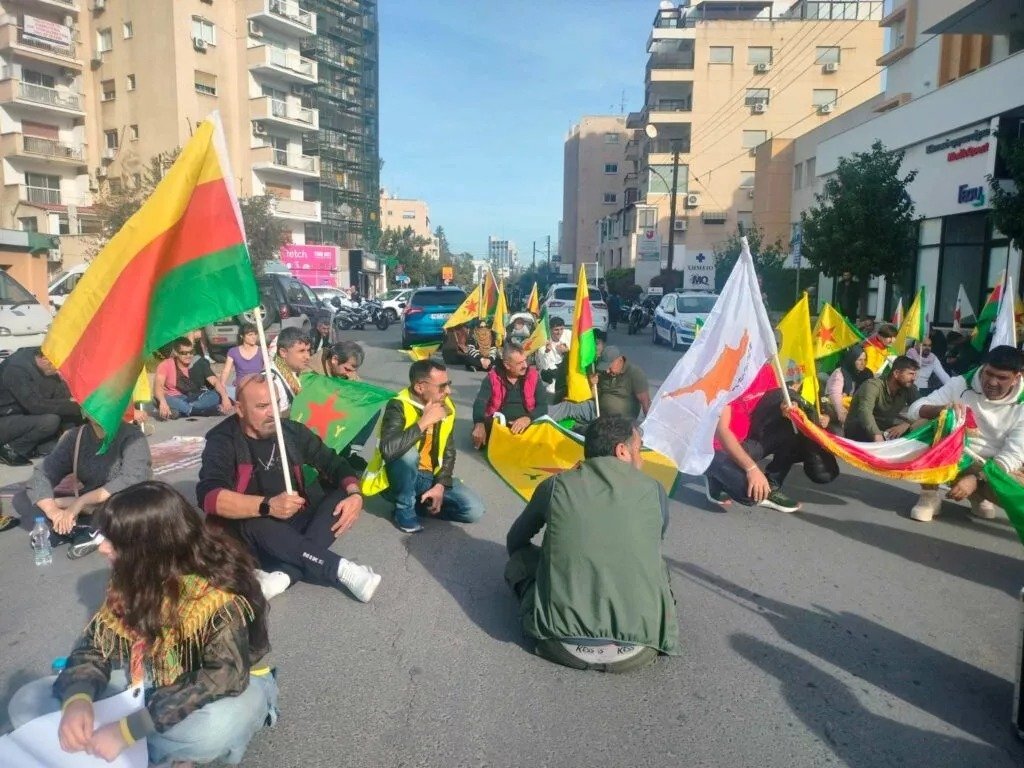
The anger, fear, and intolerance that have gripped Turkish society in response to the Kurds’ most fundamental, natural, and human demand — the desire to live freely and with dignity — is no longer a mere political reflex. It has become a deep, structural political pathology. This pathology runs far deeper than the reflexes of the state; it has penetrated the very consciousness and conscience of society as an ideology of fear.
Recent developments around Rojava have once again exposed this pathology in its starkest form. The same society that chants slogans for the freedom of Palestine seems to fall into collective hysteria when the Kurds of Syria demand the right to self-determination. Independence in Palestine is hailed as “resistance,” while in Rojava it is condemned as “separatism.” This double standard, this duplicitous conscience, is not a product of politics but of mental colonization.
On one hand, we see a political climate that claims to be the “defender of the oppressed.” On the other, the same political discourse expects the Kurds in northern Syria to submit to the regime of a dictator who was once declared an enemy and had a bounty placed on his head. This is not merely a historical contradiction — it is the portrait of moral collapse.
In recent years, Turkish society appears to have lost all political sensitivity regarding the Kurdish question. Every Kurdish actor, every expression of a desire for freedom, is reflexively placed within the category of “terrorism.” This is the internalization of the state’s security paradigm within the public consciousness. Security politics has long strangled moral politics. The issue is no longer about rights, justice, or equality — it is about control, suppression, and the perpetual perception of “threat.”
At a time when the state’s official ideology has become so deeply aligned with societal consciousness, the Kurdish struggle for existence represents not only an assertion of identity but also the final line of defense for democracy itself. When Kurdish freedom is suffocated, the entire society loses its capacity to breathe.
A state that weeps for the people of Palestine, the Muslims of Arakan, and the Uyghurs under the rhetoric of “the ummah,” yet maintains a hostile stance toward the Kurdish people — with whom it has shared the same land and fate for a century — is not merely being politically inconsistent. It is exhibiting a profound collapse of political morality. This hegemonic discourse that postures as the “voice of the oppressed” while systematically demonizing a neighboring people is both hypocritical and corrosive.
The deep-seated fear of Kurdish freedom is, in fact, a projection of the Turkish political mind’s own insecurity about its identity. The fury over the prospect of Kurds in Rojava governing themselves reveals, in the mirror of history, the democratic incapacity of Turkish society itself.
A mindset that views the Kurds’ right to self-determination as a “threat” today will inevitably come to see every internal difference as a threat tomorrow. The ultimate destination of such thinking is a vision of a society that is monolithic, obedient, and uniform. This vision does not build a modern nation; it constructs a regime of fear founded on denial and repression.
The Kurdish people seek only to live with dignity. This is a universal human aspiration, not a threat to any nation. No one should attempt to manipulate the mind, hope, or dignity of the Kurdish people. To pose as the defender of the oppressed while demanding submission from Rojava is a historical blindness that cannot be justified.
The Kurdish people will no longer accept such humiliation. For they know better than anyone what it means to resist — even in the darkest nights of denial, exile, and oppression.

